Earth Might Survive the Sun's Death After All, New Model Suggests
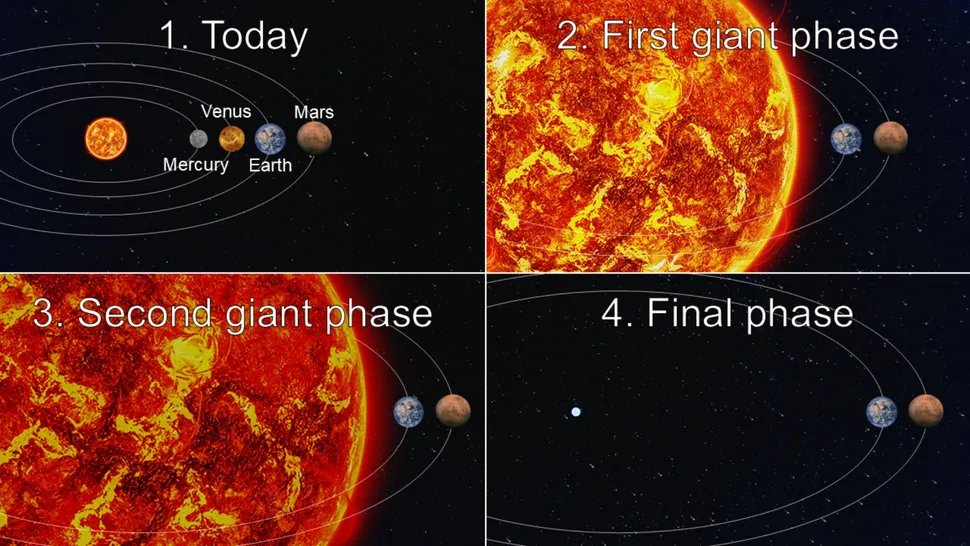
For decades, astronomers have argued about whether Earth will be swallowed when the sun dies. Around 5 billion years from now, our star will exhaust its hydrogen fuel and swell into a red giant large enough to engulf Mercury and Venus. Most models have assumed Earth follows the same fate.
A study published this June in Astronomy & Astrophysics says otherwise.
Researchers at KU Leuven’s Institute of Astronomy built an updated model of how dying stars interact with their planets. Their finding: the gravitational tidal force the expanding sun exerts on Earth is weaker than earlier models predicted. That gives Earth more time to migrate outward as the star sheds mass — potentially enough to avoid being consumed.
The physics plays out as a cosmic tug-of-war in two phases. As the sun swells, its gravitational tides act like a slow brake on Earth’s orbit, gradually pulling it inward. At the same time, the dying star blasts away roughly half its own mass through powerful stellar winds. With less mass, its gravitational hold weakens, pushing surviving planets into wider orbits — potentially doubling Earth’s orbital radius.
“Earth’s final fate depends on an extremely delicate balance between these two effects,” said Mats Esseldeurs, the study’s lead author. “If tidal forces dominate, Earth gets swallowed. If stellar mass loss dominates, Earth escapes to a more distant orbit.”
Previous studies reached conflicting conclusions largely because they handled these competing mechanisms differently. Some ignored tidal effects entirely. Others used decades-old simplified formulas that tended to overestimate how strongly the sun would pull planets inward.
The KU Leuven team built their model using updated physics of how the internal structure and dynamics of aging stars change. They simulated both tidal friction and stellar wind variations together, testing different scenarios for how much mass the sun might lose during its red giant phase.
The results: Mercury and Venus are still doomed — no version of the model saves them. But Earth and Mars could make it through both of the sun’s red giant phases intact. Earth would end up orbiting the white dwarf remnant left behind by the sun’s collapse, just on a much wider track.
The researchers caution that nothing is settled yet. Astronomers still can’t accurately measure how fast sun-like stars lose mass in their final stages. To get a better handle on this, they looked at L2 Pup, a red giant about 183 light-years away whose mass closely matches what our sun will become. Under this more realistic mass-loss scenario, Earth’s outward migration happened to be fast enough to avoid being swallowed — tipping the odds slightly toward survival over destruction.
None of this is a practical escape plan for humanity. Most scientists believe that long before the red giant phase — in about a billion years — the sun’s steadily increasing brightness and temperature will boil away Earth’s oceans and make the planet uninhabitable. Humans will almost certainly be long gone.
Still, understanding whether Earth can survive the sun’s death matters for how we think about planetary systems evolving around aging stars. The researchers say future observations of dying stars similar to the sun will help refine the model further.
“We will be able to conduct statistical studies of orbital evolution around evolved stars,” the team wrote in their paper, “and better constrain the future evolution of the Earth-sun system.”
The study was published in the June 2026 issue of Astronomy & Astrophysics.