NASA's Lucy Spacecraft Finds Water Clues on a Peanut-Shaped Asteroid
There’s a quiet tension at the heart of planetary science. We know water was abundant in the early solar system — its fingerprints are everywhere, from the Martian poles to the icy crusts of Jupiter’s moons. But exactly how it was distributed across the inner solar system remains one of the field’s most persistent open questions.
Last April, during a close flyby of the main-belt asteroid (52246) Donaldjohanson, NASA’s Lucy spacecraft delivered something that sharpens the picture: a peanut-shaped world tumbling through space in a slow, wobbling spin, its surface marked by minerals that could only have formed in the presence of liquid water.
The flyby, which took place on April 20, 2025, was originally a dress rehearsal. Lucy was testing its instruments at speed — roughly 13 kilometers per second relative to the asteroid — before heading to its primary targets, Jupiter’s Trojan asteroids, in 2027. But the probe found far more than a practice target.
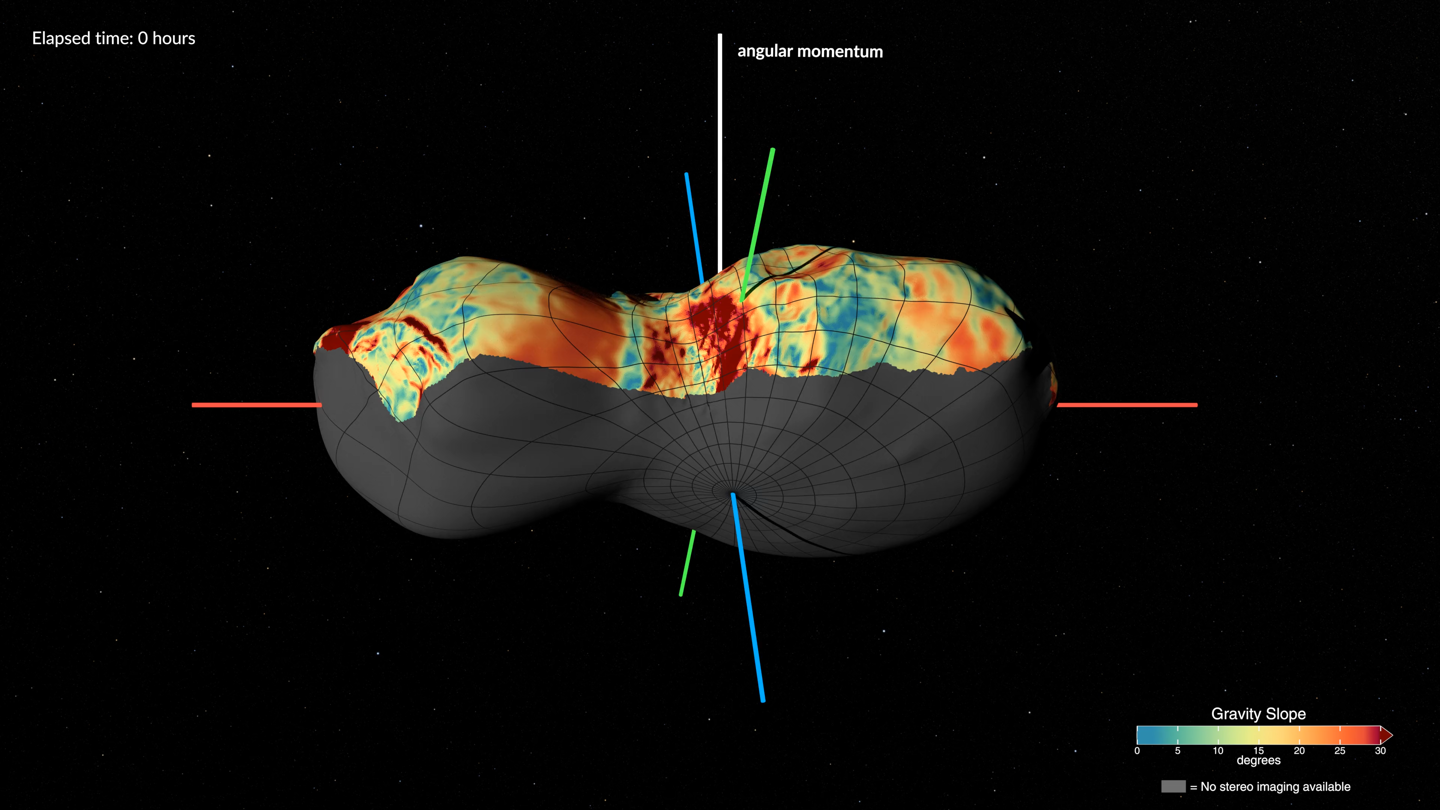
High-resolution images revealed a contact binary: two lobes connected by a narrow neck, giving the asteroid its peanut shape. Scientists believe the two halves began as separate fragments from a catastrophic collision that shattered a larger parent body. Over time, their mutual gravity pulled them back together.
The asteroid’s orbit suggests it belongs to the Erigone family, a cluster of debris formed when a much larger body broke apart roughly 155 million years ago. At birth, Donaldjohanson was spinning at least ten times faster than it does today. Its rotation has been slowing for the last 20 to 60 million years, most likely through the YORP effect — sunlight heating its irregular surface and radiating infrared energy back into space, producing tiny but cumulative nudges over geologic time. As the spin slowed, the balance between centrifugal force and gravity shifted, causing loose rock to slide downhill and smoothing the rims of many impact craters.
The real surprise came from the spectrometer data. Lucy detected iron-rich layered silicates — clay minerals — on the asteroid’s surface. These clays require liquid water to form. But crucially, the water exposure was brief. If the clay had been soaked for extended periods, the iron would have been replaced by magnesium.
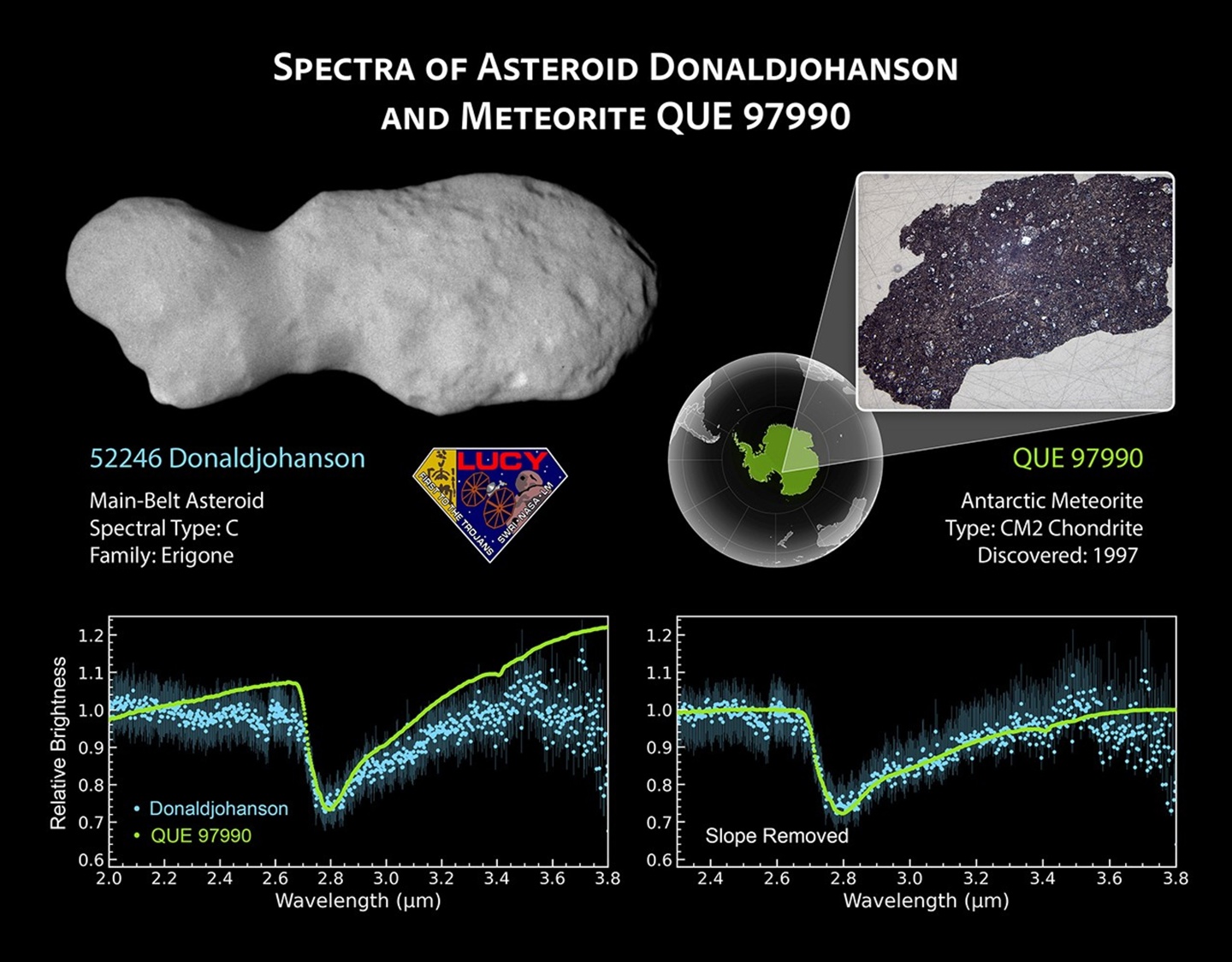
That puts Donaldjohanson in a different category from two other well-studied asteroids, Bennu (visited by NASA’s OSIRIS-REx) and Ryugu (visited by JAXA’s Hayabusa2). Both carry magnesium-rich clays, suggesting their parent bodies endured water alteration lasting millions of years. The differences point to diverse origins — these three asteroids may have formed in very different regions of the early solar system, only later migrating to their current positions in the main belt.
Donaldjohanson is named after the paleoanthropologist who discovered the famous Lucy fossil in Ethiopia in 1974 — the same fossil that gave the NASA mission its name. This flyby marks the second asteroid Lucy has visited on its 12-year journey, following a 2023 encounter with asteroid Dinkinesh. Next up: Eurybates, a Jupiter Trojan, expected in August 2027.
The findings were published June 18, 2026 in Science.