New Tantalum Alloy Doubles Strength at 2000°C — Published in Nature
There aren’t many metals that can hold their shape at 2000°C. Most — including the nickel-based superalloys that power jet engines — melt well below that. Only a handful of refractory metals like tungsten, molybdenum, and tantalum even stand a chance. And until now, none of them did it well enough to matter for the most demanding aerospace applications.
Researchers at Xi’an Jiaotong University’s State Key Laboratory for Mechanical Behavior of Metallic Materials just changed that. They’ve developed a new boron-oxide dispersion strengthened (B-ODS) tantalum alloy that doubles the tensile yield strength at 2000°C compared to conventional tantalum alloys. The work was published in Nature on Friday.
The challenge is fundamental. Aerospace components like rocket nozzles, re-entry vehicle leading edges, and hypersonic engine parts operate at temperatures that would reduce most structural metals to puddles. Tantalum, with a melting point around 3000°C, has long been one of the few viable candidates. But existing tantalum alloys simply didn’t have enough high-temperature strength. NASA’s commercially developed T-222 alloy, for example, drops below 100 MPa of tensile strength at 1926°C — too weak for serious structural use.
The Xi’an team solved this through a boron-intervened in-situ oxidation reaction that precisely controls the size and distribution of oxide particles within the tantalum matrix. The resulting B-ODS alloy achieves a balance that’s been elusive: excellent room-temperature ductility combined with ultra-high-temperature strength.
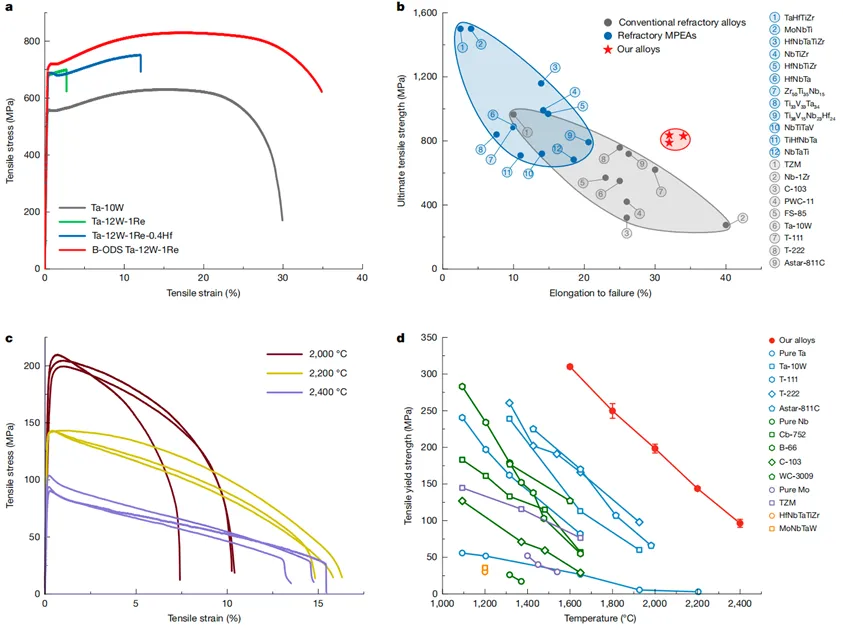
The numbers tell the story clearly. At room temperature, the new alloy delivers over 800 MPa tensile strength with 35% elongation — meaning it’s both strong and formable. At 2000°C, its tensile yield strength reaches 200 MPa, and even at 2400°C it still holds at 100 MPa. Compared to conventional tantalum alloys, that’s a 100% improvement in yield strength at 2000°C. And at the same 100 MPa load, the new alloy can operate about 500°C higher than existing options.
Creep tests further showed that the B-ODS tantalum alloy has significantly better long-term service potential than traditional refractory alloys.
The work opens a practical pathway for structural materials that need to survive in extreme thermal environments — hypersonic flight, advanced propulsion, next-generation re-entry vehicles. And for once, the performance claims come with a Nature paper to back them up.
The paper is available at: https://www.nature.com/articles/s41586-026-10708-z