48 Chinese iOS Developers File Antitrust Complaint Against Apple Over 'Global Lowest Rate' Pledge
There’s a quiet tension that has been building in China’s developer community for months, and it finally boiled over this week. A group of 48 independent Chinese iOS developers — led by a firm called Yuanbao Networks — submitted a formal antitrust complaint to China’s State Administration for Market Regulation (SAMR), accusing Apple of abusing its dominant position in the country’s mobile ecosystem. The complaint, which gained rapid traction on WeChat, centers on a single question: when Apple promised Chinese developers “globally lowest rates,” did it mean it?
The developers’ petition lays out four concrete demands. First, they want SAMR to formally investigate Apple for alleged restrictive trading practices, discriminatory treatment, tying arrangements, and unfairly high pricing. Second, they demand that Apple honor the “global lowest rate” commitment it made to the Chinese market — specifically by opening third-party app distribution, third-party in-app payment systems, and external link payment channels. Third, they propose an “automatic alignment mechanism” that would require Apple to implement any future rate reductions or channel openings in China on the same day they take effect overseas. Fourth, they request a written response detailing how the regulator will handle their complaint.
At the heart of the dispute is a promise Apple made on March 13, 2026. In an announcement that drew significant attention, the company declared it would “always provide developers distributing apps in China with competitive App Store rates no higher than the overall rate levels in other markets.” That language — the “global lowest rate” commitment — was widely interpreted as a guarantee that Chinese developers would not pay more than their counterparts anywhere else in the world.
Three months later, the developers argue, Apple has only partially delivered. The standard in-app purchase commission in China did drop — from 30 percent to 25 percent for large developers, and from 15 percent to 12 percent for participants in the Small Business Program and qualifying auto-renewing subscriptions beyond the first year. But the structural reforms that have arrived in other markets remain conspicuously absent from China. Third-party app stores, alternative in-app payment processors, and external purchase links — all available to developers in the European Union under the Digital Markets Act and increasingly offered in other jurisdictions — have not materialized for Chinese developers.
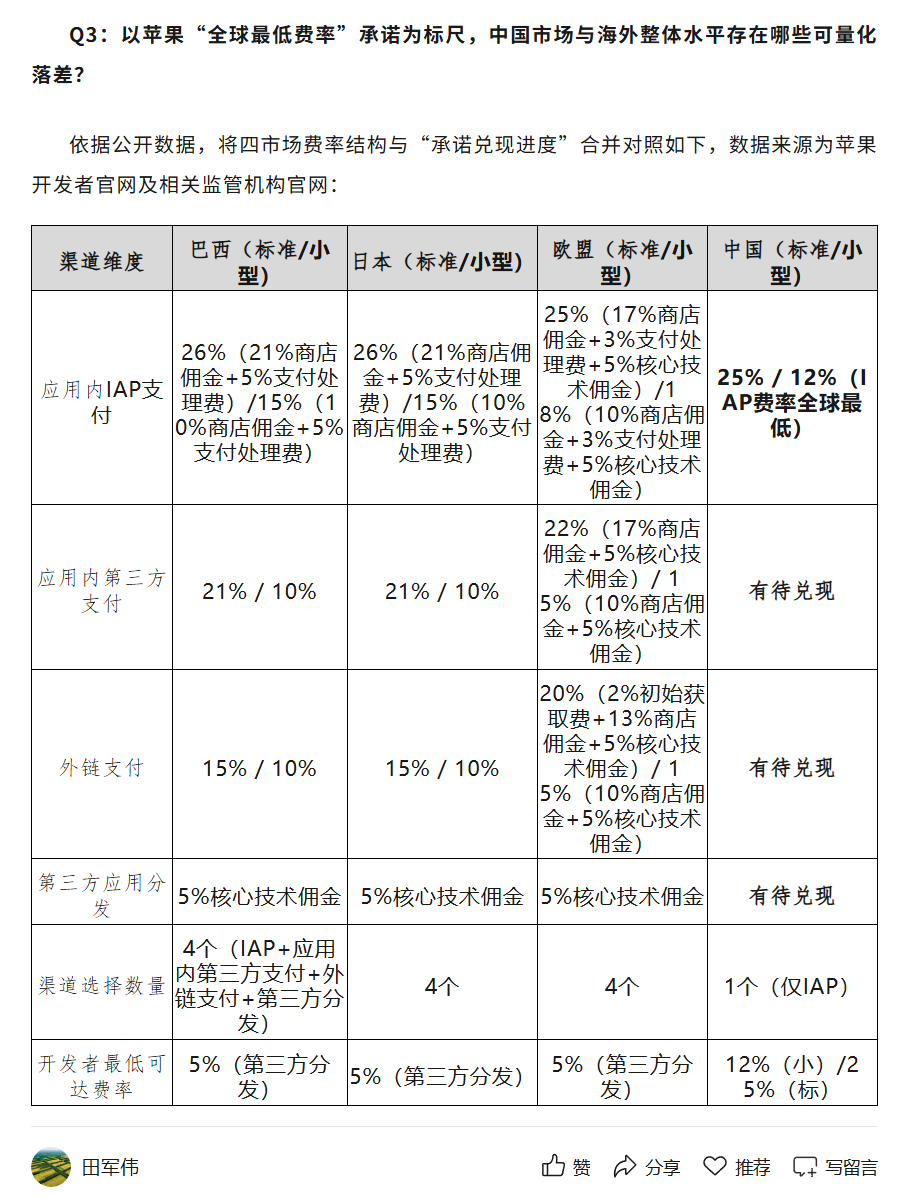
The result, according to a comparison table shared by the developers, is a significant gap between headline rates and real-world costs. While China’s standalone IAP commission rate is indeed among the lowest Apple currently charges, Chinese developers have only one channel available to them: Apple’s own payment system, with no alternatives. Overseas developers, by contrast, can route transactions through third-party processors with substantially lower fees, making their effective total cost meaningfully lower despite sometimes higher headline IAP rates.
IT-NEWS reported on the original March announcement at the time: following discussions with Chinese regulators, Apple adjusted its commission structure for the mainland China App Store effective March 15, 2026. The standard rate for in-app purchases and paid apps moved from 30 percent to 25 percent, while the reduced rate for small developers and second-year subscriptions fell from 15 percent to 12 percent.
The developers’ joint statement and the full text of the complaint have been circulated widely in Chinese tech circles, along with a supplementary open letter titled “Please, Apple, Fulfill Your ‘Global Lowest Rate’ Promise.” The documents reflect a growing frustration among smaller Chinese studios who feel the rate cut, while welcome, doesn’t address the deeper competitive imbalance they face in a market where Apple controls the sole distribution and payment pipeline.


Whether SAMR will open a formal investigation remains to be seen, but the timing is notable. Apple has been navigating an increasingly complex global regulatory landscape — DMA compliance in Europe, antitrust scrutiny in the United States, and now, a coordinated push from developers in one of its most important markets. For the 48 developers who put their names on this complaint, the math is straightforward: a rate cut without market access reform is half a promise, and half a promise isn’t what Apple advertised.