Chinese Scientists Discover Mysterious Double-Flash X-Ray Source That Defies Explanation
Astronomers using China’s Einstein Probe satellite have uncovered a deeply puzzling X-ray transient source that refuses to fit into any known category of cosmic explosion. Designated EP240305a, the source exhibits a distinctive double-flash pattern and jet-like afterglow strongly reminiscent of a gamma-ray burst — yet, crucially, no gamma rays were ever detected. The findings, published June 13 in the Monthly Notices of the Royal Astronomical Society, have sparked intense interest across the international astronomy community and may point to an entirely new class of high-energy transient.
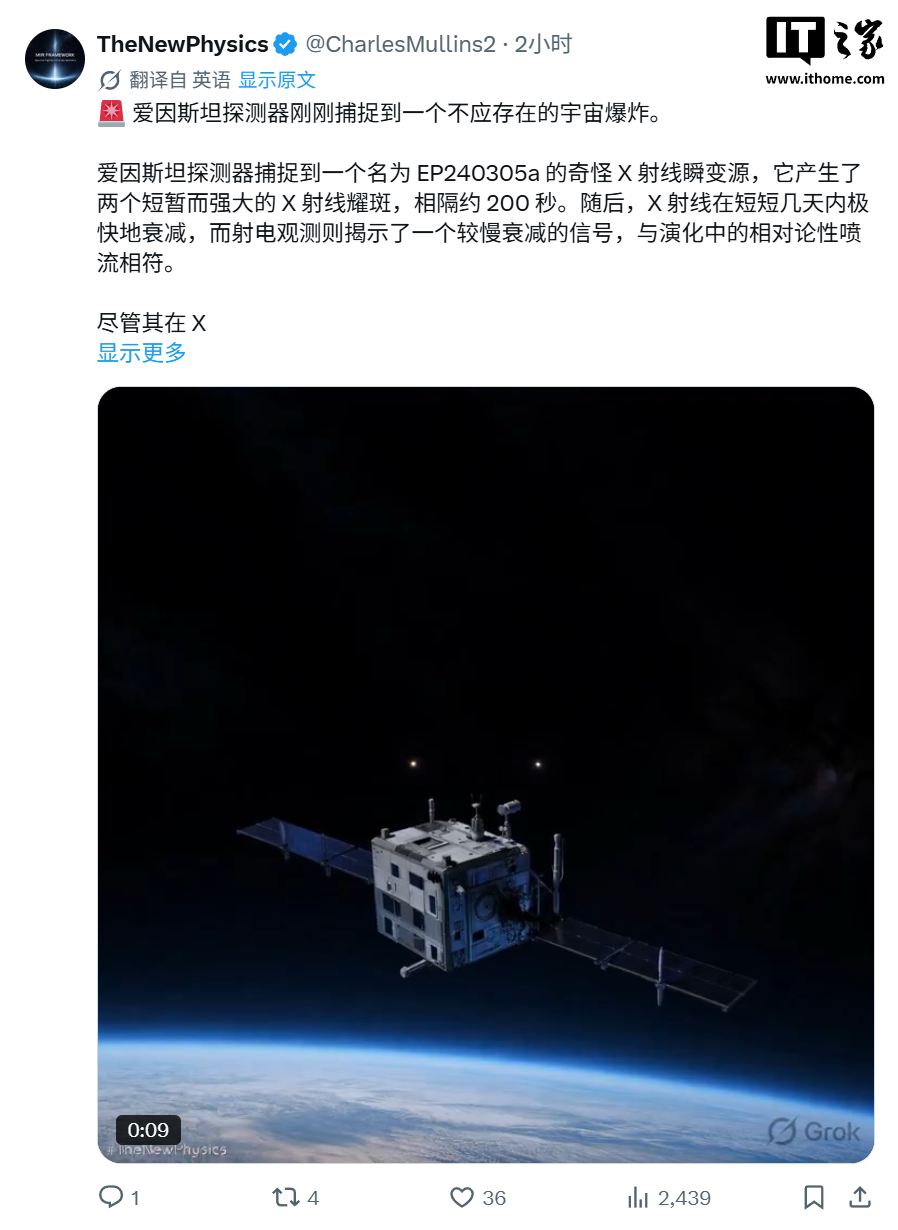
The Einstein Probe (EP) satellite, a strategic space science mission under the Chinese Academy of Sciences (CAS), first detected the anomalous signal on March 5, 2024, at 22:15:31 Beijing time during a calibration observation. Its wide-field X-ray telescope captured two distinct, powerful flares in the soft X-ray band. Each flare lasted between 100 and 250 seconds, separated by a quiet period of roughly 200 seconds — a temporal signature unlike anything previously catalogued. Following the twin outbursts, the source’s X-ray emission faded rapidly, dimming to near-invisibility within days.
Alerted by the unusual signal, the research team swiftly activated a coordinated follow-up campaign spanning the electromagnetic spectrum — from X-ray and optical to near-infrared and radio wavelengths — drawing on both ground-based and space-based observatories. The multi-wavelength data painted an equally strange picture. While the X-rays vanished quickly, the radio emission persisted for weeks, decaying far more slowly and betraying the presence of an evolving jet. At the burst location, astronomers spotted a faint, steadily dimming near-infrared source, yet optical telescopes saw nothing at all.
To pin down EP240305a’s nature, the team methodically ruled out every known class of bright transient. Tidal disruption events (TDEs) driven by jets and typical X-ray binary outbursts were eliminated because they fade over months, not days. Even the rarer short-duration X-ray binary subclass, which can decay within weeks, showed none of the powerful radio emission observed here. Thermonuclear bursts fell short on temperature and radio persistence. Magnetar giant flares, which rise and fall in under a second, were orders of magnitude too fast. And the radio signal outlasted anything a stellar flare could produce.
What makes EP240305a genuinely confounding is how closely it matches the profile of a gamma-ray burst (GRB) — except for the gamma rays themselves. Its double-flash morphology mirrors the “double-burst” phenomenon seen in certain GRBs. The X-ray brightness evolution follows canonical GRB patterns. The radio afterglow decay tracks exactly as expected for a GRB remnant. And yet, throughout the entire observation window, not a single gamma-ray photon was recorded. The event is what astronomers call a “gamma-ray dark” GRB-like transient.
The researchers propose several scenarios that could account for the missing gamma radiation. The jet may be pointed away from Earth’s line of sight, a geometric misalignment that would hide the narrow gamma-ray beam while still allowing wider-angle X-ray and radio emissions to reach us. Alternatively, the jet may have failed to fully break through the dense circumstellar material surrounding the progenitor, smothering the gamma rays. A third possibility invokes a “dirty fireball” — a jet laden with baryonic matter that quenches gamma-ray production while preserving the lower-energy signatures.
In their paper, the team remains carefully measured: “For EP240305a, the current data do not allow us to conclusively identify it as originating from a gamma-ray burst, so we cautiously classify it as a gamma-ray-dark GRB-like transient, or more broadly as an extragalactic fast X-ray transient.” They emphasise that such faint, elusive events are easily drowned out by brighter, more conspicuous explosions and can only be captured by highly sensitive instruments like the Einstein Probe, combined with rapid multi-wavelength follow-up.
Since its launch, the Einstein Probe has already detected over 180 transient events, establishing itself as a powerful tool for uncovering the universe’s most fleeting and enigmatic phenomena. Whether EP240305a ultimately represents a known phenomenon viewed from an unusual angle or something genuinely new, its discovery underscores how much of the high-energy sky remains unexplored. As the team notes, capturing these “dark” events is essential to building a complete census of cosmic explosions — and the Einstein Probe is just getting started.