Huawei explains why its driving mileage counter keeps rolling after going offline
There’s an uncomfortable question rattling around Chinese social media this week: if your car goes offline, why does the mileage counter on Huawei’s website keep climbing?
The short answer — it doesn’t. But the way Huawei displays it can sure look like it does.
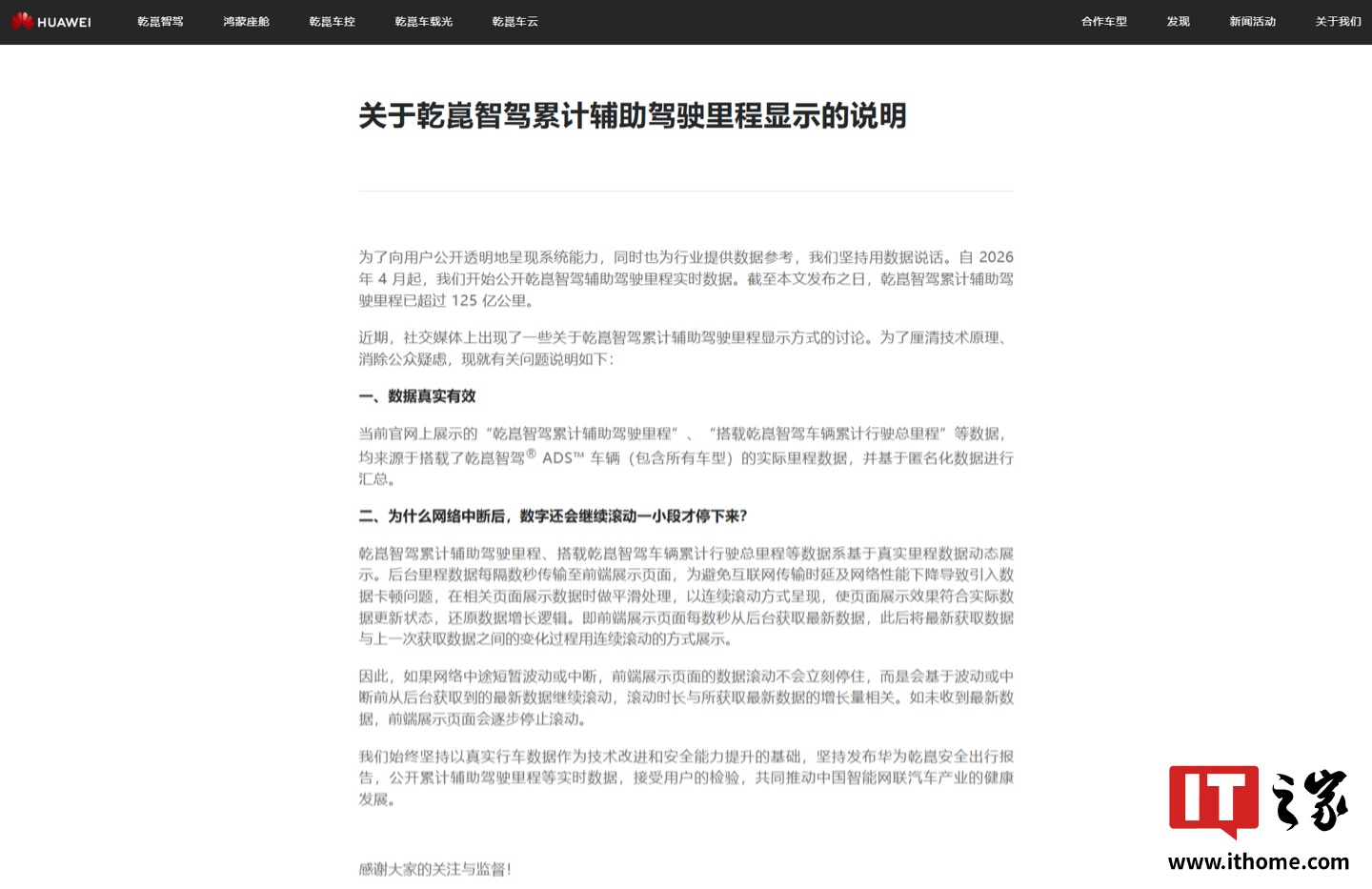
IT-NEWS, July 7 — The controversy started when sharp-eyed owners noticed that the “accumulated assisted driving mileage” displayed on Huawei’s Qiankun smart driving portal kept ticking upward even after they disconnected from the internet. Screenshots circulated. Accusations of inflated numbers followed.
Huawei Qiankun, the company’s autonomous driving division, posted a detailed explanation late Tuesday. The core claim: every number on that page comes from real vehicle data — specifically from cars equipped with the Qiankun ADS system (all models included), anonymized and aggregated. The company says the cumulative assisted driving mileage has already exceeded 12.5 billion kilometers as of the date of the statement.
So why does the counter keep moving when there’s no network?
The answer is cosmetic — but honest. Huawei says the backend sends fresh mileage data to the frontend every few seconds. To avoid the jerky, stop-start feel that internet latency would introduce, the frontend doesn’t snap to each new value. Instead, it smoothly interpolates between updates, rolling the digits continuously so the display looks fluid. If the network cuts out mid-update, the counter keeps scrolling based on the last batch of data it received. Only if the outage lasts long enough will it gradually slow to a stop.
In other words, the rolling numbers aren’t fake data — they’re a visual buffer between real data points.
The company stressed that all figures are drawn from actual miles driven by real vehicles. It publishes regular safety reports and open data on assisted driving mileage as part of its commitment to transparency, and it invited users to keep scrutinizing the numbers.
The explanation has largely calmed the debate. Onlookers who initially suspected inflated figures now seem satisfied that the mechanism is a quirk of frontend engineering rather than a deliberate deception. Still, the episode highlights a growing tension in the auto-tech world: as Chinese automakers compete on autonomous driving credentials — and publish flashy real-time counters to prove it — the line between transparent display and slick marketing can blur.
Huawei’s counter keeps rolling. But at least now everyone knows why.