Apple's Latest Camera Patent Kills Tilted Horizons with a Rotating Image Sensor
Every smartphone photographer has been there: you snap what feels like a perfect shot, only to find the horizon tilted by a few degrees. Today’s fix is digital — crop, rotate, lose pixels. Apple’s latest patent proposes a hardware solution instead: physically rotate the image sensor.
IT-NEWS, July 2 — Tech site PatentlyApple reported Tuesday that a newly granted Apple patent describes a camera module that physically rotates the image sensor to correct tilt caused by camera roll during handheld shooting.
Camera roll — when the camera rotates around its optical axis — is what makes horizons look tilted and vertical objects lean against the edges of the frame. It happens whenever you twist your wrist slightly while taking a photo or recording video. Most phones correct this by cropping and rotating the frame digitally, throwing away image data. Apple’s patent skips that entirely.
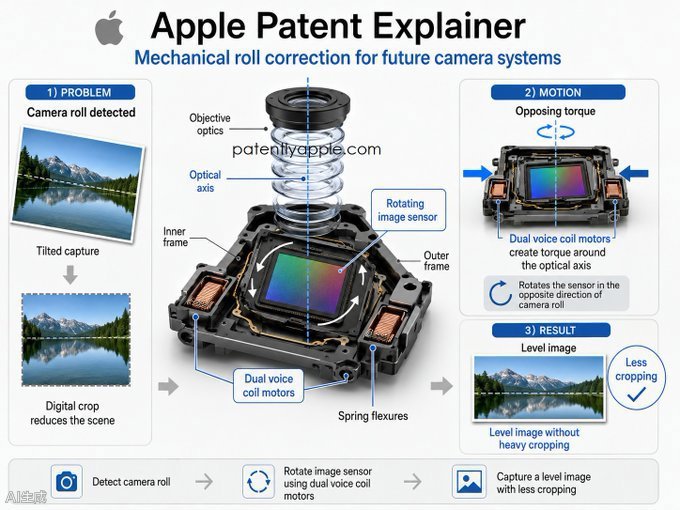
The patent lays out a mechanical stabilization system built around an objective lens, an image sensor mounted on a substrate, a rotatable frame, actuators, and a controller. When the camera housing rotates in one direction, the controller drives the sensor frame in the opposite direction, canceling out the tilt in real time.

Two voice coil motors sit on opposite sides of the optical axis. Each has a magnet assembly and a coil. When current flows, Lorentz force is generated. The two motors produce equal and opposing forces, creating torque that rotates the sensor substrate around the optical axis. It’s the same electromagnetic principle used in high-end speaker drivers, applied here at microscopic precision.
The patent also describes an anti-shake bracket with an inner and outer frame. The inner frame holds the sensor substrate and image sensor; the outer frame attaches to the camera housing. They’re connected by a spring-like flexible joint that allows rotation while providing restoring force, letting the controller fine-tune the sensor’s orientation by adjusting coil current.
If this system makes it into production, it would be a real shift from how smartphone stabilization works today. Current optical image stabilization (OIS) moves the entire lens assembly. Moving the sensor instead lets the system correct for a wider range of motion without the mechanical complexity of a gimbal-like lens system, and it preserves the full image since no cropping is needed.
Apple files hundreds of patents every year, and not all of them reach shipping products. But this one has the feel of something grounded in engineering reality — voice coil motors are proven technology, and rotating the sensor instead of the lens sidesteps several optical alignment challenges. If the next Pro iPhone can shoot a landscape without a tilted horizon, that’s one less thing to fix in Lightroom.