Google-backed Apptronik built a 'robot school' — and it's the size of two basketball courts
There’s a warehouse in Austin, Texas, where robots go to school. Not the kind of school where they memorize facts or recognize images. The kind where they learn to pick up a box and put it on a conveyor belt, over and over, until they get it right.
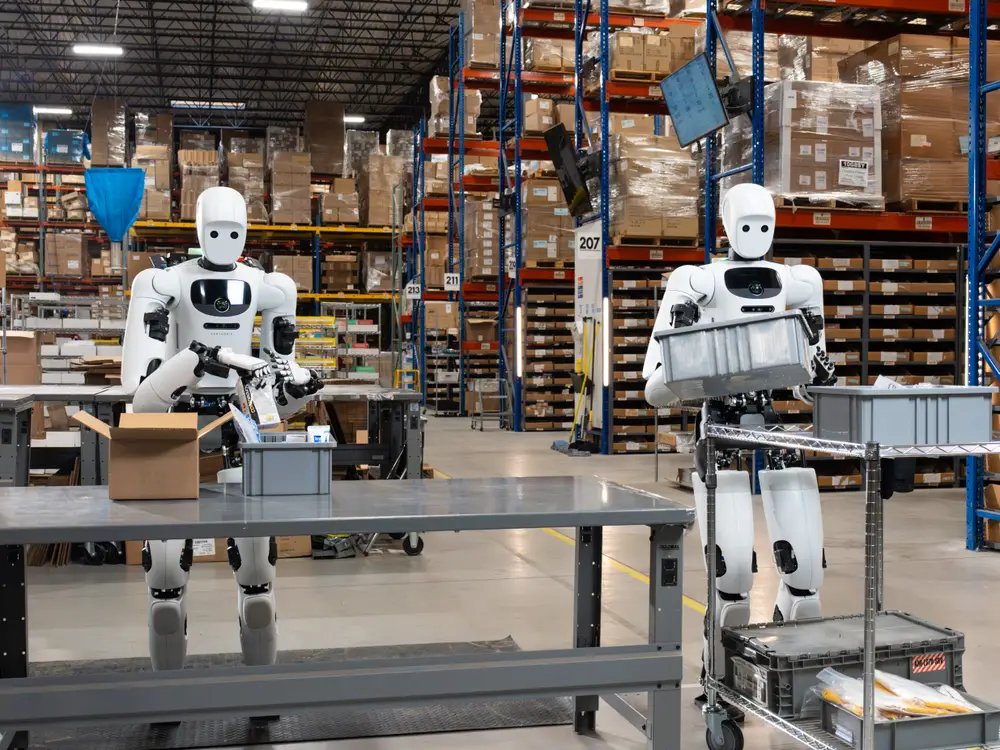
The facility belongs to Apptronik, a humanoid robotics startup backed by Google and Mercedes-Benz. At roughly 9,000 square feet, the company calls it a “robot training park” — a purpose-built space where its Apollo humanoid robots spend their days practicing real-world tasks, mostly under remote human supervision. Workers stand nearby, guiding each movement, while the system logs everything. The data flows back into the AI models that serve as each robot’s brain.
The goal is straightforward but expensive: teach a humanoid robot to function without a human in the loop. That turns out to be much harder than training a chatbot.
“Just as we need factories to build robots, we also need a data factory to produce the training data needed for development,” said Jeff Cardenas, Apptronik’s co-founder and CEO. “This is the robot’s learning playground.”
The training data problem is the central bottleneck in humanoid robotics right now. LLMs train on the entire internet — trillions of words and images scraped from every corner of the web. Humanoid robots don’t have an equivalent dataset. There is no vast archive of robots picking things up, opening doors, or sorting packages. Every real-world interaction has to be generated from scratch, one motion at a time.
Elon Musk is pursuing the same strategy. He’s talked about creating an “Optimus Academy” where Tesla’s humanoid robots run through tasks in a controlled environment, creating a virtuous data loop that improves performance over time.
Apptronik spun out of the University of Texas’ Human-Centered Robotics Lab in 2016, born from research commissioned by DARPA’s robotics challenge — a competition designed to build robots that could operate in disaster zones. The company started by selling components to other robotics firms, but Cardenas said the end goal was always a general-purpose humanoid.
That bet has attracted serious money. Apptronik has raised roughly $1 billion and carries a valuation north of $5.5 billion. Mercedes-Benz already has Apollo robots working in its factories, handling parts sorting and tool organization on the assembly line. Google’s DeepMind is using Apollo as a hardware testbed for Gemini Robotics, its AI model for robotic applications.
The first-generation Apollo debuted in 2023. The second-gen model, currently being tested, packs upgraded batteries, motors, and sensors. It stands about 1.8 meters tall, can lift 55 pounds, and runs for about four hours on a single charge. A third-generation commercial version is still in development — Cardenas isn’t saying when it will ship.
Cardenas sees the humanoid robotics industry moving through three phases: first, prove the technology works; second, prove customers will pay for it; third, scale and turn a profit. The industry, he said, is just now entering phase two.
“Humanoid robots are the personal computer of our era,” he said. “If you buy that comparison, we’re roughly in the early 1980s — word processors and spreadsheets have just arrived.”
The broader industry is shifting from lab demos to early commercial deployments. Figure AI, based in San Jose, is now valued at $39 billion and has humanoids working in logistics warehouses. 1X, headquartered in Palo Alto, plans to deliver more than 10,000 humanoid robots to households starting later this year. Agility Robotics, based in Oregon, is preparing for an IPO and already has its Digit humanoid deployed at nine customer sites, including Amazon, Toyota, and logistics firm GXO.
Apptronik is unusual in developing both bipedal and wheeled versions of Apollo. Cardenas said the bipedal form factor has more long-term potential — it can theoretically replicate any physical task a human can perform — but wheeled robots will scale faster because they’re safer. A bipedal robot has to carry a heavy battery pack high in its torso, uses more energy, and risks tipping over.
The company has set up similar training facilities at partner locations globally and plans to build more. “Our vision is to establish robot training parks around the world,” Cardenas said, “and eventually open them to the public so everyone can see firsthand how the future is being built.”