AWS billing glitch showed some users a $1.5 trillion bill
There’s a special kind of dread that comes with opening an unexpected billing email from a cloud provider. Dan Harvey, marketing director at the UK charity Learning through Landscapes, felt that dread on a whole new level this week when AWS sent him a notification about his organization’s campus audit app.
The app normally costs less than £1 a month. On July 17 — barely halfway through the billing cycle — the charity’s bill had already reached $7.8 billion.
His previous month’s bill? Forty-three cents.
“I nearly had a heart attack,” Harvey told The Guardian. He and his support team spent hours combing through their account, trying to figure out what went wrong.
He wasn’t alone. On X, a user named @Bharath posted a screenshot of his AWS dashboard showing a projected balance of $1.5 trillion. The usage increase compared to the previous month: 745,728,201,771 percent.
“Just saw $1.5 TRILLION on my AWS bill,” he wrote. “I almost s**t myself.”
Andrea Zuvich, a historian specializing in the Stuart period who runs the website “Seventeenth Century Lady” from Bolsover, Derbyshire, received a bill for $245 billion. Her typical monthly spend: around $15.
“I was horrified,” she said. “We usually get charged around $15 per month, so you can imagine our surprise… The really serious part is that this could cause some people extreme panic, and even health issues.”
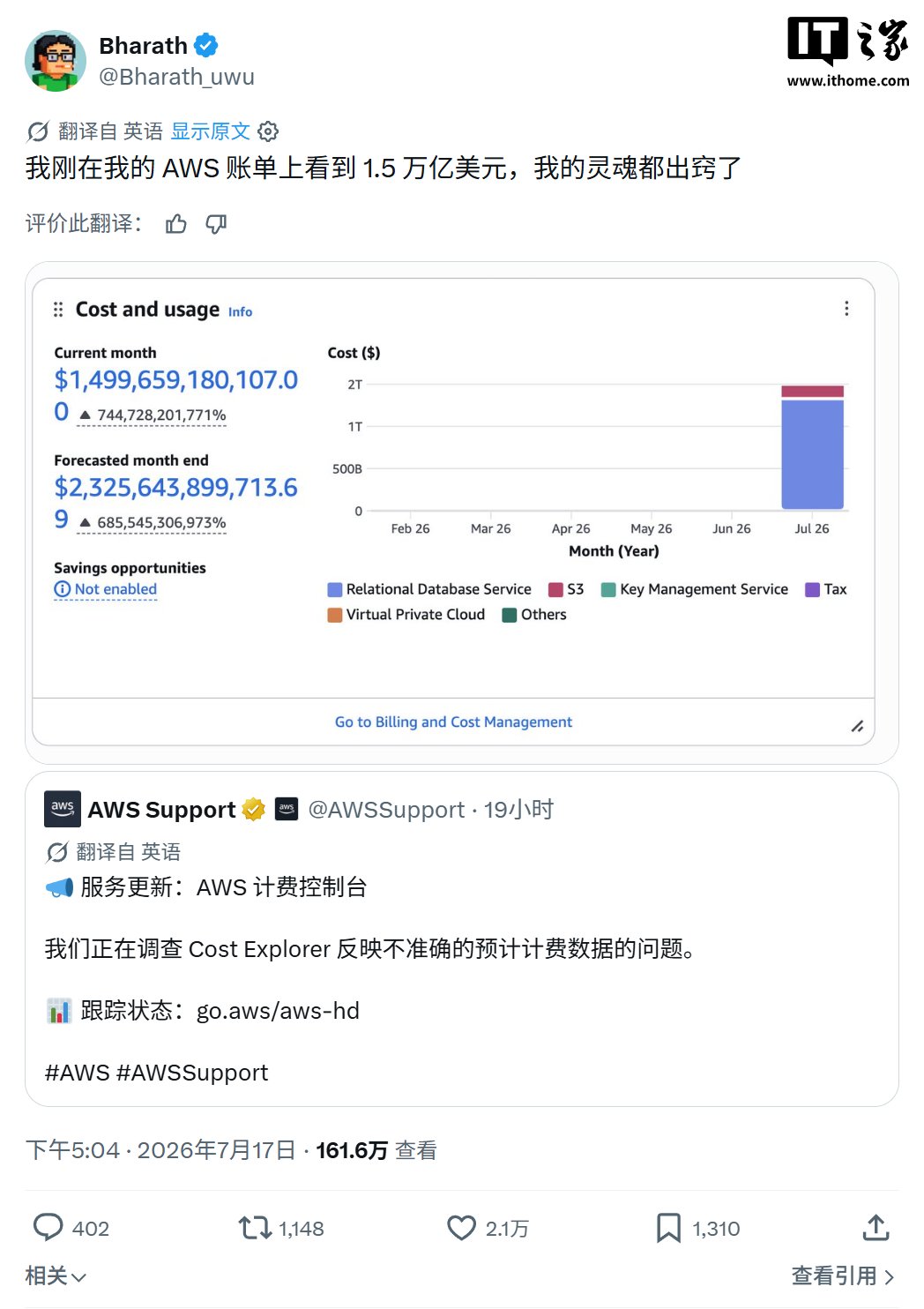
The bug appears to have affected AWS’s Cost Explorer tool — the billing dashboard customers use to track their projected spending. An inaccurate forecasting error inflated usage numbers by orders of magnitude, turning routine cloud bills into figures that could fund a small country’s GDP.
AWS’s official support account acknowledged the issue on X, posting: “We are investigating an issue where Cost Explorer is reflecting inaccurate projected billing data.”

The company has not yet shared a root cause analysis or confirmed how long the glitch persisted before it was caught. Actual billing — the final invoices AWS generates — typically runs through separate systems from Cost Explorer projections, so affected customers are unlikely to actually owe the astronomical amounts shown. But the emotional toll of that moment before you realize it’s a glitch? That’s already been collected.
For a charity managing tight budgets, or a small historian running a niche website on a shoestring, seeing a nine-figure bill flash across the screen isn’t just a UI bug. It’s the kind of thing that makes you rethink whether the cloud is worth it.