DF1000: A Chinese startup's 3D AI chip hits 520 TFLOPS using 14nm process
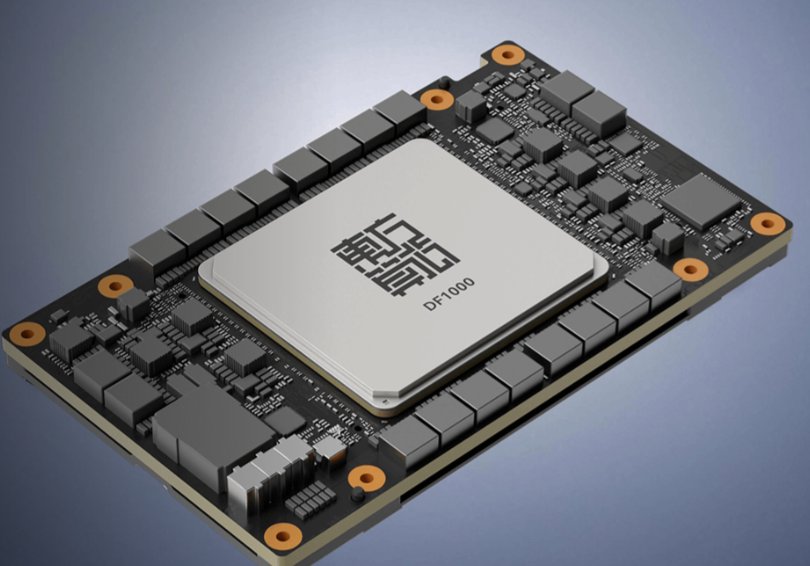
There’s a quiet story unfolding in Shanghai this week. At the World Artificial Intelligence Conference (WAIC 2026), a relatively young Chinese company called Orient Computing (东方算芯) unveiled what it describes as the world’s first software-defined near-memory computing 3D AI chip. The DF1000 delivers 520 TFLOPS at BF16 precision, built on a 14nm process node using an entirely domestic supply chain.

The chip relies on software-defined chip technology to decouple hardware from software and enable dynamic reconfiguration. This approach, combined with 3D hybrid bonding for wafer-level stacking, addresses three critical bottlenecks that have constrained Chinese high-end AI chip development: memory bandwidth, process dependency, and supply chain security.
By using spatial parallelism and time-division multiplexing, the DF1000 improves hardware utilization while reducing reliance on cutting-edge fabrication nodes. The result is a chip that achieves competitive performance figures — 520 TFLOPS@BF16 — without needing sub-10nm manufacturing.
The DF1000 also won the 2026 SAIL Award (Superior Artificial Intelligence Leader), one of WAIC’s top honors.
Orient Computing is a new player in the space. Founded in May 2024 and headquartered in Shanghai’s Zhangjiang hi-tech park, the company has grown to over 500 employees with offices across Beijing, Nanjing, Xi’an, Chengdu, Suzhou, and Shenzhen. Its product lineup includes the DF1000 chip, basic and application software, high-performance servers, and large-scale cluster solutions.
The broader context here matters. Chinese AI chip companies have been racing to build competitive alternatives to NVIDIA’s GPUs amid ongoing export restrictions. What makes Orient Computing’s approach different is the emphasis on software-defined silicon — a method that lets the same hardware adapt to different AI workloads through runtime reconfiguration, rather than relying on fixed-function accelerators.
Whether the DF1000 can scale from prototype to production remains an open question. But it’s one of the more interesting hardware announcements to come out of WAIC this year.