BMW, Volvo, Google, and Xiaomi just joined forces to make EV batteries truly recyclable
There’s a quiet tension at the heart of the electric vehicle boom. Automakers keep selling more EVs, but nobody has fully figured out what to do with the batteries when they die. A new alliance — announced during London Climate Action Week — is the most serious attempt yet to fix that.
The Ellen MacArthur Foundation, alongside CATL, BMW, Renault, Volvo, Google, and Xiaomi, has launched the Global Energy Circular Economy Alliance. Their first order of business: developing a set of Battery Recyclable Design Guidelines that will define how batteries should be built from the ground up with their end-of-life — disassembly, repair, and material recovery — already factored in.
CATL described the initiative as a shift from talking about battery recycling to actually building the systems to make it work at scale. The alliance is focused on establishing standardized evaluation criteria across five dimensions: battery usage history, health status, degradation data, and recycling accountability. The idea is to create a common language that every player in the supply chain — from cell manufacturers to scrap processors — can agree on.
The guidelines themselves will cover five design principles: easy disassembly, diagnostic capability, repairability, remanufacturing, and material recycling. They are scheduled for release in 2027.
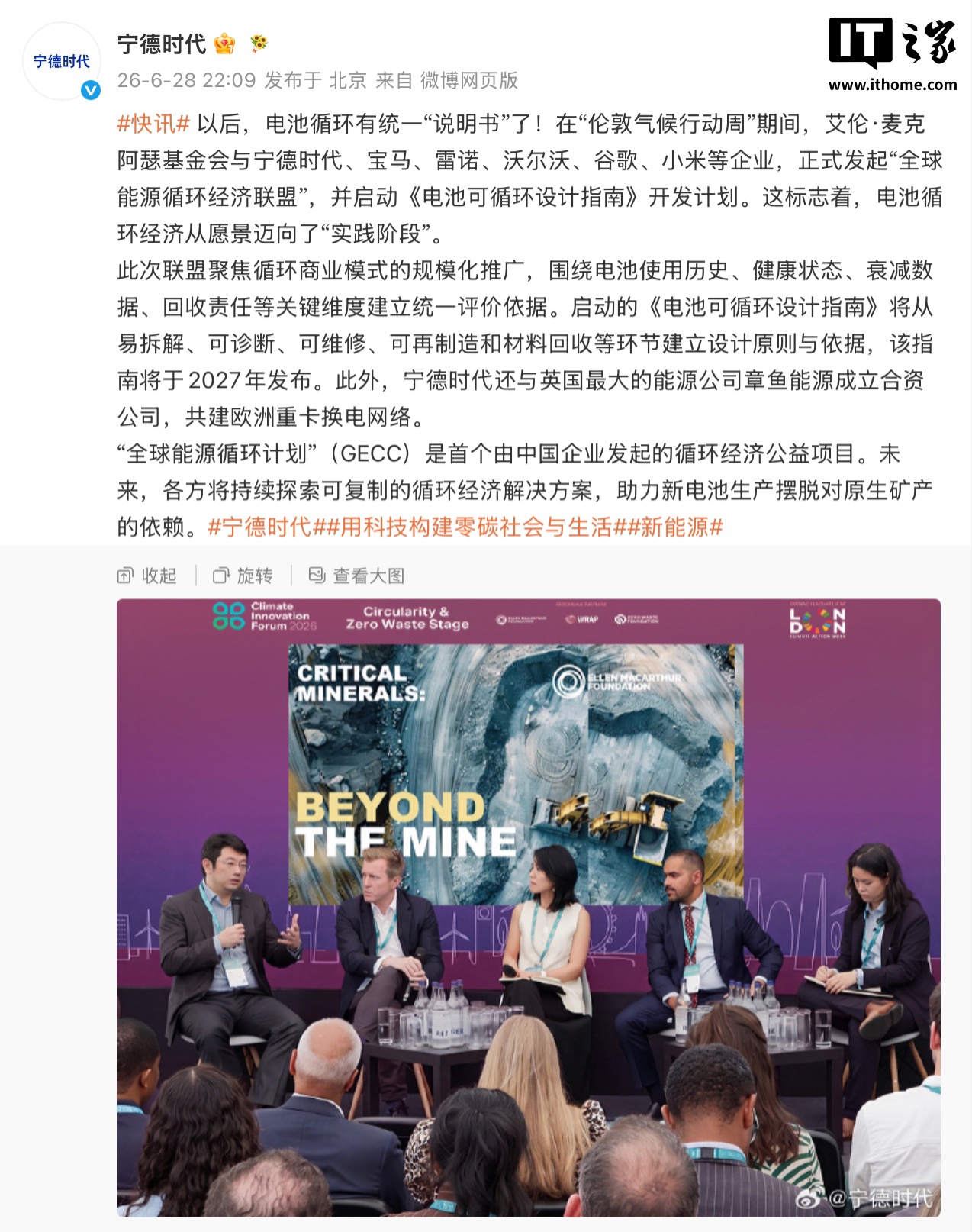
Separately, CATL formed a joint venture with Octopus Energy, Britain’s largest energy supplier, to build an electric heavy truck battery swapping network across Europe. That effort runs in parallel to the alliance but shares the same underlying logic: batteries don’t have to be single-use components.
The alliance brings together an unusually broad coalition — an automaker from China, two from Europe, one from the US via Volvo (Geely-owned), a Chinese battery giant that supplies most of them, and two of the world’s largest tech platforms. That mix suggests the industry may finally be ready to treat battery circularity as a shared infrastructure problem, not a competitive one.