Chinese Scientists Created Diamonds by Rubbing Carbon — and It Rewrites 100 Years of Friction Physics
For more than a century, friction scientists have held a quiet consensus: when you rub carbon-based materials together, they turn into graphite. Diamond formation under those conditions was considered impossible — it required the crushing heat and pressure of deep earth or industrial reactors.
A research team at the Chinese Academy of Sciences just proved that consensus wrong.
Researchers at the Lanzhou Institute of Chemical Physics designed a two-dimensional “sandwich” structure using layered materials that traps carbon debris between its sheets during friction. Under the right conditions, that trapped carbon converts into diamond — with conversion rates reaching 38.5%.
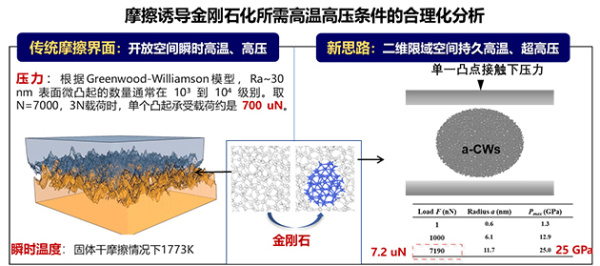
The key insight was deceptively simple. Normally, friction generates intense heat that makes carbon atoms highly mobile, allowing them to rearrange into graphite — the most thermodynamically stable form of carbon under those conditions. The Lanzhou team realized that if they could trap that heat and restrict atomic movement at the same time, they might force carbon atoms into diamond’s denser crystal structure instead.
They built their trap using thin two-dimensional material sheets. During friction, these sheets delaminate and stack, creating confined pockets that capture carbon wear debris. The confined space traps heat that would otherwise dissipate, keeping the local temperature high enough for diamond nucleation. At the same time, the stacked sheets physically compress the trapped carbon into a tighter arrangement — mimicking the extreme pressure of traditional diamond synthesis. And the sheets’ ordered crystal lattice acts as a template, nudging carbon atoms into diamond’s structure rather than graphite’s.
The result is a controlled environment where traditional friction physics — transient heat, high pressure, and high carbon mobility favoring graphite — gives way to sustained heat, localized ultra-high pressure, and limited atomic mobility favoring diamond.
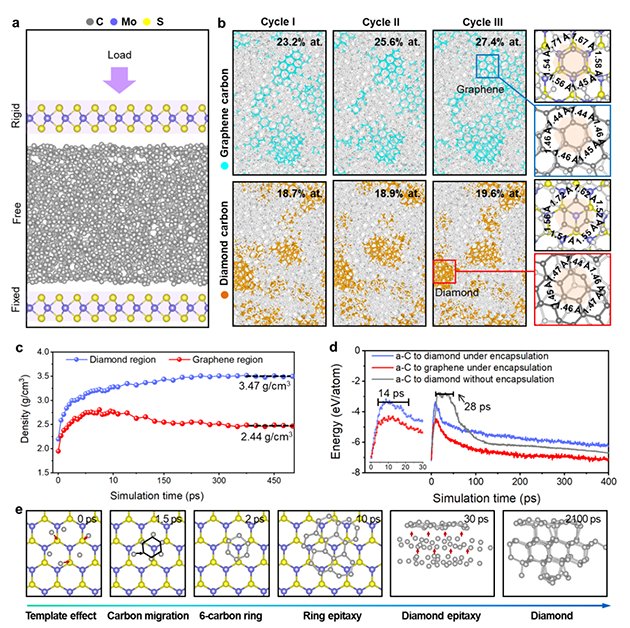
Computer simulations backed the experimental results. The team’s reactive molecular dynamics models showed that the two-dimensional confined space lowered the energy barrier for the amorphous carbon-to-diamond transition by about 30%, while speeding up structural relaxation by roughly 2 times.
At an initial contact pressure of 1.08 GPa, the conversion rate from amorphous carbon to diamond reached about 11.2%. Cranking the pressure to 1.40 GPa pushed that figure to 38.5%.
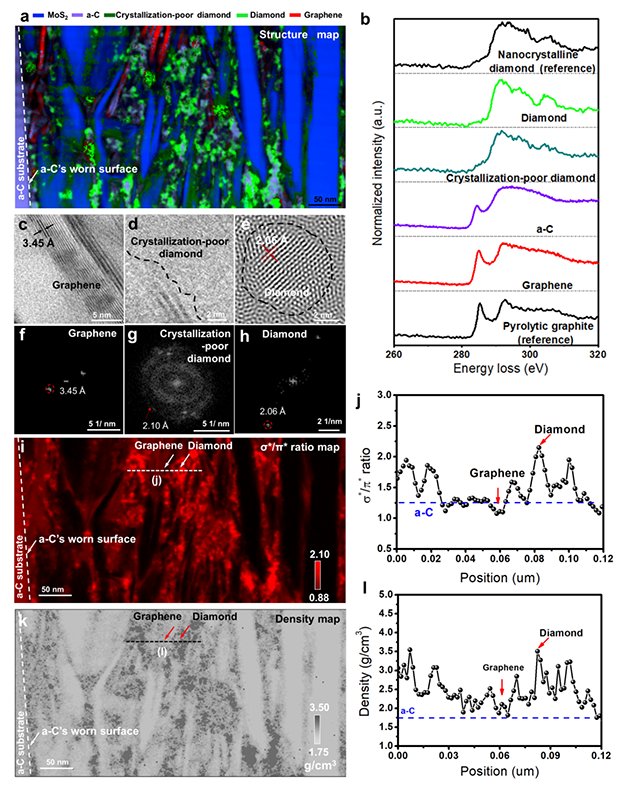
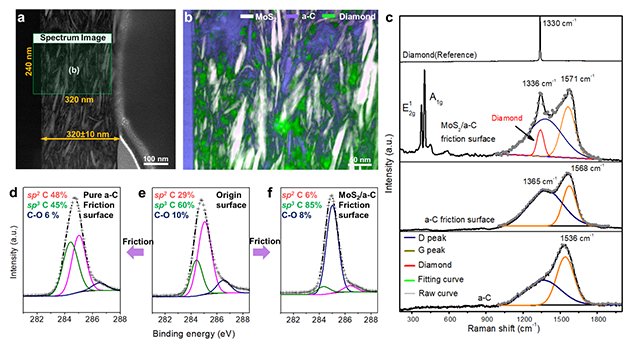
Not that the result was pure diamond. The confined pockets produced a composite structure mixing amorphous carbon, graphene, amorphous diamond, and actual diamond crystals — possibly even new carbon phases. Crucially, the graphene and diamond formed separately from each other, both evolving independently from the amorphous carbon debris rather than through a graphite-to-diamond pathway.
The paper, published June 25 in Advanced Materials, lists Wang Yongfu of the Lanzhou Institute of Chemical Physics as first author, with corresponding authors Li Ruiyun (Lanzhou University), Ernst Meyer (University of Basel), and Zhang Junyan (LICP). Funding came from China’s National Key R&D Program, the CAS Future Partners program, and Gansu Province’s major science projects.
This work overturns a long-held assumption in tribology — the study of friction, wear, and lubrication. It also opens a practical pathway for making diamond coatings and superhard materials without the massive energy bills that come with traditional high-pressure, high-temperature synthesis. If the technique scales, it could transform how industries produce wear-resistant coatings, cutting tools, and diamond-based electronics.
The team is already exploring where this goes next. The sandwich structure they built is tunable — different 2D materials, different layer configurations, different contact pressures. Each variable potentially shifts the diamond yield, the crystal quality, or the types of carbon phases that emerge.
For a field that has been running on the same graphite-centric assumption since the early 1900s, it’s a genuinely new direction. Diamonds, it turns out, can come from somewhere other than a pressurized chamber or a planet’s mantle — they can come from a precisely managed rub.