DeepSeek Responds to 'No Foreigners' Hiring Criticism: Chinese Proficiency Required, Not Citizenship
DeepSeek Harness team lead Cui Tianyi has pushed back against online accusations that the AI company refuses to hire foreigners, drawing a comparison to how American tech firms operate. In a social media post on June 21, Cui explained that the requirement is straightforward: employees must be able to work in Chinese — just as their US counterparts expect English fluency — and there is no policy barring foreign nationals from joining the company.
The response came as Cui announced that the newly formed DeepSeek Harness department is aggressively hiring. The team, which sources say is internally benchmarked against Anthropic’s Claude Code, is focused on building code agent products and faces what Cui described as “grand ambitions and heavy workloads” with serious staffing shortages. Three positions are currently open: Harness Researcher, Harness Engineer, and Harness Product Manager.
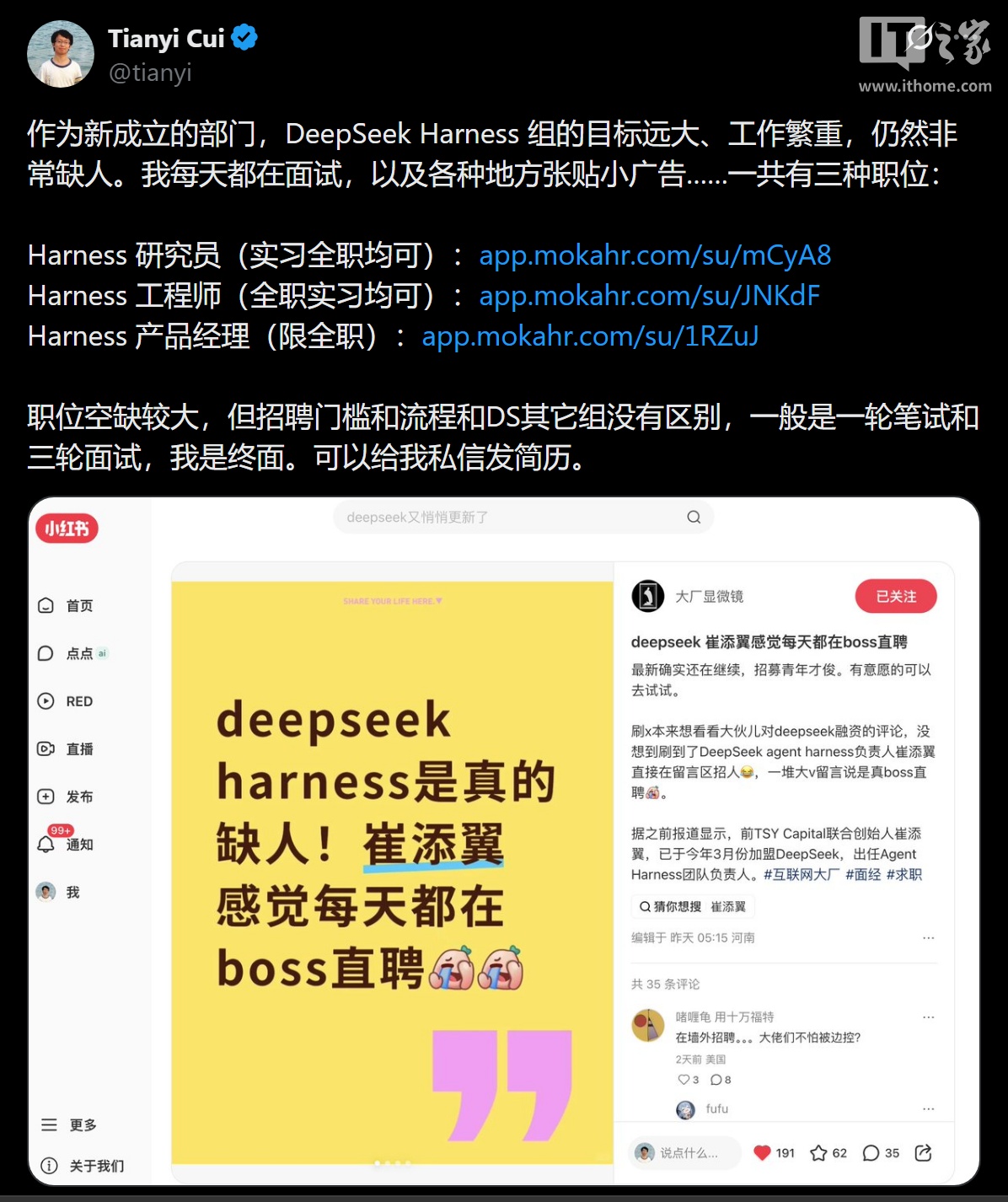
The “no foreigners” accusation surfaced in the comments of Cui’s hiring announcement. His reply was direct: “Just as US companies in the same field require employees to be able to use English for work, this company requires employees to be able to use Chinese for work. There is no rule against hiring foreigners.”

DeepSeek has been rapidly expanding its product ecosystem beyond foundation models. The Harness team represents a significant push into the developer tools space, aiming to compete with established code agents like Claude Code. The company’s aggressive talent search underscores the intensifying AI talent war in China, where firms are scrambling to build practical applications on top of large language models.
The clarification also touches on a broader conversation about workplace language requirements in global tech. While English remains the dominant language of international software development, DeepSeek’s stance reflects a pragmatic reality for China-based operations where internal documentation, meetings, and code reviews are conducted in Chinese — making language proficiency a legitimate job requirement rather than a nationality filter.