Epic's Tim Sweeney Hints AI Could Save Destiny by Slashing Content Costs
Tim Sweeney has a reputation for saying what he thinks. The Epic Games CEO’s latest target? The economics of live-service games — and he thinks AI might be the answer nobody’s talking about.
In a reply to a Forbes report that broke down Destiny’s persistent profitability problems, Sweeney was characteristically blunt. “If only some novel new technology could emerge to solve problem number one, allowing games like Destiny to keep evolving,” he wrote.
For context, that was sarcasm.
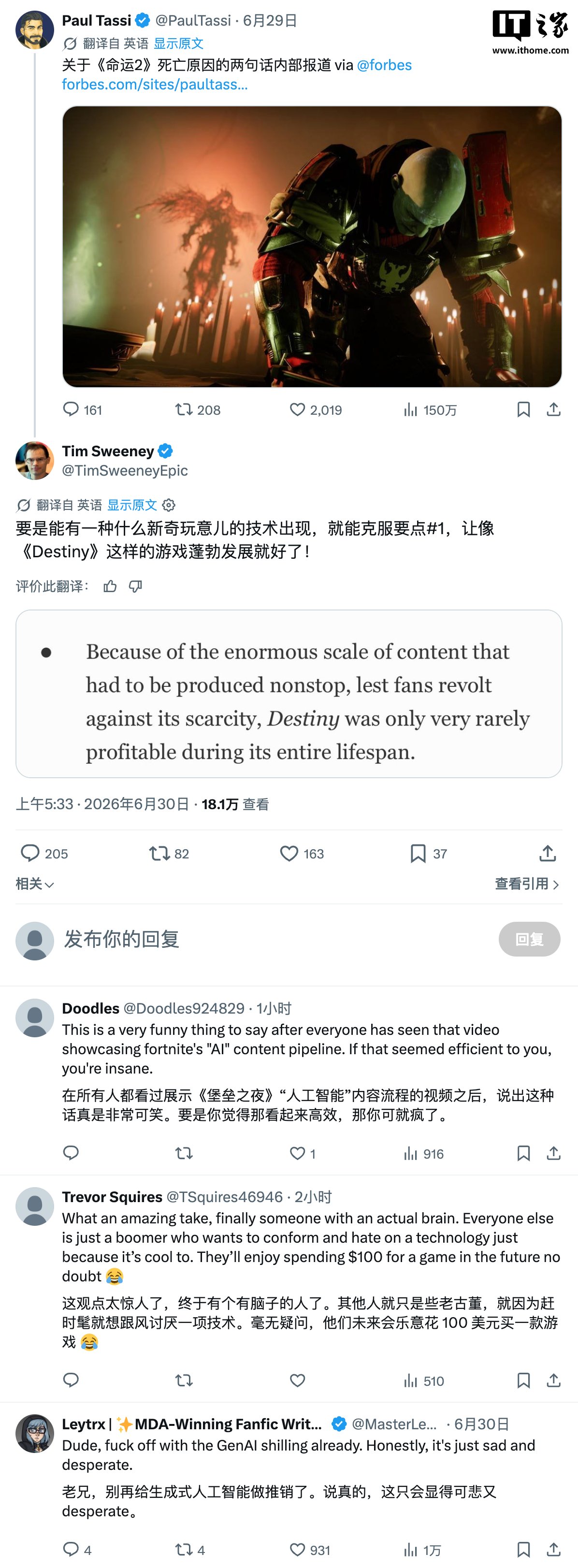
The Forbes piece Sweeney responded to laid out a straightforward problem: Destiny demands a relentless pipeline of new content — expansions, seasons, events, gear, raids — and that costs more money to produce than the game makes back most of the time. The report claimed Destiny has been profitable only during brief windows across its entire lifecycle, making it a poster child for the unsustainable cost structure of live-service games.
Sweeney’s point, though delivered with a smirk, is real. AI tools that can automate parts of content generation — texture work and quest scripting — could fundamentally change the math. If studios can produce the same volume of content at a fraction of the cost, games like Destiny that depend on constant updates suddenly look viable again.
This isn’t the first time Sweeney has waded into the AI-in-gaming debate. Earlier this year, he publicly criticized Steam’s requirement that developers disclose AI usage in their games, calling the policy “grossly irresponsible.” In June, Epic announced that Unreal Engine 6 would ship with built-in AI tools designed to “dramatically reduce” the repetitive grunt work in game development.
But Sweeney conveniently sidestepped the other reason Destiny is in trouble. Forbes also reported that Destiny was, at one point, genuinely profitable — but the money was quickly squandered by the very people running the studio. In August 2024, a group of former Bungie employees called for then-CEO Pete Parsons to resign, accusing him of being a liar and a thief, along with other accusations they said they couldn’t discuss publicly.
AI can’t fix mismanagement. No amount of procedural generation or automated asset pipelines will help if the people in charge run the business into the ground. Sweeney’s optimistic framing skips over that messier, more human part of the story.
Then again, Sweeney has never shied away from picking fights. In March 2024, internal emails surfaced as part of an antitrust lawsuit against Valve, in which Sweeney referred to Valve executives as “a bunch of assholes.” He’s not a CEO who minces words — which is exactly why his AI-as-salvation pitch for Destiny is worth paying attention to, even if it’s only half the story.