Hubble Telescope Detects Ultraviolet Light from Galaxy Just 1.4 Billion Years After the Big Bang
NASA announced on June 23 that astronomers using the Hubble Space Telescope have successfully detected ultraviolet light originating from a galaxy that existed a mere 1.4 billion years after the Big Bang. The discovery marks a significant breakthrough in observational cosmology, piercing a veil that researchers long believed to be impenetrable.
The ultraviolet light in question was emitted near the end of the so-called Reionization Era — a pivotal chapter in cosmic history when the universe transitioned from a neutral, opaque state to an ionized and increasingly transparent one. During this period, interstellar space was dominated by neutral hydrogen, which acted as a dense fog that absorbed ultraviolet radiation and rendered it invisible to any observer. The fact that Hubble has now captured such light means it successfully escaped the galaxy’s immediate surroundings and traveled across more than 12 billion years of cosmic expansion before reaching Earth’s vicinity.
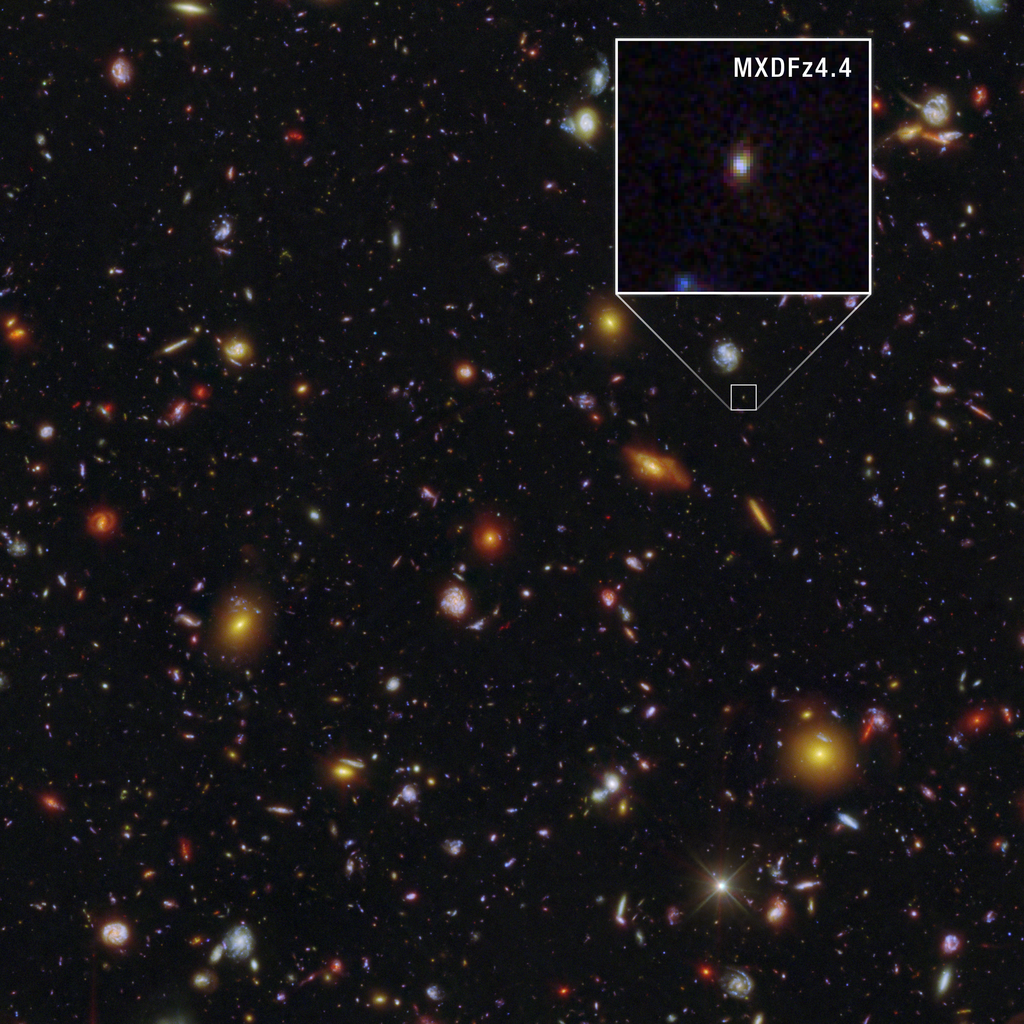
Ilias Goovaerts, the study’s lead author and a postdoctoral researcher at the Space Telescope Science Institute in Baltimore, described the finding as a challenge to prior consensus. According to the prevailing view among astronomers, the neutral hydrogen fog of the early universe was simply too thick to allow ionizing radiation from such distant galaxies to be observed.
The galaxy in question, designated MXDFz4.4, is a compact powerhouse. The research team estimates it spans roughly one-hundredth the area of our own Milky Way galaxy, yet it churns out new stars at a rate approximately ten times higher. This extreme density of young, massive stars appears to be the key: in a smaller galaxy, stars are packed more tightly together, and the combined force of their radiation can carve channels through the surrounding gas that would otherwise trap the light. The team further estimates that between 50 and 100 percent of the high-energy ionizing light produced by the galaxy’s young stars is escaping into intergalactic space.
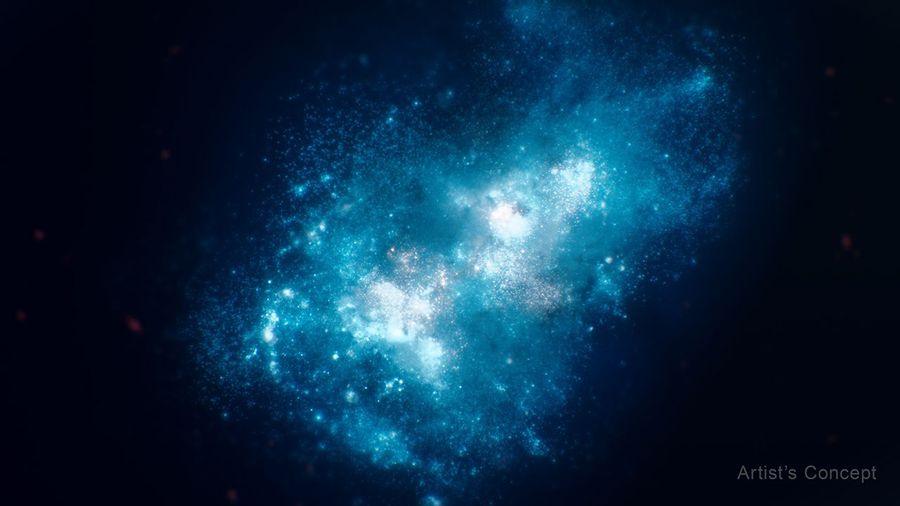
Because the ultraviolet radiation has been stretched into the visible light spectrum over the course of more than 12 billion years of cosmic expansion — a phenomenon known as redshift — Hubble’s specific wavelength coverage and its space-based resolution make it uniquely capable of capturing this ancient signal. No other active observatory currently possesses the right combination of capabilities to peer this deeply into the universe’s adolescent years and detect the faint glow of escaping ionizing radiation.