Lenovo Warns DRAM Prices May Never Return to Pre-Surge Levels, Even with Massive Capacity Expansion
At the ISC 2026 conference in Hamburg, Lenovo delivered a sobering forecast for anyone hoping memory prices will eventually crater: they probably won’t. Even if the industry’s largest manufacturers embark on aggressive capacity expansion over the next decade, DRAM and NAND flash pricing is unlikely to revisit the lows seen just a year ago, the company told attendees.
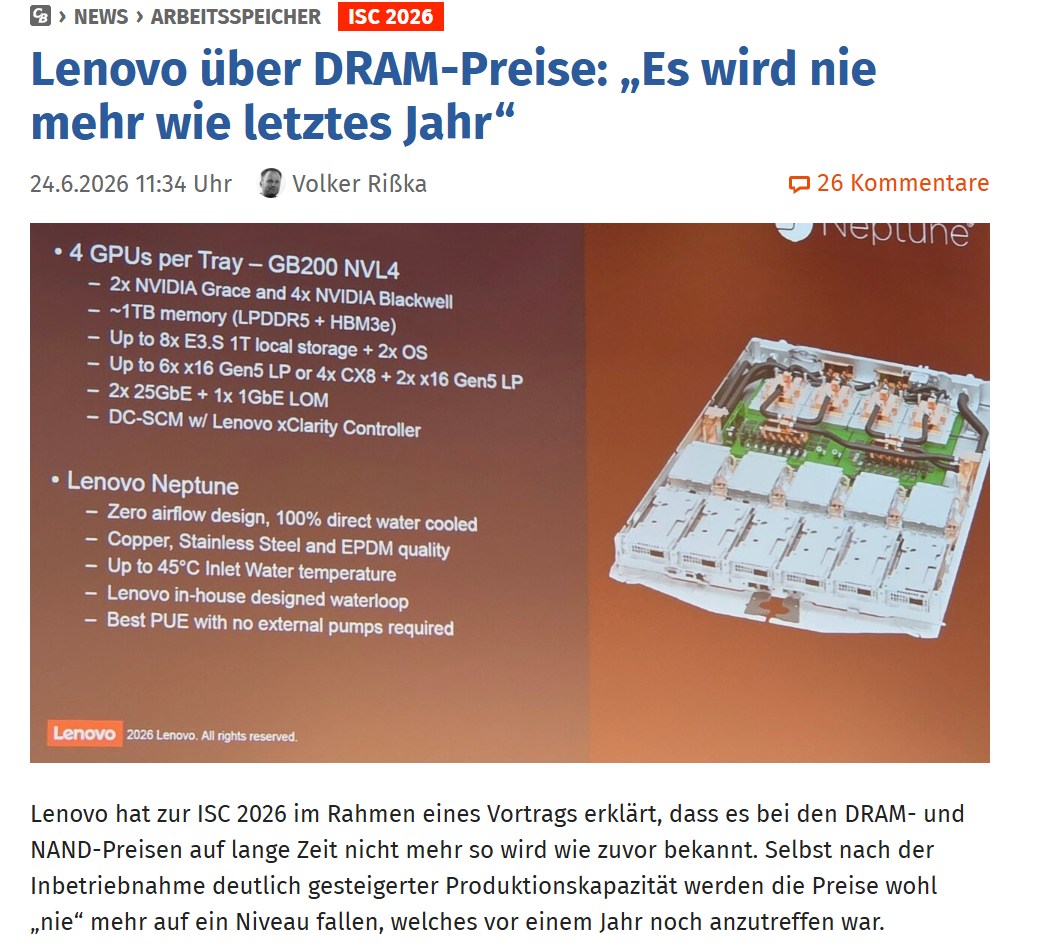
Lenovo’s outlook aligns with the direction major memory makers are already taking. SK Hynix, for instance, recently announced plans to triple its production capacity by 2034 — a move that signals the Korean giant sees sustained, long-term demand rather than a looming glut. The implication is clear: the industry is betting that even after 2030, memory-hungry workloads will keep supply tight enough to support structurally higher prices.
The “RAMageddon” Era
Lenovo used its ISC 2026 platform to drive home an urgent message for server architects: the industry is entering what the company calls the “RAMageddon” era. In this new landscape, designing servers with generous memory headroom isn’t just a competitive advantage — it’s a necessity.
Historically, server vendors have marketed “maximum memory capacity” as a headline specification to differentiate their platforms. But Lenovo argues that era is effectively over. Many of today’s platforms simply cannot afford to populate all available DIMM slots at current pricing, and the economics are forcing a rethink of how compute and memory are balanced.
In some configurations, Lenovo noted, pairing a system with a GPU accelerator can actually deliver better price-to-performance than simply loading up on CPU-attached memory — a counterintuitive shift that would have been unthinkable just a few years ago.
16-Channel Memory Servers Arriving This Summer
The conversation around memory capacity is about to get more urgent. Lenovo confirmed that a new generation of servers featuring 16 memory channels per socket will begin rolling out this summer. While these platforms promise significantly higher bandwidth and capacity ceilings, they will only deliver their full potential when adequately populated — a proposition that, given the current pricing environment, will demand careful planning from IT procurement teams.
The bottom line from ISC 2026: cheap memory may not be coming back, and the data center of the near future will need to be designed accordingly.