Museum Pulls '1980s Photos' After Visitors Spot AI Tell: Blurry Text
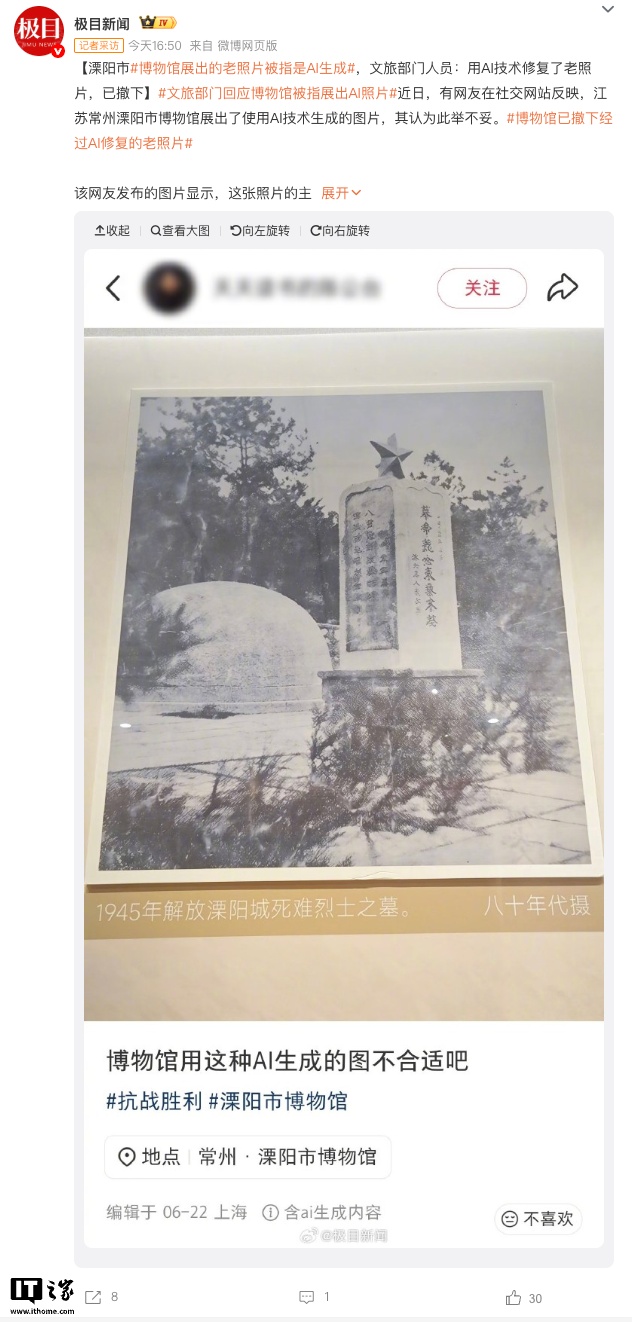
When visitors walked into the Liyang Museum in Jiangsu province this spring, they found a photography exhibition that seemed straightforward — old photos from the 1980s, capturing a rapidly changing Chinese city. Zoom in on any stone inscription, and the text was a jumbled, illegible mess. Classic AI fingerprint.
The museum pulled the photos within hours of the posts going viral. The images were not from the 1980s. They were AI-restored versions of blurry originals.
The exhibition, “Home in Time — Liyang’s Urban-Rural Transformation Through Workers’ Memories,” opened May 1 at the Liyang Museum. Organized by the Liyang Federation of Trade Unions, it drew from old photographs of the city’s industrial and urban development over several decades. The goal was to document how the city changed — factory buildings replaced by shopping centers, dirt roads paved into highways.
But eagle-eyed visitors noticed something strange. The photos were unusually sharp for 1980s documentary photography, yet the text on stone monuments and building signs was distorted, smeared, and unreadable. That is a well-known artifact of AI image models, which handle text poorly — especially complex scripts like Chinese characters.
The Liyang Culture, Radio, Television and Tourism Bureau confirmed the problem. The original photos were too blurry for display, so the union used AI to “restore” them. The AI sharpened faces and buildings but mangled the text. The photos have since been removed from the exhibition.
What matters here is not a small museum’s mistake. It is how fast the public caught it. Chinese netizens have become increasingly skilled at spotting AI artifacts — distorted text, unnatural lighting, impossible geometry. Where a museum curator saw “restoration,” the audience saw fabrication.
The incident also points to a broader tension in cultural heritage work: when does AI restoration cross into AI generation? Restoring faded color, removing scratches, and upscaling low resolution are widely accepted. But AI systems do not just repair images. They invent details. Every pixel that did not exist in the original is, technically, a hallucination.
| Restoration technique | What it does | Where the line blurs |
|---|---|---|
| Colorization | Adds plausible color to B&W images | AI chooses hues from training data, not the original |
| Super-resolution | Upscales low-res images | AI fills in facial features and textures that may not match reality |
| Text repair | Reconstructs unreadable inscriptions | AI often generates gibberish or wrong characters |
| Scratch removal | Erases physical film damage | Can accidentally remove details the photographer intentionally kept |
The Liyang case is not isolated. Museums worldwide are experimenting with AI tools to digitize and restore historical photographs, with mixed results. The Metropolitan Museum of Art marks AI-restored images clearly, distinguishing between “restored” and “original” versions. The Liyang Museum labeled AI-restored images as “taken in the 1980s” — technically accurate for the originals but misleading for what was actually on display.
The museum promised to strengthen content review for future exhibitions and flagged the need for better cross-department coordination. For the public, the incident is a practical lesson in media literacy. AI-enhanced images now look good enough to fool most people at a glance. The tells are there. You just have to know where to look.