A new method cuts platinum catalyst production from hours to minutes
Hydrogen fuel cells are a clean-energy cornerstone, but they rely on platinum — expensive, scarce, and notoriously hard to work with at the atomic scale. The conventional way to make platinum catalysts is slow and wasteful: hours of heating, multiple processing steps, and a lot of energy spent on things you don’t actually need. A team at Tianjin University just published a fix in Science that sounds almost too simple.
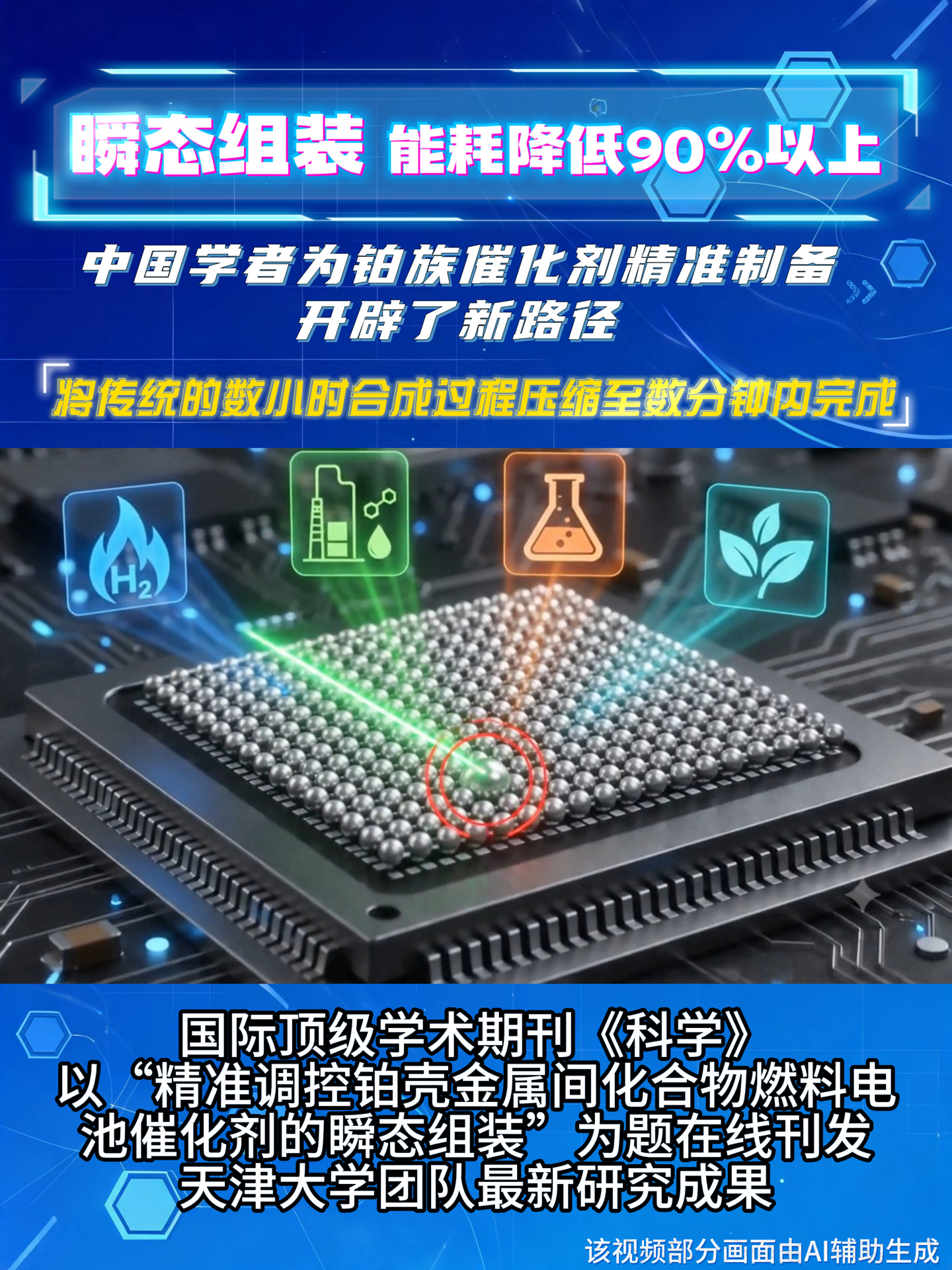
Their innovation is called “transient assembly.” Instead of slowly coaxing platinum atoms into position over hours at high temperatures, they hit the raw materials with millisecond-scale heat pulses — think of it as controlled bursts rather than a long simmer. This rapid-fire approach forces the atoms into a core-shell structure in minutes, with the platinum shell exactly three atomic layers thick. That precision matters: too thin and the catalyst degrades; too thick and you’re wasting precious metal.
The numbers are striking. The new method cuts synthesis time from hours to minutes and reduces energy consumption by 90 percent. In testing, the resulting catalysts delivered 15.2 kilowatts per gram of platinum in hydrogen fuel cells — a strong benchmark for real-world viability — while maintaining good durability over repeated cycles.
The core-shell architecture is the key. By wrapping a non-precious metal core in exactly the right number of platinum layers, the interface between the two metals creates lattice strain and ligand effects that supercharge catalytic activity. Traditional synthesis methods can’t achieve that level of control reliably because they rely on slow thermodynamic equilibrium shifts that are inherently imprecise. The Tianjin team’s millisecond pulse technique sidesteps that limitation entirely by operating in a non-equilibrium regime — a fundamentally different approach to how these structures form.
The paper, titled “Precisely controlled transient assembly of platinum-shell intermetallic fuel cell catalysts,” was published online in Science on July 11.
What makes this more than a lab curiosity is that it addresses a real bottleneck. Platinum group metals are essential not just for fuel cells but for chemical refining, emissions control, and green hydrogen production. Anything that makes them cheaper and easier to deploy has knock-on effects across clean energy and industrial chemistry. Cutting energy use by 90 percent while also cutting production time from hours to minutes moves the economics in the right direction — and that’s the kind of progress that matters outside the lab.