Inside the UK's £750 Million Supercomputer That Will Simulate Quantum Physics and Earthquakes
There aren’t many places on Earth where you’ll find a particle physics simulation running steps away from the lab where scientists once cloned a sheep. But that’s exactly the kind of collision of eras happening in Midlothian, Scotland, where the UK has quietly started building what will become its most powerful computer ever.
The British government has committed £750 million (about $950 million USD) to the project, which broke ground this week at the University of Edinburgh’s campus near the Roslin Institute — the same facility where Dolly the sheep was born in 1996. The supercomputer is scheduled to go live by the end of next year.
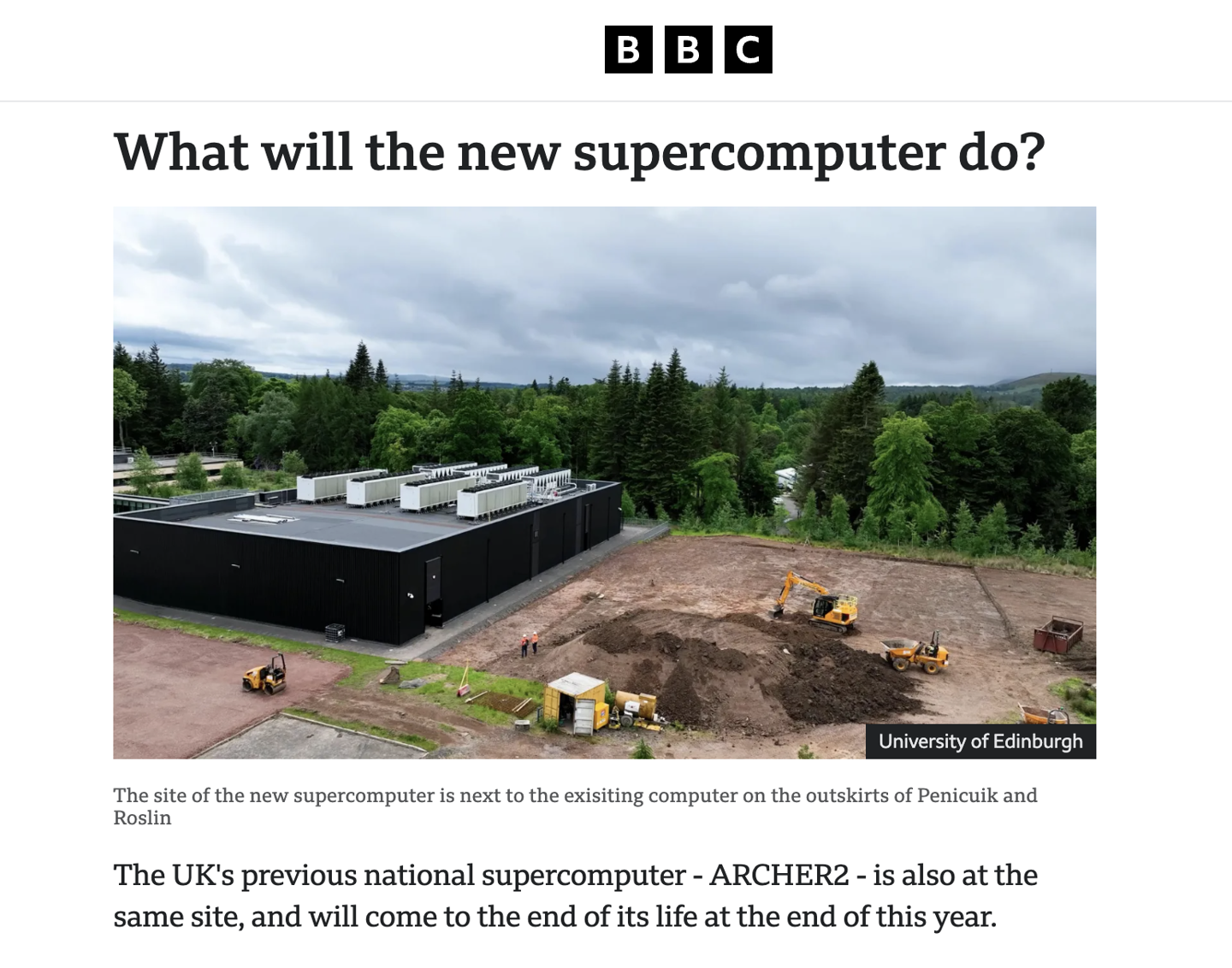
Mark Parsons, the professor leading the project at Edinburgh, describes the machine as roughly the size of a medium supermarket. It will house thousands of processors and is designed to hit a performance target of one exaflop — a billion billion calculations per second, or 10^18 operations.
The real story is what researchers plan to do with that kind of horsepower. Parsons said the computer will help scientists “simulate the world around us” by building models of phenomena that can’t easily be reproduced in a lab. That includes quantum processes that happen too fast to observe directly, earthquakes that unfold on too large a scale to control for, and cosmic events like the expansion of the universe that take billions of years.
The machine’s applications span quantum computing research, climate change modeling, and industrial simulations. Its waste heat — a natural byproduct of running thousands of processors at full tilt — won’t go to waste either. It will be piped into Edinburgh’s campus heating system, with plans to eventually extend that heat to nearby homes.
The project’s path to shovels in the ground was anything but smooth. It was initially approved under the previous Conservative government, but after Labour won the general election in 2024, the funding was paused in August of that year. It took until June 2025 for the new administration to give the green light and restore the budget. Construction is now underway, with completion expected by late 2027.