America's yellow school buses are spending summer as mobile power banks for the grid
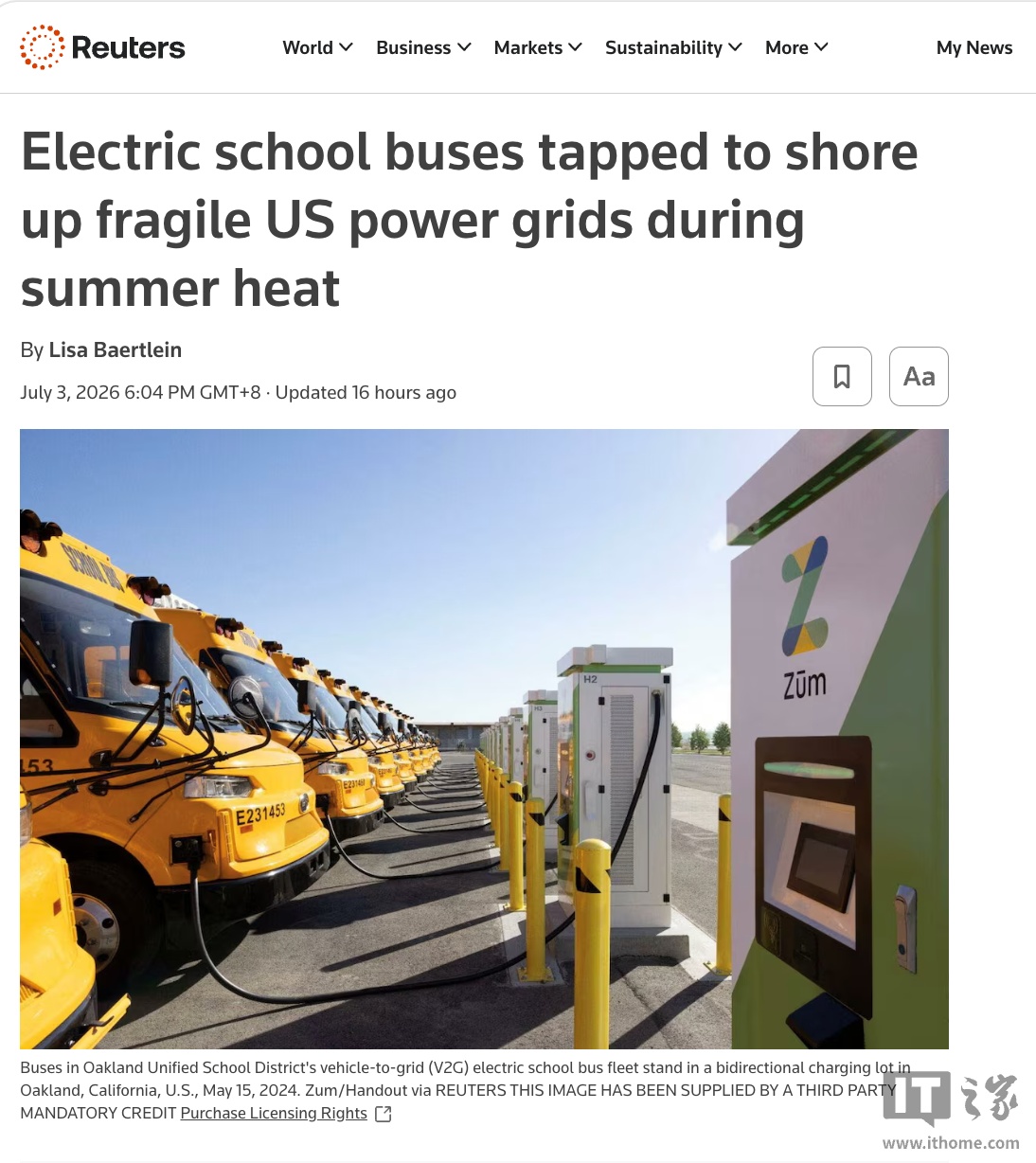
Summer break means empty school buses parked in lots across America. But a growing fleet of electric models isn’t sitting idle — it’s selling power back to the grid.
From California to North Carolina, yellow electric school buses have started discharging their batteries during heat waves, sending electricity to a strained grid when demand peaks. Hundreds more are expected to come online in the coming months.
The mechanism is vehicle-to-grid (V2G) technology, which lets EV batteries push power in both directions. During off-peak hours, the buses charge. When the afternoon sun pushes air conditioners into overdrive, they feed energy back.
Data from the World Resources Institute’s electric school bus initiative shows roughly 230 out of the roughly 6,700 electric school buses operating nationwide are enrolled in active V2G programs. Together, they can deliver up to 8 megawatt-hours of electricity at any given time.
That sounds like a lot until you look at what the grid actually needs. The PJM Interconnection (America’s largest regional grid, serving 67 million people) has required over 160,000 megawatts this week alone as most of the country endures record-breaking temperatures. Eight megawatt-hours from school buses won’t solve that gap. But the trend suggests the potential is real.
Steve Letendre, a senior advisor to the national Vehicle-Grid Integration Council, put it plainly: “V2G is still in a very early stage, but school buses will become a critical pillar of this system.”
The math works because school buses carry unusually large batteries — some models exceed 200 kWh, roughly four times what a typical passenger EV packs. Summer is when school buses sit unused, which is also when electricity demand peaks. The timing is almost too convenient.
At least 31 utility companies across 21 states are already involved in school bus V2G programs, according to the World Resources Institute.
Over the next few years, America’s electric school bus fleet is expected to more than double to around 14,600 vehicles — about 3% of all school buses. Most of those new additions are expected to include V2G capability.
Still, the total capacity from school buses needs to grow substantially before it meaningfully shifts the supply-demand balance. Consulting firm ICF estimates the US grid will need an additional 445,000 megawatts of capacity by 2030, driven largely by the rapid expansion of data centers.
V2G adoption faces real headwinds. Upfront costs are high. Technical standards are fragmented. Regulatory frameworks and industry guidelines could take years to settle. Owners and operators worry that frequent charge-discharge cycles will accelerate battery degradation — or even void warranties.
Critics of vehicle electrification and public funding for alternative energy projects argue that mass charging could strain the grid further rather than relieve it. Some schools have addressed this by pairing their bus fleets with solar arrays, charging from rooftop panels instead of pulling from the grid at all.
None of this means the school bus V2G model doesn’t work. It means it’s early, small-scale, and still finding its footing. But for a few hundred communities this summer, those yellow buses are doing more than sitting in a lot — they’re keeping lights on and air conditioners running.