Xiaomi YU7 GT Sets World's First Autonomous Driving Lap Record at Nürburgring
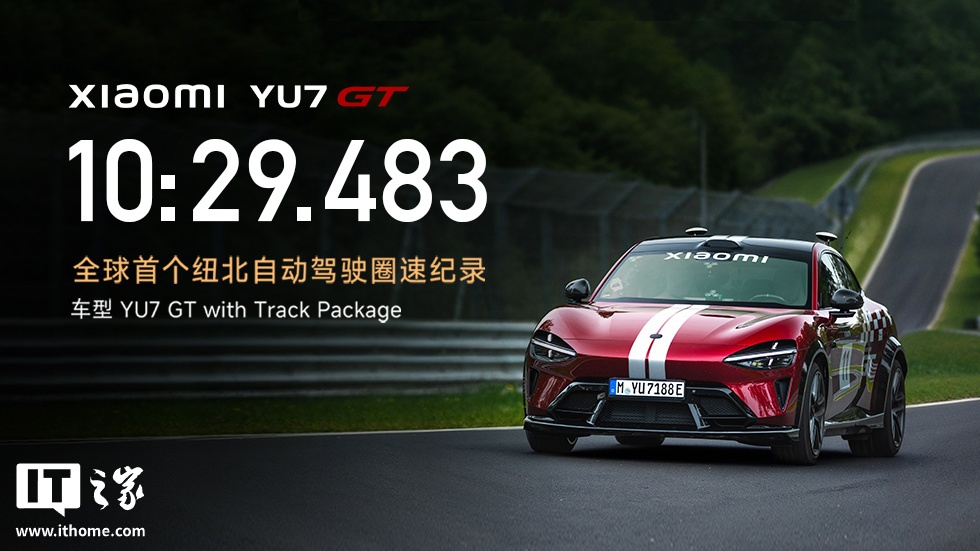
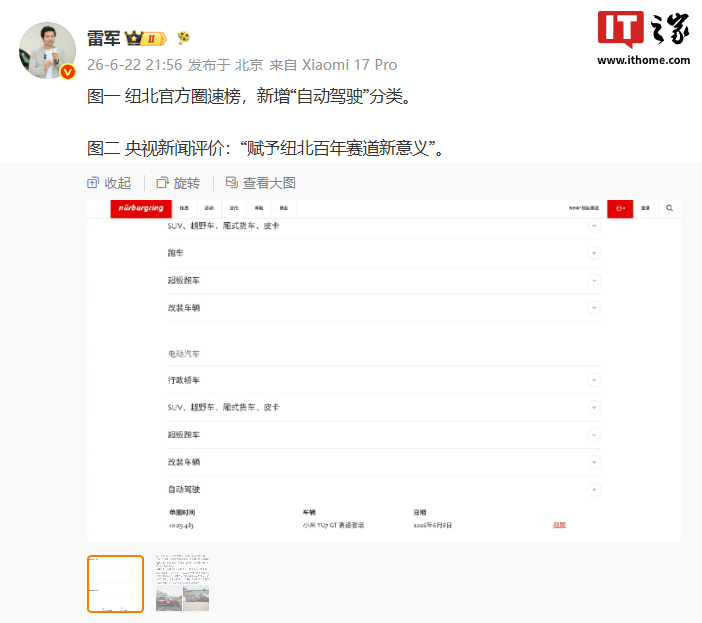
Xiaomi Auto has officially announced that its YU7 GT has become the first vehicle in history to complete a fully autonomous timed lap of the Nürburgring Nordschleife, posting a time of 10 minutes 29.483 seconds. The achievement marks a significant milestone for both the Chinese automaker and the legendary German track, which has responded by adding a dedicated “Autonomous Driving” category to its official lap time leaderboard for the first time.
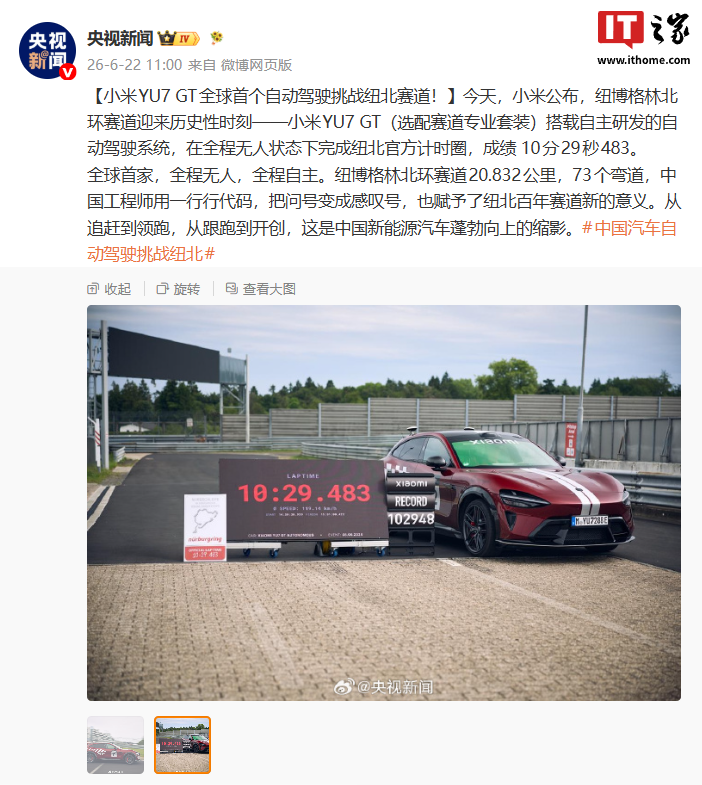
Lei Jun, founder, chairman, and CEO of Xiaomi, shared the news on social media, noting that the track’s decision to create a new classification specifically for autonomous vehicles represents a quiet but meaningful shift in how the motorsport world views self-driving technology. The event was also covered by CCTV News, which framed the milestone as emblematic of China’s new energy vehicle sector transitioning “from catching up to leading, and from following to pioneering.”
The record-setting run was completed by a YU7 GT equipped with the optional Track Professional Package and powered entirely by Xiaomi’s in-house autonomous driving system. The vehicle navigated all 20.832 kilometers and 73 corners of the Green Hell in a fully driverless state — no safety driver, no remote intervention. As Xiaomi put it, Chinese engineers turned “question marks into exclamation marks, one line of code at a time.”
In a statement explaining the motivation behind the challenge, Xiaomi Auto emphasized that the endeavor was never about publicity alone. The dynamic vehicle models, high-frequency torque distribution algorithms, and millisecond-level recovery capabilities developed and stress-tested on the extreme track environment will be progressively rolled out to consumer production vehicles through over-the-air updates.
The company’s ultimate ambition is for everyday drivers to benefit from what amounts to a “phantom professional racing driver” embedded in the vehicle’s chassis and intelligent driving systems. In extreme real-world scenarios — hydroplaning on flooded highways, losing traction on black ice — the system is designed to make split-second corrective decisions that pull the vehicle back into a controllable state before the human driver even registers the danger.
The Nürburgring’s decision to formalize an autonomous driving category on its official leaderboard is itself a telling development. For a track synonymous with raw human skill and mechanical limits, the addition signals that the institution sees autonomous performance not as a gimmick, but as a legitimate technical discipline — and one worth benchmarking.
Xiaomi’s entry into this space adds a compelling new dimension to the company’s automotive ambitions. Barely two years into its automotive journey, the brand has now claimed a world-first on one of motorsport’s most hallowed proving grounds, while simultaneously building a pipeline to funnel that extreme-condition learning directly into the software that will run on customer cars.