360 Unveils 'Heavenly Sword and Dragon Saber' AI Security Duo to Rival Anthropic's Mythos
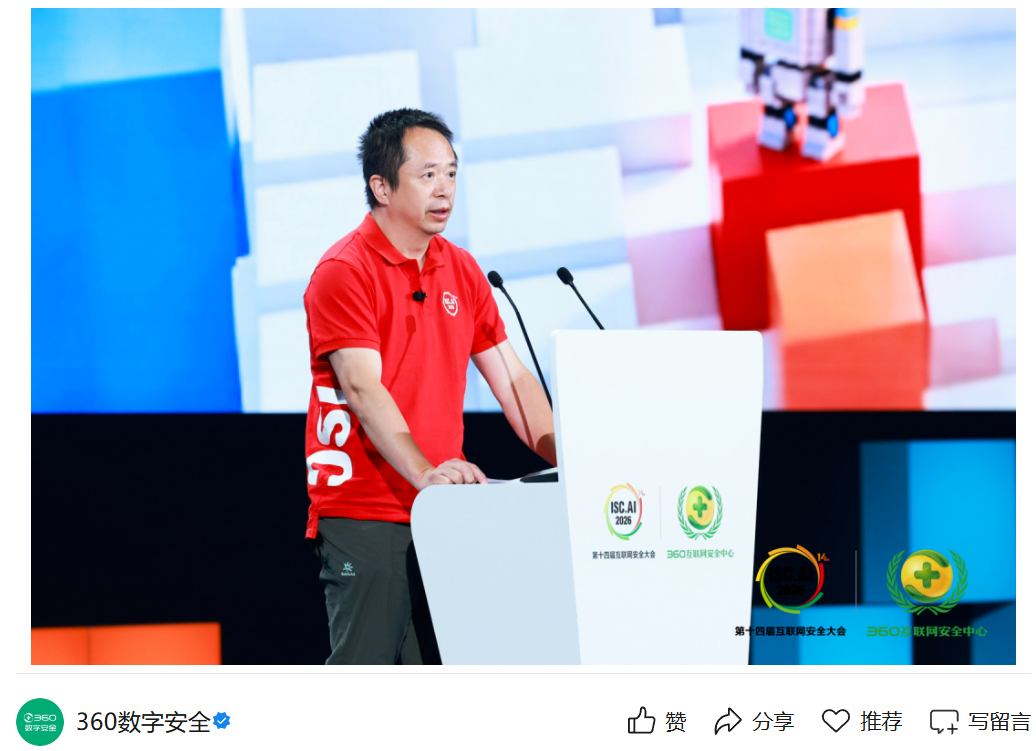
At the ISC.AI 2026 conference in Beijing, 360 founder Zhou Hongyi unveiled the company’s two-pronged AI security strategy — an automated vulnerability discovery agent codenamed “Tulong Feng” and an autonomous defense system called “Yitian Array” — positioning them as China’s direct response to Anthropic’s restricted Mythos model.
The announcement comes against a backdrop of heightened concern over AI-driven cyber threats. Anthropic’s Mythos, which demonstrated the ability to autonomously discover vulnerabilities, analyze exploit chains, and even construct attack weapons, was recently barred by the US government from access by any foreign nationals — a move Zhou characterized as treating the model as “a cyber nuclear weapon” and a new form of strategic deterrence.
The Four Disruptions
Zhou laid out four fundamental shifts that AI-powered vulnerability discovery brings. First, speed: where discovering a high-value vulnerability once took months or years, Mythos-class AI can find decades-old flaws in under 24 hours, compressing the defense window from weeks to hours. Second, volume: AI can perform 24/7 code analysis at scale, surfacing vast numbers of previously hidden vulnerabilities across open-source and supply-chain software. Third, cost collapse: the estimated compute cost to find a high-value vulnerability drops to roughly $1,000, compared with the six-to-seven-figure sums previously required from specialized teams. Fourth, democratization of attack capability: AI can distill expert hacker knowledge into replicable agents, making sophisticated attack chains available to actors who would never have possessed them before.
The compounding effect, Zhou warned, is that China faces a “second era of one-way transparency” — not the old problem of unseen adversaries, but one where “the enemy is faster and more numerous.” Traditional defenses built on stacking hardware and software may no longer hold.
China’s Own Mythos, Built Differently
Rather than competing head-on with US-level model capabilities and compute — where Zhou acknowledged a 20-30% gap — 360 is pursuing an agent-based engineering path. “Tulong Feng” (屠龙锋, literally “Dragon-Slaying Blade”) is the vulnerability-discovery agent that has already uncovered 3,432 vulnerabilities, with 105 confirmed by regulators and multiple classified as high-risk by China’s national vulnerability database. It spans open-source code, operating systems, office software, and AI agent platforms.
Zhou emphasized three differentiators: real-world attack-and-defense experience from 360’s 20-year security history (including record bug bounties from Apple, Microsoft, and Google); an agent platform that equips large models with tool-use and execution capabilities rather than just reasoning; and a “multi-agent swarm” approach that distributes vulnerability hunting across specialized collaborative agents — performing threat modeling, cross-file dataflow analysis, and automated exploit verification in sandbox environments.
The companion system, “Yitian Array” (仪天阵), targets the defense side. It autonomously plans tasks, triages alerts, and orchestrates responses within live network environments, aiming to move security operations from manual, human-dependent workflows toward what 360 calls an “autopilot” model.
Rock Shield Coalition
Alongside the technical unveilings, 360 launched the “Rock Shield” (磐石之盾) security collaboration initiative, bringing together domestic chipmakers (Phytium, Hygon), OS vendors (Kylin, UnionTech), database, and cloud computing partners. The coalition mirrors — in a limited, domestic scope — the US-led Glasswing alliance through which Anthropic is offering up to $100 million in Mythos access to allied critical infrastructure operators. Zhou stressed that the initial rollout of “Heavenly Sword and Dragon Saber” capabilities will be restricted to trusted domestic infrastructure partners.
“The AI security race has only just begun,” Zhou concluded. “China has not been absent from it, and cannot afford to be.”