Baidu's M100 AI Chip Makes Its Physical Debut at WAIC 2026
Baidu’s AI chip subsidiary Kunlunxin showed the physical M100 processor in public for the first time this week at the 2026 World Artificial Intelligence Conference in Shanghai, giving the industry its first real look at the fourth-generation chip that the company has been quietly designing for the AI inference market.
The M100 is built on Kunlunxin’s self-developed XPU architecture and targets large language model inference workloads. The company describes it as a general-purpose chip that delivers strong performance without the premium price tag — a practical play for the wave of companies deploying generative AI where inference cost per token matters more than raw training throughput.

The chip made its first television appearance in a CCTV report on WAIC 2026, where cameras captured the processor on display alongside Kunlunxin’s broader product lineup. Beyond the chip itself, the company is showcasing accelerator cards, complete server nodes, and what it calls “supernode” clusters — 32-card, 64-card, and 256-card configurations that interconnect individual M100 chips into high-bandwidth compute pools for large-scale model serving.
Kunlunxin claims the 256-card supernode cluster is one of the first such products to reach mass production and customer delivery in China, positioning it ahead of domestic competitors in the race to deliver practical large-model infrastructure.
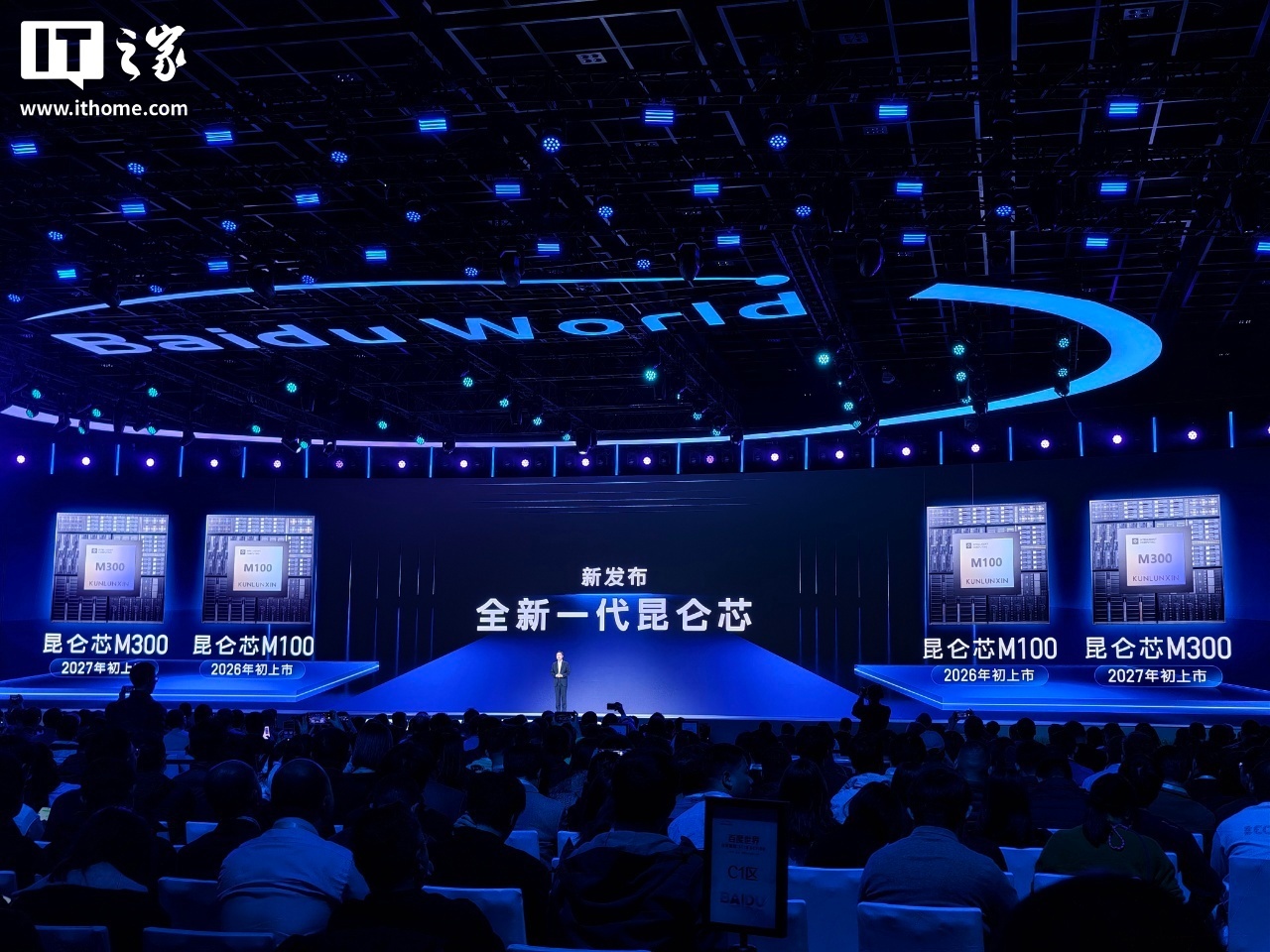
The M100 and its bigger sibling, the M300, were first announced in November 2025. At the time, Kunlunxin positioned the M100 as an inference-focused chip built for “extreme cost-performance” — targeting the wave of companies deploying generative AI applications where inference cost per token matters more than raw training throughput. The M300, by contrast, targets large-scale multimodal model training, pushing for maximum performance on the heaviest compute loads.
Kunlunxin started as Baidu’s internal chip design unit a decade ago before spinning out as an independent subsidiary. The company filed for a Hong Kong IPO earlier this year at a reported $50 billion valuation, and is now balancing its push into external chip sales with the compute demands of its former parent company.