A Potentially Habitable Planet Just 25 Light-Years Away
There are about 300,000 stars within 100 light-years of Earth. Most of them are probably hiding planets. The hard part is finding the ones that might actually support life.
A team of French astronomers has been tracking one intriguing candidate since last year. GJ 3378b, an exoplanet orbiting a red dwarf star in the constellation Camelopardalis, was first spotted in 2024 using the Canada–France–Hawaii Telescope. At the time, it looked like a big world — roughly 5.26 times the mass of Earth. But new observations have revised that number down sharply, and in doing so, they’ve turned it into something far more interesting.
The planet now clocks in at about 2.3 Earth masses. That’s a significant change. At 5 Earth masses, GJ 3378b was firmly in “mini-Neptune” territory — a gassy world with no solid surface and little chance of hosting life. At 2.3 Earth masses, it’s still toward the upper end of the rocky planet range, but it’s much closer to being a super-Earth, a class of planet that could theoretically have continents, oceans, and an atmosphere.
The orbit has been revised too. Earlier estimates put GJ 3378b’s orbital period at 25 days. The latest data says 21 days. That brings it closer to its host star, but not dangerously close. The red dwarf is much dimmer than the Sun, so the planet receives about 90 percent of the radiation Earth gets from the Sun. That puts it squarely inside the habitable zone — the region where temperatures could allow liquid water to exist on the surface, assuming the planet has an atmosphere to trap heat.
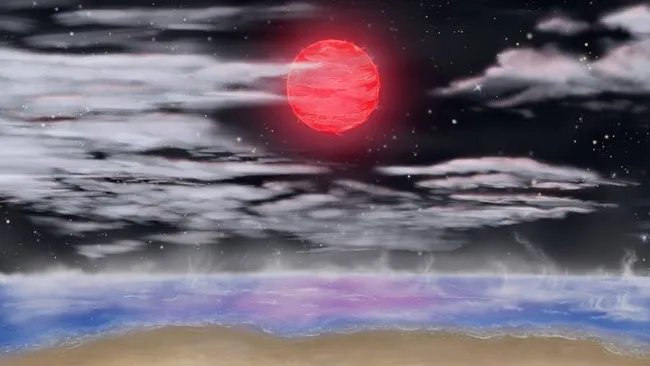
A lot remains unknown. The research team can measure the planet’s mass and orbit reasonably well, but they can’t yet tell us what the surface looks like. No one knows if there are oceans, clouds, or landmasses. Whether the planet even has an atmosphere at all is still an open question. Those answers will have to wait for the next generation of telescopes — the kind that can directly image exoplanets and analyze the chemical composition of their atmospheres.
Still, GJ 3378b is one of the closest potentially habitable exoplanets ever found. At 25 light-years, it’s close enough that future space telescopes could study it in detail. For comparison, the famous TRAPPIST-1 system is about 40 light-years away. This one is right in our galactic backyard.
The revised findings haven’t been published in a peer-reviewed journal yet, so the scientific community is watching closely. But if confirmed, GJ 3378b will join a short list of nearby worlds where the conditions for life — liquid water, rocky surface, temperate radiation levels — are at least plausible.