Thermaltake's Dr. Power III Pro Diagnoses Your GPU's 12VHPWR Connector for $50
There’s a quiet anxiety that comes with building a modern high-end PC. You route the chunky 12VHPWR cable to your RTX 5090, snap it in, and hope — really hope — it’s seated properly. That connector has been responsible for enough melted GPUs over the past few years that Thermaltake decided to build a tool for it.
The Dr. Power III Pro, launched Friday at $49.99, is a power supply tester designed specifically for ATX 3.1 power supplies. Its headline feature is the ability to read the sideband signals on the PCIe 12+4-pin connector — the SENSE0 and SENSE1 pins that tell the GPU how much power the PSU can deliver. If the PSU and GPU disagree on wattage, the result is instability at best and a melted connector at worst.
The device plugs into the 12+4-pin cable and reads those identification signals, letting you confirm before you button up your case that your power supply is correctly reporting its power tier to the graphics card. It’s a simple diagnostic check that most builders skip because there hasn’t been an easy way to verify it.
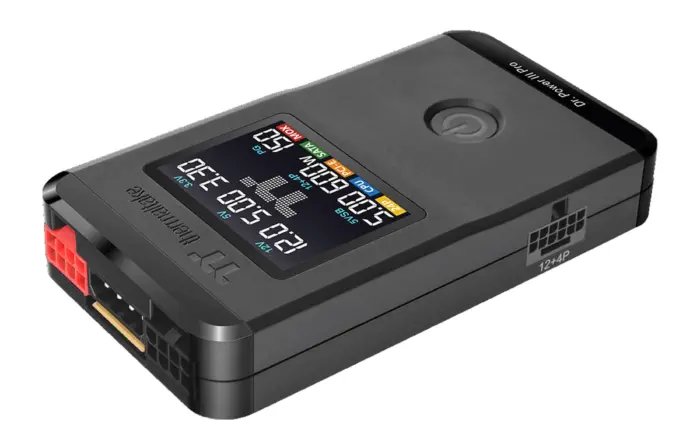
Thermaltake is careful to set expectations here. This is not a load tester — it won’t tell you if your PSU can actually deliver its rated wattage under stress. It’s a connectivity and signaling checker designed to catch the common mistakes: partial insertion, miswired cables, or a PSU incorrectly identifying its capability to the GPU.
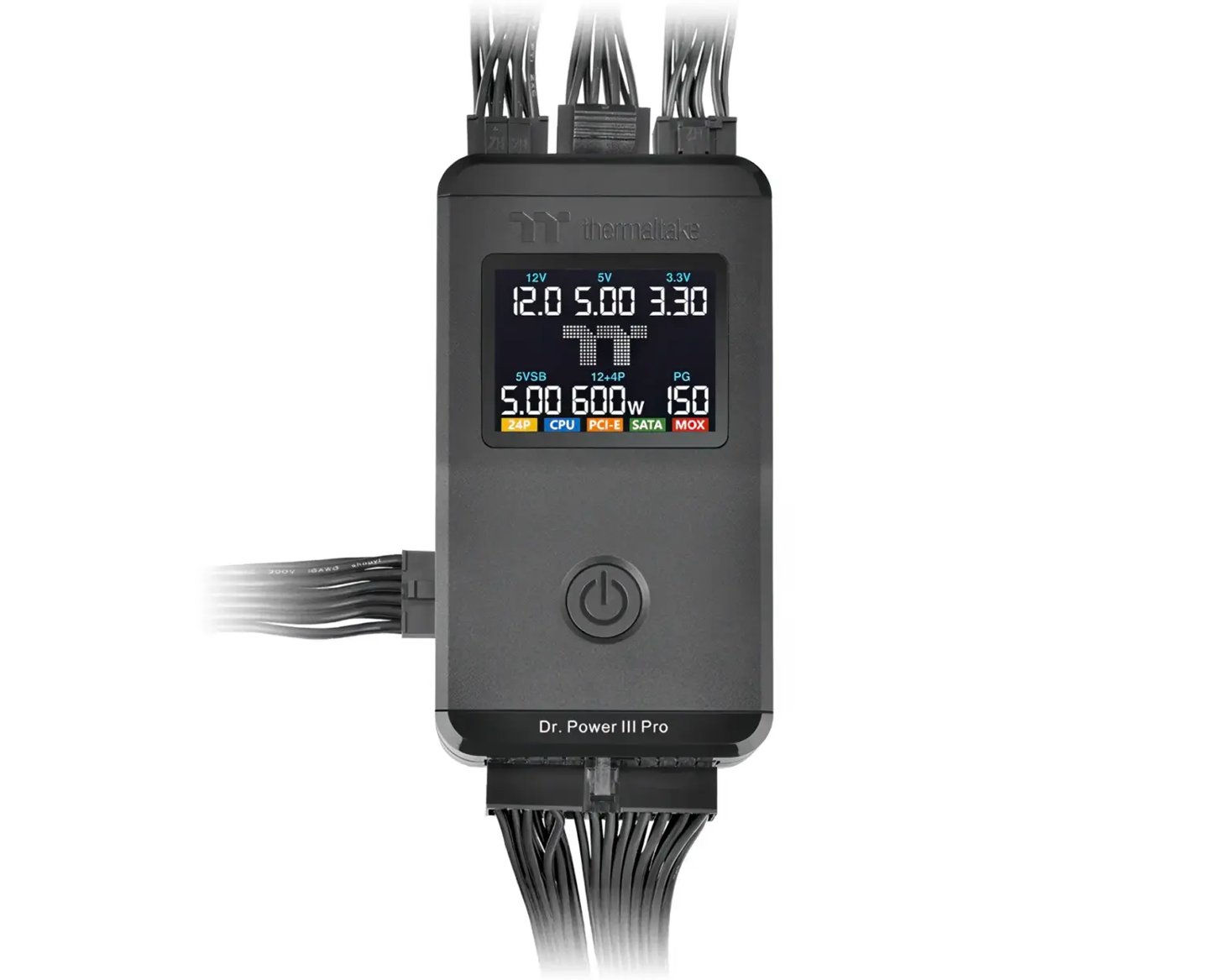
Beyond the 12VHPWR port, the Dr. Power III Pro handles the full range of PC power connections: the 24-pin ATX motherboard connector, 4-pin and 8-pin CPU power, 6-pin and 8-pin PCIe graphics, SATA, and legacy IDE (Molex). A color display on the front of the unit shows the voltage reading for each rail.
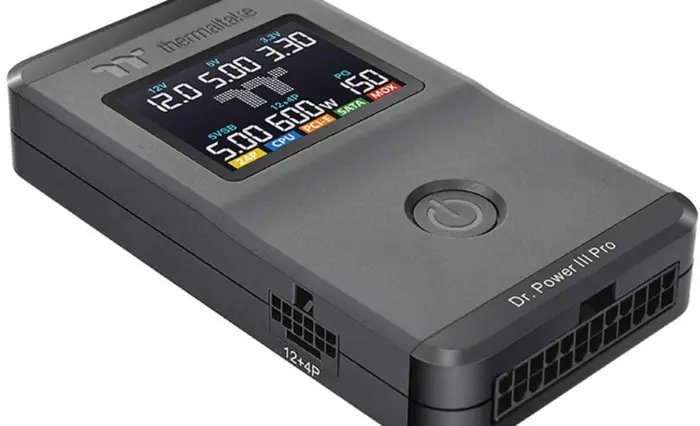
The tester operates in two modes. In manual mode, you select each connector individually. In automatic mode, it cycles through every connection sequentially. If anything is out of spec — voltage too low, a pin missing, a signal misread — the screen flashes red and the buzzer sounds.
At $49.99, it’s a specialized tool that most builders won’t need every day. But for anyone assembling a system with a high-wattage GPU — or troubleshooting an intermittent crash that could be power-related — it’s cheaper than replacing a melted card.