Linux Bumps RISC-V CPU Core Limit From 64 to 256 — Hardware Is Already Running Ahead
Linux’s default cap on how many CPU cores a RISC-V system can support just got a lot bigger — from 64 to 256 — and the change is already merged into the 7.2-rc2 tree.
The patch, submitted this week as part of a batch of RISC-V fixes, adjusts the NR_CPUS kernel configuration parameter. That parameter controls how much static memory the kernel allocates per core, so raising it isn’t free — every extra slot costs a little RAM. But the old limit of 64 simply wasn’t enough anymore.
The request came from SpacemiT, a Chinese RISC-V chip designer that’s already shipping an 80-core server chip compliant with the RVA23 standard. Even before that, the dual-socket “Pisces” server based on Sophgo’s SG2042 chip was running 128 cores. When hardware passes a kernel limit by a factor of two, someone has to turn the dial.
The developer who submitted the patch picked 256 because it’s “a power of two that is at least twice the known maximum core count” — meaning headroom for the next generation of chips without wasting memory on allocations that’ll never be used.
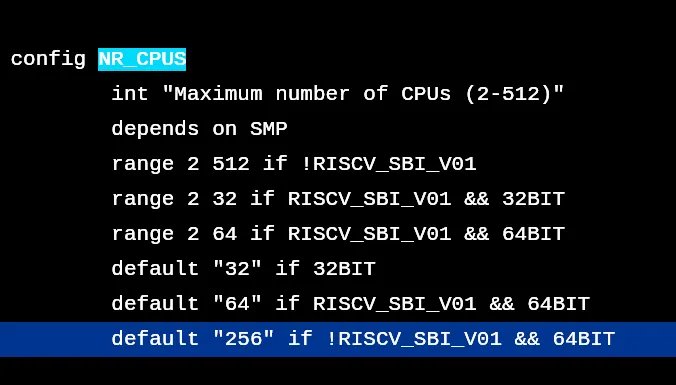
Ubuntu’s RISC-V builds have actually been running with NR_CPUS set to 512 for a while now. And engineers at the Institute of Software, Chinese Academy of Sciences (ISCAS) tested a 256-core configuration and reported “negligible performance impact with no adverse effects” — the memory overhead just doesn’t matter much at this scale.
Compared to other architectures, RISC-V’s new default is still conservative. On x86_64, enabling MAXSMP pushes NR_CPUS to 8,192 to handle AMD EPYC and Intel Xeon monsters. ARM64 defaults to 512, and Loongson’s LoongArch ships at 2,048. RISC-V is playing catch-up. A few years ago nobody would have asked for these numbers at all — the architecture sat entirely in embedded microcontrollers. Now it’s competing in server silicon.
Linus Torvalds himself accepted the patch after the merge window had technically closed, which signals he judged it low-risk and unlikely to cause regressions. That’s about as strong a stamp of approval as a kernel patch can get.
The change is a reminder that RISC-V isn’t just a hobby architecture anymore. When the kernel has to bump fundamental limits because real hardware is shipping with more cores than the software expected, the ecosystem has crossed a threshold.