NIO Day 2026 will be held in one of these three Chinese cities
NIO Day is the Chinese EV maker’s biggest event of the year, where it unveils new vehicles and technologies to thousands of owners and investors. Past editions have given us the ES8 SUV, the ET7 sedan, the ET9 flagship, and a self-driving chip called the Shenji NX9031. Now the company is choosing where to hold the next one.
Three cities made the cut: Harbin, Wuhan, and Xiamen. They emerged from a field of eight that included Changchun, Chongqing, Jinan, Nanjing, and Qingdao. All eight presented their bids on Saturday. The final decision will involve community voting, NIO said.
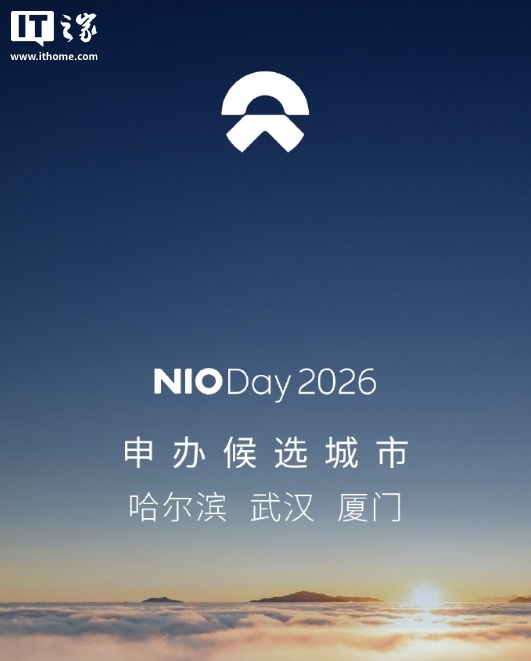
Harbin, in China’s far northeast, would be the coldest NIO Day venue by a wide margin — temperatures in December routinely hit minus 20 degrees Celsius. That could make for an interesting backdrop if NIO plans to showcase battery performance in extreme cold. Wuhan, the central Chinese megacity that was the epicenter of the early pandemic, has been aggressively recruiting tech investment and manufacturing. Xiamen, a coastal city in Fujian province known for its mild climate and livability, would be the smallest and most relaxed option.
NIO hasn’t announced a date or a program yet, but the event has historically landed in December or January. The main exception was 2025, when it shifted to fall for the first time, with the new ES8 launching in Hangzhou.
A look at what each NIO Day has brought so far tells you how fast the company has evolved:
2017 (Beijing). The first NIO Day. NIO revealed its debut production vehicle, the ES8 flagship SUV, along with the NIO Pilot driver-assistance system, the NOMI in-car AI, and the NIO Power battery-swapping network.
2018 (Shanghai). The ES6 mid-size SUV launched, plus a six-seat version of the ES8.
2019 (Shenzhen). A revised ES8 and a new model, the EC6 coupe SUV.
2020 (Chengdu). The ET7 flagship sedan — NIO’s first full-size car — alongside second-generation battery-swap stations, a 150 kWh solid-state battery, and the full-stack NAD autonomous-driving technology.
2021 (Suzhou). The ET5 midsize sedan, plus 7 kW and 11 kW DC home chargers.
2022 (Hefei). Two new models: the EC7 mid-to-large coupe SUV and the second-generation ES8, plus third-generation swap stations.
2023 (Xi’an). The ET9 executive flagship sedan, a 640 kW liquid-cooled ultra-fast charger, fourth-generation swap stations, and NIO’s first self-driving chip, the Shenji NX9031.
2024 (Guangzhou). The ET9 went on sale, and NIO launched a sub-brand called Firefly (萤火虫) positioned below the main NIO lineup.
2025 (Hangzhou). The new ES8 formally launched, and the event was moved to autumn for the first time.
NIO Day 2026 will likely bring another major product reveal — possibly the first Firefly-brand production vehicle, or an update to the ET5 or ES6 lineup. The company has been expanding its offerings faster than almost any other EV maker, and the NIO Day stage has become the default venue for its biggest bets.
Which city gets it will say something about where NIO sees its next growth market inside China.