China just opened a national test lab for seawater desalination — and its daily capacity just passed 3 million tons
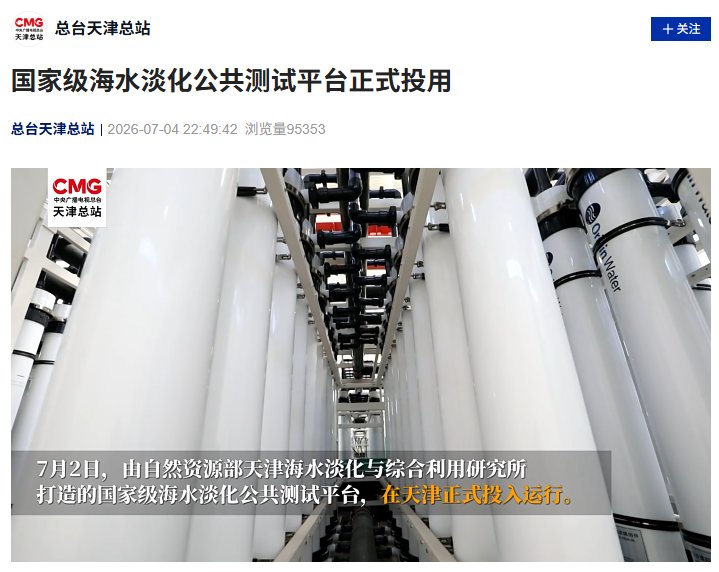
A national testing platform for seawater desalination equipment went live in Tianjin on July 2, built by the Institute of Seawater Desalination and Multipurpose Utilization under the Ministry of Natural Resources. The facility sits in the Lingang area of Tianjin Port Free Trade Zone and is designed to give Chinese manufacturers a centralized place to validate their hardware.
China’s daily desalination capacity has already crossed 3 million tons and is growing at 10 to 15 percent per year. That growth accelerated after 2023, when domestic manufacturers began producing desalination equipment locally instead of relying on imports. The shift cut equipment prices by roughly 30 percent compared to foreign alternatives — but it also created a problem. With more Chinese-made systems entering the market, the industry urgently needed a unified, authoritative testing body to verify performance claims.
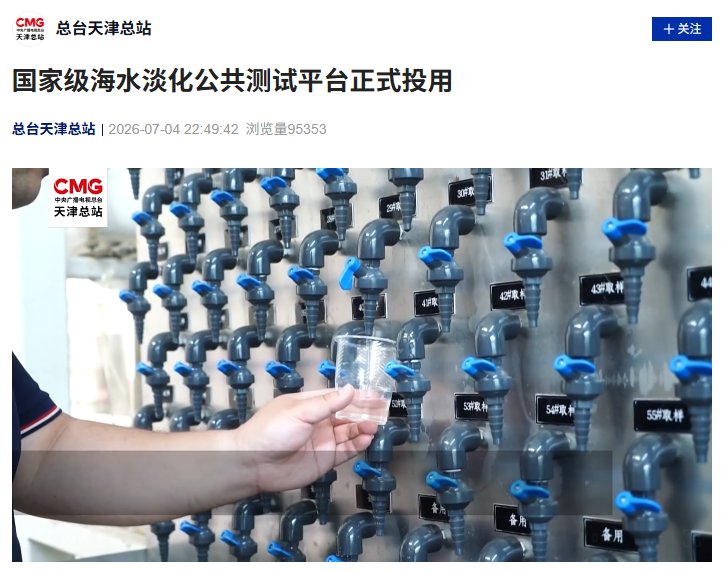
The new platform covers more than 2,000 square meters. It can fully replicate the operating conditions and water quality parameters of real desalination plants, then test equipment on energy consumption, output water quality, and service life. The institute issues certified inspection reports that feed directly into engineering design and product iteration.
Seawater desalination splits into two main technical routes: thermal methods like distillation and membrane methods like reverse osmosis. By the end of 2024, China had 158 desalination projects nationwide with a combined capacity of 2.856 million tons per day. The largest of those is the Tianjin Nangang Industrial Zone project, a fully integrated desalination and multipurpose utilization facility that produces 150,000 tons of freshwater daily.
In April 2025, the country’s first desalination plant powered by warm discharge water from a thermal power plant came online in Yantai, Shandong. That facility uses a cascade process and runs to “dark factory” automation standards, delivering 108 million tons of freshwater per year.
Beyond drinking water and industrial supply, desalination is opening unexpected research directions. In December 2022, a Chinese research team published a paper in Nature demonstrating a method for direct electrolysis of seawater to produce hydrogen — without desalinating the water first.