NVIDIA's Quarterly Revenue Is Approaching $100 Billion — and Jensen Huang Says Growth Is Still Accelerating
There’s a certain tension that comes with being the most valuable chip company on earth. When your market cap pushes toward $5 trillion and your quarterly revenue is on the verge of hitting $100 billion — roughly $68 billion USD — the question shifts from “can you grow” to “how long can you keep this up?”
Jensen Huang spent last week answering exactly that question.
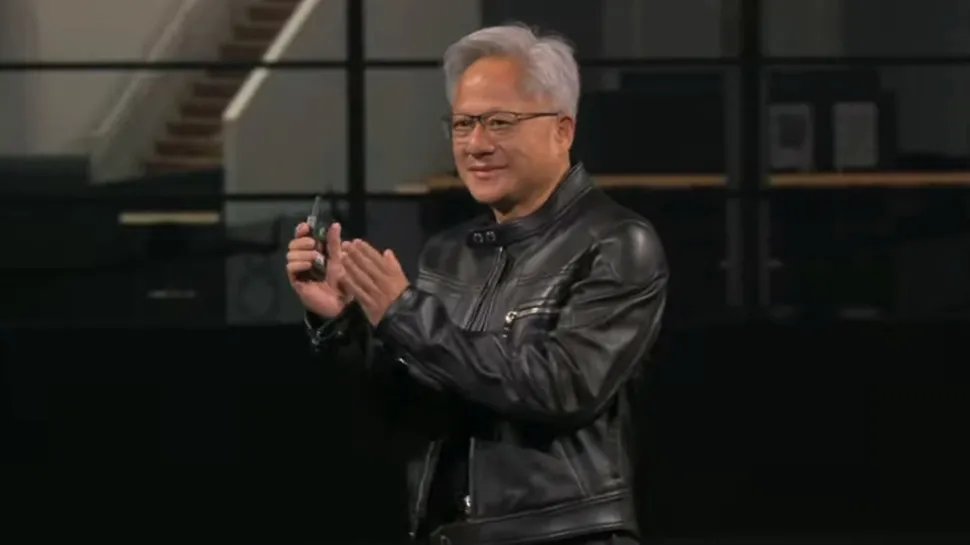
NVIDIA’s CEO appeared at a Morgan Stanley non-deal roadshow in California alongside CFO Colette Kress, delivering what analysts described as an unambiguously bullish message to institutional investors. The headline: growth isn’t plateauing — it’s accelerating.
Morgan Stanley analyst Joseph Moore, who attended the closed-door session, summarized the tone as “very positive” and reaffirmed an Overweight rating on NVIDIA with a $288 price target. That’s roughly 42 percent upside from recent trading levels.
The three fears Huang addressed head-on
Investor anxiety around NVIDIA has coalesced around three themes in recent months: rising competition from custom ASIC chips built by hyperscalers like Amazon and Google, whether the next-generation Rubin Ultra architecture would slip past its 2027 target, and whether AI compute demand could sustain its breakneck pace.
On Rubin Ultra, Huang was blunt. Reports that the flagship architecture had been pushed to 2028? Incorrect. It ships next year, as planned.
Moore noted some rack-level design changes — the Kyber rack solution is being replaced with a new design to support larger AI clusters — but these are system-level optimizations, not roadmap shifts. Key technologies including 800V power delivery and optical interconnects between racks are all on schedule.
The Anthropic signal
The most revealing data point from the roadshow came from an unexpected place: a customer switch.
Moore’s report described a prominent AI frontier model project that historically relied almost entirely on ASIC accelerators, with virtually no NVIDIA GPU usage. Today, NVIDIA’s compute share in that project has climbed to nearly 50 percent.
Morgan Stanley didn’t name the customer, but the profile — frontier-model developer, heavily ASIC-dependent — points squarely at Anthropic. The company has been closely tied to AWS and its Trainium chips. If Anthropic is now splitting its compute load between Trainium and NVIDIA GPUs, it sends a powerful signal that ASIC and GPU aren’t a zero-sum game.
Moore argued exactly that: customers care about cost per token, not chip family loyalty. And by that metric, NVIDIA’s full-stack solution still wins in enough scenarios to maintain — even grow — its competitive position across both training and inference workloads.
Three engines, not one
NVIDIA broke down its customer base into three growth pillars to address concerns about revenue concentration.
AI labs represent roughly 20 percent of current demand. OpenAI remains a deep NVIDIA shop, and Anthropic’s shift adds to that pile.
The hyperscalers — Microsoft, Meta, Amazon, Google — together account for about half of NVIDIA’s revenue. Their expansion is increasingly gated by power availability, land permitting, and data center construction timelines rather than chip demand. And NVIDIA’s product scope with these customers has expanded beyond GPUs to include CPUs and networking gear.
The third bucket — sovereign AI, emerging cloud platforms, and enterprise customers — is where NVIDIA sees the fastest growth. Governments racing to build domestic AI infrastructure, driven by data sovereignty and geopolitical concerns, tend to prefer NVIDIA’s integrated full-stack approach over stitching together custom ASIC solutions. That means less competitive pressure in this segment.
The quiet pivot to CPUs
NVIDIA also made a point of highlighting its CPU business — not something you heard much about a year ago. The company expects roughly $20 billion in CPU revenue this fiscal year, and notably, nearly half of that may come from standalone CPU racks.
That’s a meaningful shift. The next-generation Vera CPU is no longer just an ancillary management processor inside GPU servers. With an architecture optimized for single-threaded workloads, it’s quietly stepping into the broader general-purpose server market.
From growth stock to cash machine
With its market cap approaching $5 trillion, NVIDIA is adjusting its capital markets strategy. Moore noted that many growth funds have hit internal concentration limits on their NVIDIA holdings, so the company will increasingly court value-oriented investors.
The pitch is straightforward: NVIDIA generates enormous free cash flow. Morgan Stanley expects the company to allocate more than half of it to share buybacks and shareholder returns going forward. That gives NVIDIA a dual identity — a hypergrowth AI play that’s starting to behave like a stable, cash-generating value stock.
Morgan Stanley’s model projects 82 percent revenue growth in fiscal 2026, followed by 52.4 percent growth in fiscal 2027.
The risks haven’t disappeared. If AI compute supply outpaces demand, data center growth could decelerate. Falling AI development costs, a disruptive competitor, or faster-than-expected customer migration to custom silicon could all dent the thesis.
But coming out of this roadshow, the takeaway from Morgan Stanley was clear: NVIDIA’s biggest bottleneck right now isn’t whether AI demand holds up. It’s whether the company can physically build, power, and deliver enough hardware — fast enough — to turn its massive order backlog into recognized revenue.