OpenAI's AI agents just had their biggest week — token usage jumped 2.5x after GPT-5.6
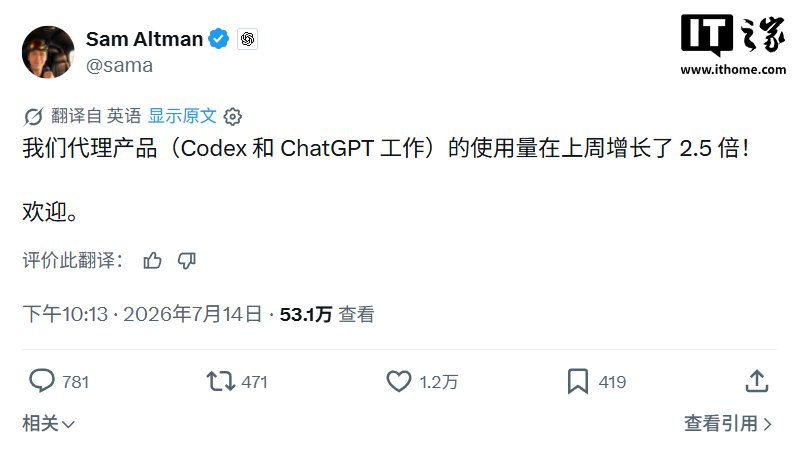
Sam Altman posted a number on X Monday that tells you more about where AI is heading than any benchmark ever could: token usage across OpenAI’s agent products — Codex and ChatGPT Work — jumped 2.5x in a single week.
The timing lines up perfectly with the July 10 launch of GPT-5.6. The new model family rolled out across ChatGPT, the Codex agent platform, and OpenAI’s API simultaneously, and the usage spike suggests people aren’t just chatting with it — they’re putting it to work.
In a CNBC interview, Altman offered a more specific comparison. On AI agent coding tasks, he said GPT-5.6 Sol performs “as well or better” than the leading competing models, but with a 54% improvement in token efficiency. That’s the kind of stat that matters for anyone running agents at scale — better results, fewer tokens, lower cost.
The internal adoption numbers at OpenAI itself are revealing. As of June, 98% of OpenAI employees use Codex. Over seven months, research-related Codex usage grew 56x. Demand for eight-hour autonomous agent tasks — the kind where an AI works independently on a complex problem for a full shift — grew 10x.
Altman didn’t specify whether the 2.5x figure is week-over-week or year-over-year. But the context makes it less important than the trend: agent-based AI products are seeing adoption curves that look more like a social network launch than enterprise software.
OpenAI has been positioning Codex less as a coding tool and more as a general-purpose agent platform. The GPT-5.6 integration appears to be accelerating that shift. When a company’s own employees are 98% adoption on an internal agent tool, and external usage is spiking at 2.5x per week, the agent era isn’t coming — it’s already here.