A new tandem solar cell just hit 28.04% efficiency. It's flexible, stable, and published in Nature.
There’s a quiet tension in solar energy research between record-breaking lab results and real-world durability. A team at the Chinese Academy of Sciences just published a result in Nature that bridges both sides: a perovskite-organic tandem solar cell with a certified 28.04% steady-state efficiency — a world record for its class — that also survived 625 hours of continuous operation with only 10% degradation.
Conventional single-junction solar cells — the silicon panels on rooftops and in solar farms — use one material to absorb sunlight. That means they capture only a fraction of the available spectrum: high-energy and low-energy photons both get processed at the same mediocre efficiency, leaving significant potential untapped. Tandem cells solve this by stacking two different light-absorbing materials, each tuned to a specific slice of the solar spectrum.
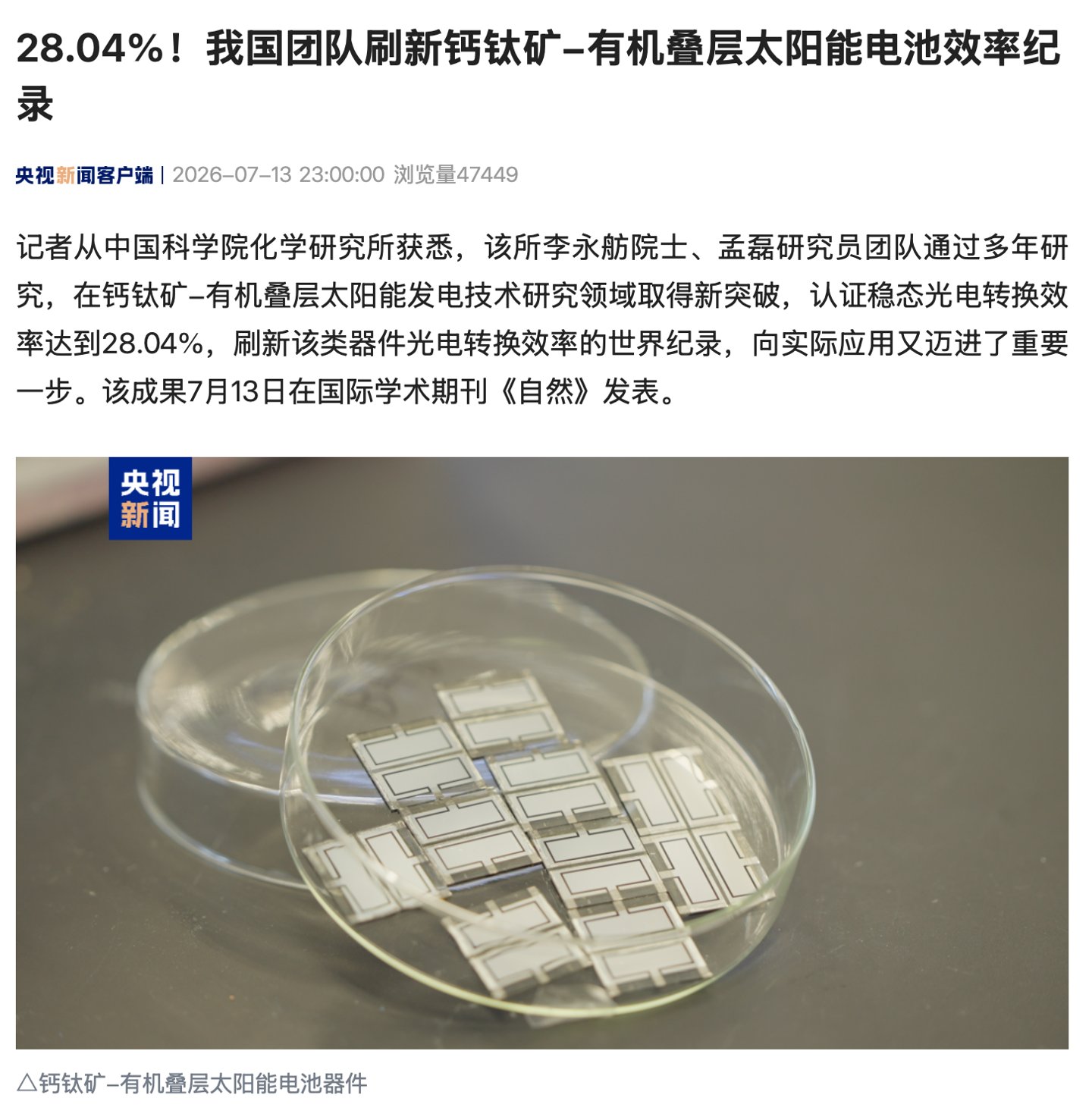
The CAS team’s design pairs a perovskite top layer with an organic bottom layer. The perovskite catches high-energy photons; the organic layer handles the rest. The 28.04% certified result proves the concept works outside simulation — a meaningful step for a technology that has long been described as promising but fragile.
Fragility was the real problem. Perovskite-organic tandems historically degraded too fast and lost performance during manufacturing. The researchers tackled both issues with a molecular additive called TDB, which stabilizes the device from fabrication through continuous operation. After 625 hours of constant light exposure, the cell kept 90% of its initial efficiency — a durability figure that earlier prototypes couldn’t approach.
The practical advantage goes beyond the lab numbers. These cells are thin and lightweight, and they’re flexible enough to bend around curved surfaces. That opens applications where rigid glass-and-silicon panels don’t fit: building-integrated photovoltaics like windows and facades, portable power packs, wearable devices, drones, and spacecraft power systems.
The record is still a laboratory achievement. Scaling up manufacturing and proving multi-year reliability are the next hurdles. But the paper, published July 13, signals that tandem cells are moving from “promising curiosity” toward something closer to a real-world technology. The science is solid, and the trajectory is clear.