Volkswagen's Diesel Era Is Ending in Europe — a Troubled Engine Is Partly Why
There’s something quietly symbolic about Volkswagen’s plan to kill off diesel in Europe. The engine family that powered millions of Golfs, Passats, and Skodas across the continent is being put out to pasture, and the car tasked with carrying that torch won’t even offer a diesel option.
The next T-Roc will debut a full hybrid system instead. It’s based on the eHybrid plug-in architecture, but with a smaller 1.6 kWh battery and no charging port. Two power levels are planned: a 136-hp low-output version and a 170-hp variant. Volkswagen claims fuel consumption will land at 4.5 L/100 km. The same powertrain will also find its way into the Golf.
The decision is part of a broader cost-cutting push by CEO Oliver Blume. Volkswagen plans to launch its last generation of internal combustion engines in 2026. Meanwhile, it’s considering closing up to four factories in Germany and cutting as many as 100,000 jobs worldwide — the largest restructuring in the company’s 89-year history. Capital spending over the next five years will be trimmed by about 15 percent. Diesel’s market share in Europe has already fallen to 7.3 percent as of May 2026.
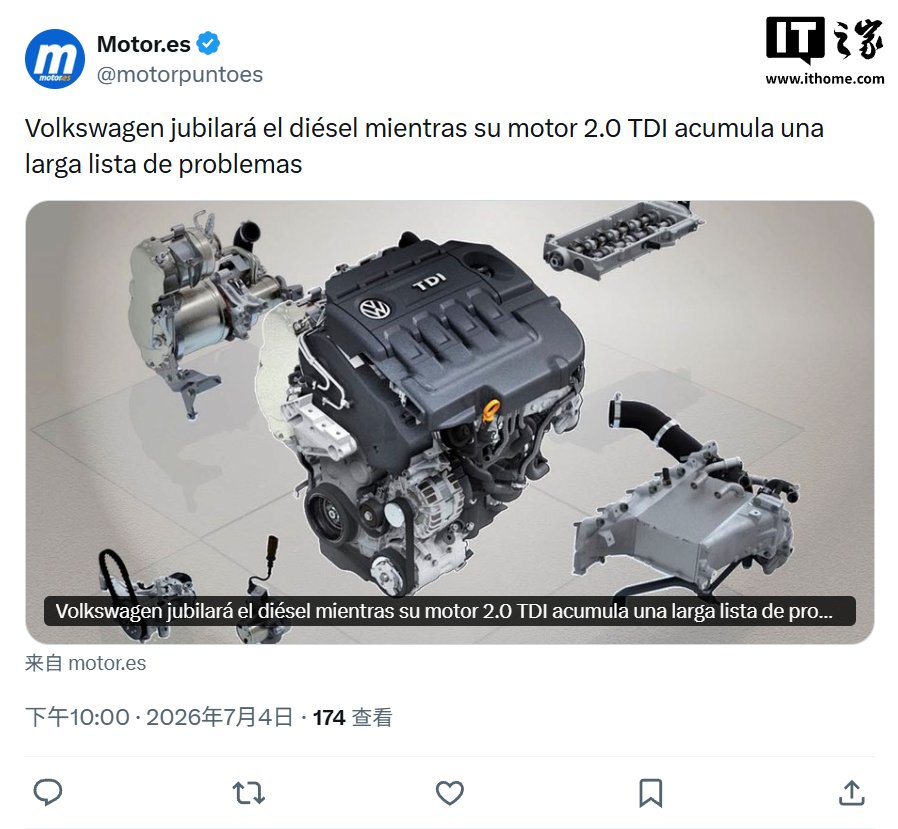
But there’s another, less strategic reason diesel is being shown the door. Volkswagen’s final 2.0-liter TDI, codenamed EA288, has been plagued by persistent technical problems.
Introduced in 2012 as a replacement for the EA189 engine at the center of the Dieselgate scandal, the EA288 was supposed to be a fresh start. Instead, it came with its own laundry list of issues.
The cooling system is the most notorious. The radiator contains a bag of silicate meant to protect aluminum parts from corrosion. If that bag ruptures, the released particles clog the entire cooling circuit. The standard fix is to remove the bag and replace the coolant every two to three years — far more often than Volkswagen recommends. Leaks at the thermostat housing, water pump, EGR valve, intercooler, and various hose connections are also common. A particularly nasty failure involves the mechanical water pump’s diaphragm sticking in the low-flow position, which can cause the engine to overheat and blow the head gasket.
The high-pressure fuel pump has its own troubles. Wear particles contaminate the entire fuel system, leading to expensive repairs. On the emissions side, the diesel particulate filter is relatively reliable, but the SCR system that injects AdBlue tells a different story. AdBlue has a shelf life of about a year once opened, and for vehicles that mostly do short trips, the fluid crystallizes before it can be consumed, triggering a cascade of faults.
Then there’s the oil consumption issue, most visible on the 184-hp versions found in cars like the Skoda Octavia RS TDI and the Golf GTD. The combination of piston ring design and sustained high-power use leads to carbon buildup and noticeably high oil consumption.
Phasing out diesel in Europe lets Volkswagen sidestep the risk of massive fines under tightening EU emissions rules. It also quietly closes the chapter on the EA288, an engine that never quite lived up to its promise. Replacing it with an HEV system may not be the boldest move Volkswagen could make, but given the cost pressures and technical baggage, it’s probably the most realistic one.