The World's First Commercial Nuclear-Powered Satellite Just Reached Orbit
A satellite powered by a nuclear battery — the first of its kind to fly as a commercial payload — reached orbit early Tuesday morning aboard a SpaceX Falcon 9 rocket.
The spacecraft, called BOHR (short for Betavoltaic Orbital High-Reliability satellite), was built by City Labs, a Florida-based company. It hitchhiked to space on SpaceX’s Transporter-17 rideshare mission, which carried 81 payloads total from Vandenberg Space Force Base in California.
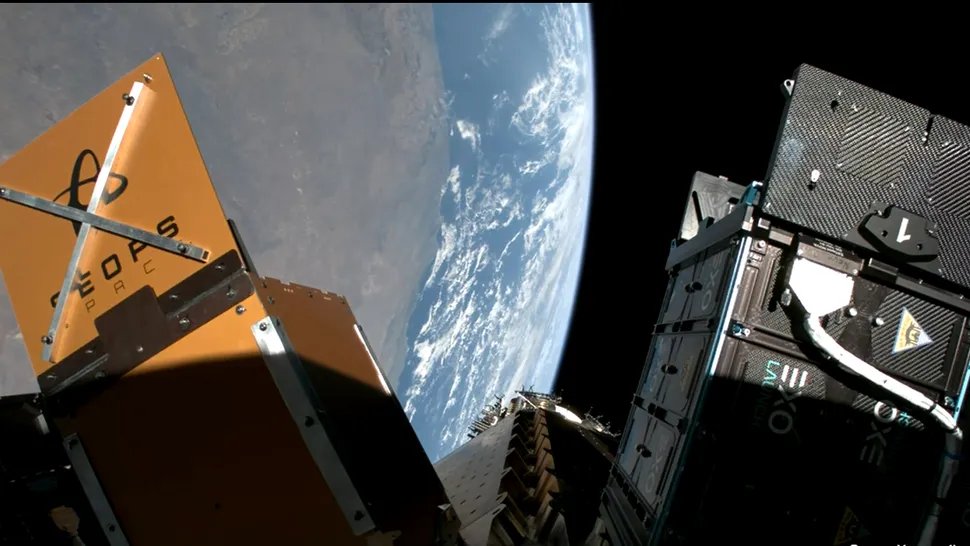
What makes BOHR different is its power source. Instead of the solar panels that keep most satellites alive, it carries a “NanoTritium” betavoltaic micro-power supply that generates electricity from the radioactive decay of tritium — the same hydrogen isotope used in exit signs and some watch dials. The decay releases beta particles, which a semiconductor layer converts directly into current.
The idea is not entirely new. NASA’s Voyager probes, now more than 40 years into their mission, rely on plutonium-based radioisotope thermoelectric generators. But those use heat from plutonium-238 decay, and they’re large, expensive, and politically sensitive to launch. City Labs is trying to do something similar at a fraction of the size — and with tritium, which emits such low-energy radiation that a sheet of paper can stop it.
BOHR is primarily a technology demonstration. The satellite’s daily operations still run on conventional solar power. The tritium core is not the main power source on this flight. But the test is meant to prove that the technology works in space, so future spacecraft can ditch solar panels entirely and operate in places sunlight never reaches.
Places like the lunar poles.
NASA’s Artemis program has made the moon’s south pole a priority target. The region’s permanently shadowed craters hold water ice — a resource that could support a long-term base — but they are also bathed in continuous darkness. Solar power is useless there. Nuclear is the only option that works 24/7.
City Labs CEO Peter Cabauy called the launch “a landmark step for commercial space nuclear power.” The company says the NanoTritium design can be scaled up over time to eventually power an entire base, though the current unit produces nowhere near that level of energy.
One advantage of tritium over plutonium is safety. Tritium’s radiation is so weak it cannot penetrate human skin. City Labs says its power systems are designed to be safely stored, transported, and integrated with spacecraft under standard commercial launch conditions — no special handling required.
BOHR was funded in part by a U.S. Department of Defense contract. It is also the first nuclear-powered spacecraft approved under the Federal Aviation Administration’s nuclear launch licensing framework, which was established following the 2019 National Security Presidential Memorandum 20 issued by the Trump administration.
If the mission succeeds, City Labs expects it to open the door for more nuclear-powered spacecraft — both for defense and commercial customers.
“BOHR demonstrates that safe, miniaturized, and regulatorily-approved nuclear power systems are ready for routine commercial launch operations,” Cabauy said.