XPeng CEO: Autonomous Driving Can Legally Go Global by End of 2026
XPeng CEO He Xiaopeng announced today that the company’s VLA 2.0 autonomous driving system is on a confirmed path toward global deployment, following landmark regulatory approvals at the United Nations level.
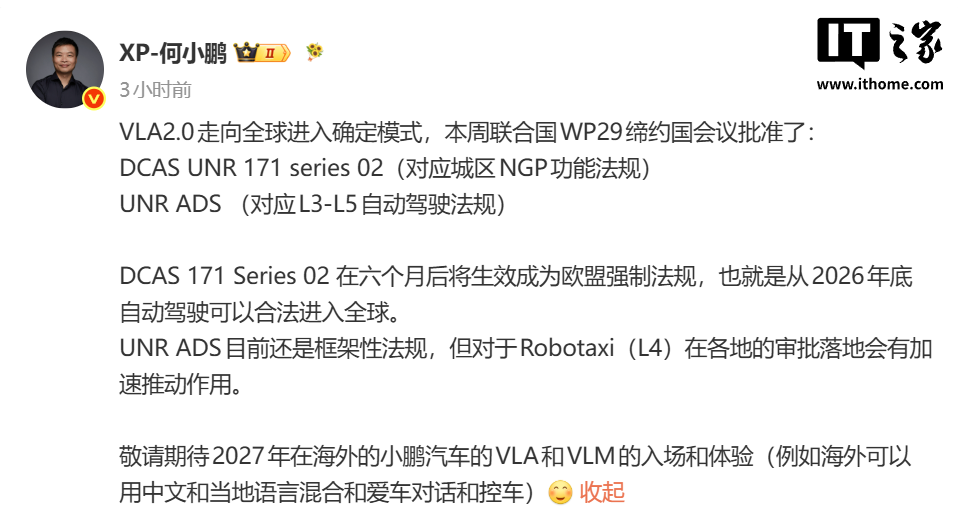
In a post on Weibo, He Xiaopeng revealed that this week’s UN WP.29缔约国会议 (Contracting Parties meeting) approved two critical regulations: DCAS UNR 171 series 02, which corresponds to urban NGP (Navigation Guided Pilot) functionality, and UNR ADS, covering L3-L5 autonomous driving regulations.
The DCAS UNR 171 series 02 regulation will become a mandatory EU regulation six months after its approval, meaning that by the end of 2026, autonomous driving technology can legally enter markets globally. This represents a significant milestone for the industry, as it provides a clear legal framework for automakers deploying advanced driver assistance systems worldwide.
The UNR ADS regulation, while still serving as a framework-level rule at this stage, is expected to accelerate the approval and rollout of L4-level Robotaxi services across various regions. This could dramatically speed up commercial autonomous taxi deployments that have been stalled by regulatory uncertainty.
He Xiaopeng also teased that XPeng’s VLA (Vision-Language-Action) and VLM (Vision-Language Model) technologies will make their overseas debut in 2027. He highlighted a particularly interesting feature: the ability for users to interact with their vehicles using a mix of Chinese and local languages for dialogue and vehicle control.
The approval signals a pivotal shift in the global regulatory landscape for autonomous driving, moving from fragmented local rules toward internationally harmonized standards — a development that major EV and autonomous driving companies have been pushing for years.