105,000 Nano-Oscillators Synced in 45 Nanoseconds, Opening a New Path for AI Hardware
There’s a problem brewing inside every AI data center: the chips are getting too hot, and the power bills are getting too big. Silicon transistors, for all their decades of dominance, hit a wall when you try to push them past a certain density. One alternative that has long lived in the lab — networks of tiny magnetic oscillators that can synchronize and compute collectively — just took a big step toward practicality.
A team from the University of Gothenburg, the Indian Institute of Technology Bhubaneswar, and Tohoku University demonstrated the largest-ever synchronized network of nanoscale magnetic oscillators. Writing in Nature Nanotechnology, they report that 105,000 oscillators, each just 10 to 20 nanometers wide, locked into sync within 45 nanoseconds.
The devices, called spin-transfer torque nano-oscillators (STNOs), work by exploiting the spin Hall effect to drive magnetic moments into oscillation, producing microwave signals. Think of them as tiny tuning forks that vibrate at gigahertz frequencies when current passes through. The challenge has always been getting thousands of them to vibrate in unison. Before this work, the largest publicly demonstrated array had just 64 oscillators. This new network is nearly 1,000 times larger.
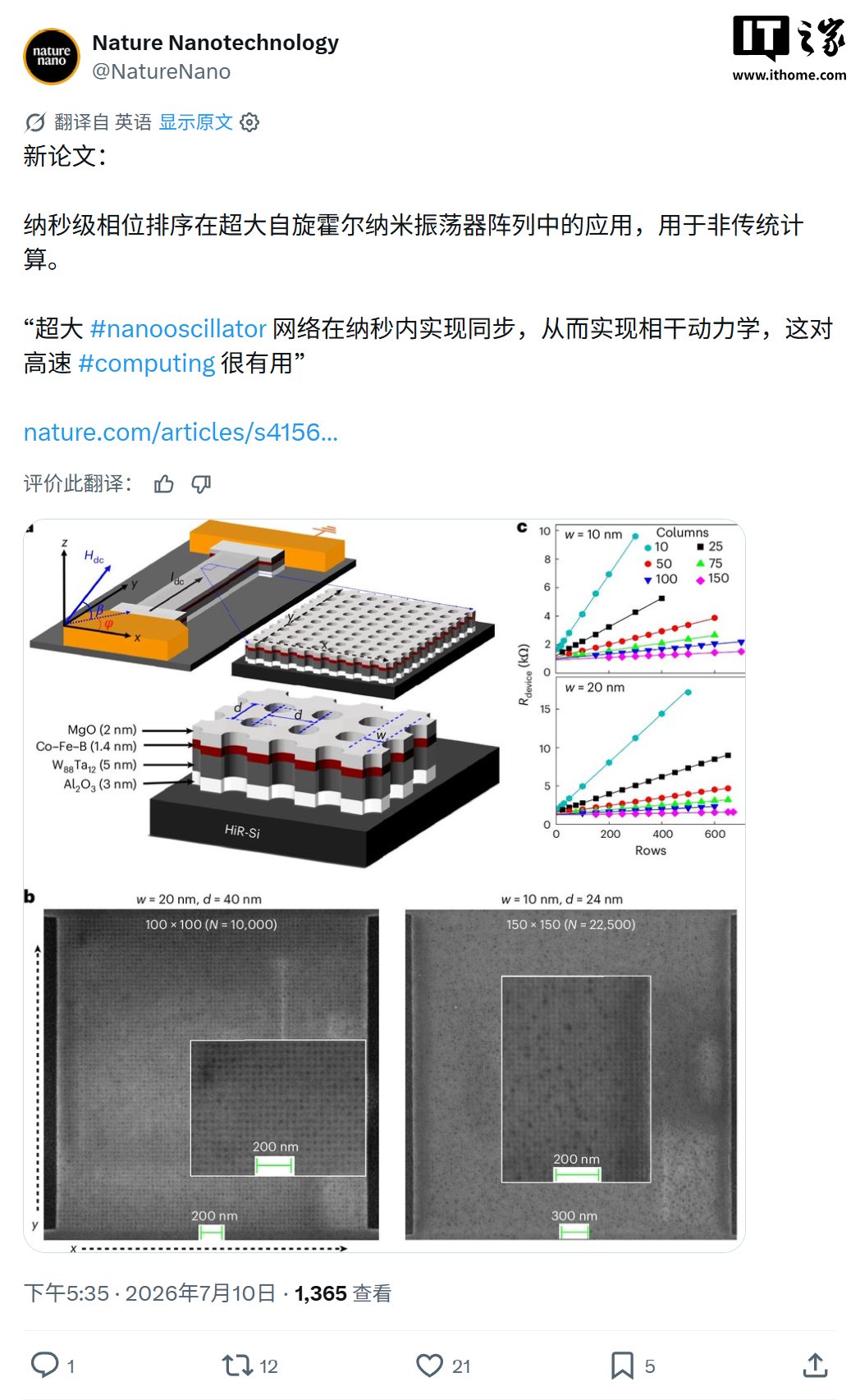
The researchers used microwave spectroscopy and time-resolved Brillouin light scattering microscopy to watch the synchronization happen in real time. With 100 oscillators, sync took about 10 nanoseconds. Scaling to 105,000 pushed that to only 45 nanoseconds — a remarkably small increase given the 1,000x jump in size. The result suggests that spintronic networks can maintain coherent operation at very large scales and keep scaling further.
These synchronized oscillator arrays are more than a physics demonstration. The team points to two concrete applications: Ising machines and reservoir computing hardware. Ising machines solve optimization problems by finding the lowest-energy state of a coupled system — useful for everything from logistics to drug discovery. Reservoir computing, meanwhile, is a brain-inspired architecture that maps input signals into a high-dimensional state space, ideal for time-series prediction and pattern recognition. The arrays operate at tens of gigahertz, fast enough for real-world workloads.
The broader context is hard to ignore. AI’s insatiable appetite for compute is colliding with the physical limits of conventional silicon. Power density and heat dissipation are becoming the binding constraints in data centers, not transistor count. Oscillator-based computing, if it can be manufactured at scale, sidesteps some of those limits by doing computation in the analog, collective behavior of thousands of coupled devices — no switching losses, no leakage current.
What makes this work stand out is the sheer scale. Going from 64 oscillators to 105,000 in a single demonstration is the kind of jump that separates academic curiosities from something you might one day build a chip around. The team says these arrays can be programmed by encoding temporal inputs through drive currents or magnetic fields, giving them the nonlinear transient response and short-term memory that neuromorphic systems need.
It is still early. Nobody is replacing GPUs with oscillator arrays tomorrow. But for the first time, the numbers are starting to look plausible.