A Distant Black Hole Has Been Blasting Radio Waves for Over Eight Years — and Won't Stop
A black hole 1.8 billion light-years away has been pumping out radio signals at 20 times its normal brightness since 2018 — and it’s still going.
The object is the supermassive black hole at the center of spiral galaxy SDSS J110546.07+145202.4 in the constellation Leo. It belongs to a rare class of active galactic nuclei called narrow-line Seyfert 1 (NLS1) galaxies. These are systems where the central black hole is relatively low-mass but feeds aggressively, producing narrower-than-usual emission lines in its spectrum.
What sets this one apart: most changing-look active galactic nuclei — objects that switch between quiet and bright states — stay bright in radio for just days or weeks. This one has been flaring for eight years straight.
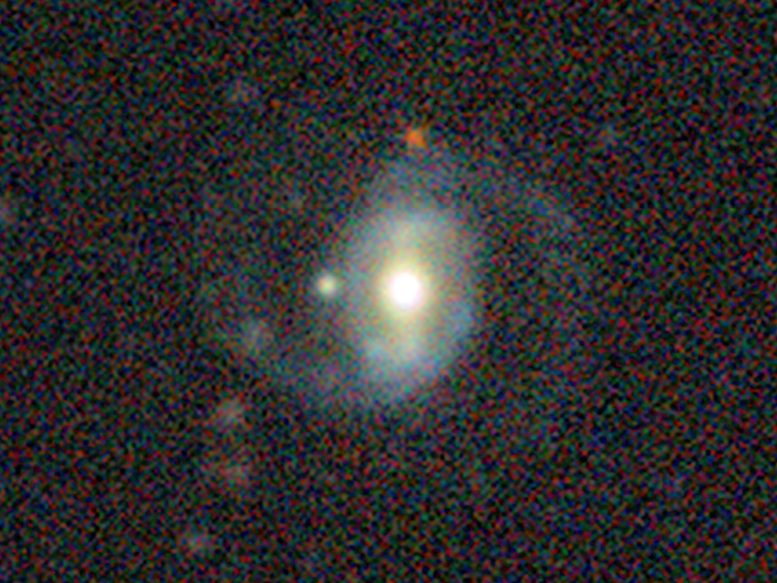
A team led by Stefanie Komossa at the Max Planck Institute for Radio Astronomy tracked it across radio, optical, and X-ray wavelengths. Their findings appeared May 13 in The Astrophysical Journal.
The best guess: a surge in the black hole’s accretion rate kicked off a narrow relativistic jet. As material spirals toward the event horizon, magnetic fields catch some of it and fling it outward at near-light speed. The radio energy from that jet clocks in at roughly 10^16 times the Sun’s total output.
The galaxy is now the first confirmed “long-duration radio changing-look NLS1” — a clunky label that means astronomers caught a black hole mid-tantrum, and nobody knows when it’ll calm down.
The discovery opens a window into how supermassive black holes behave over long timescales. Most radio flares from active galactic nuclei are short enough that catching one in real time is pure luck. This one has been generous enough to stick around, giving researchers a front-row seat to the physics of accretion and jet formation.