A Maya mathematician named 'White-chested Fox' left a formula on a wall 1300 years ago — archaeologists just decoded his signature
Deep inside a small stone chamber in northeastern Guatemala, a Maya scribe once hunched over walls covered in glyphs, working out the rhythms of planets and stars. On one wall, he scratched a compact mathematical formula linking Venus, Mars, and the Sun into a single 2,920-day cycle. And then he signed his name.
The name is Sak Tahn Waax — “White-chested Fox” — and it belongs to a Maya astronomer-mathematician whose work was published on July 14 in the journal Antiquity. A team led by archaeologist Heather Hurst of Skidmore College decoded the glyphs inside an 8th-century scribal workshop at the Xultun site in Guatemala, near the Mexican border. It’s the oldest named astronomer-mathematician ever recorded in the Americas, according to MIT archaeologist Franco Rossi.
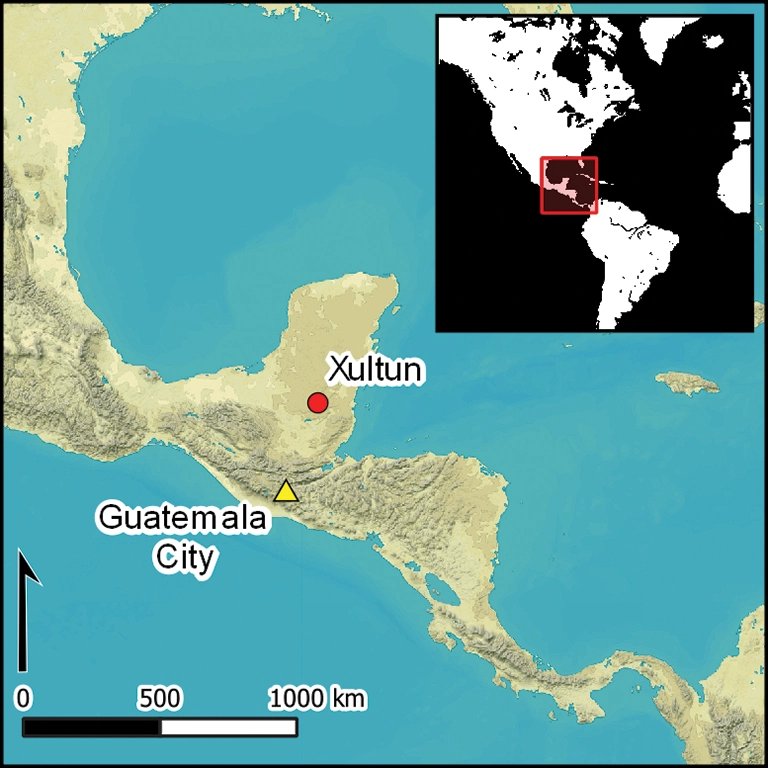
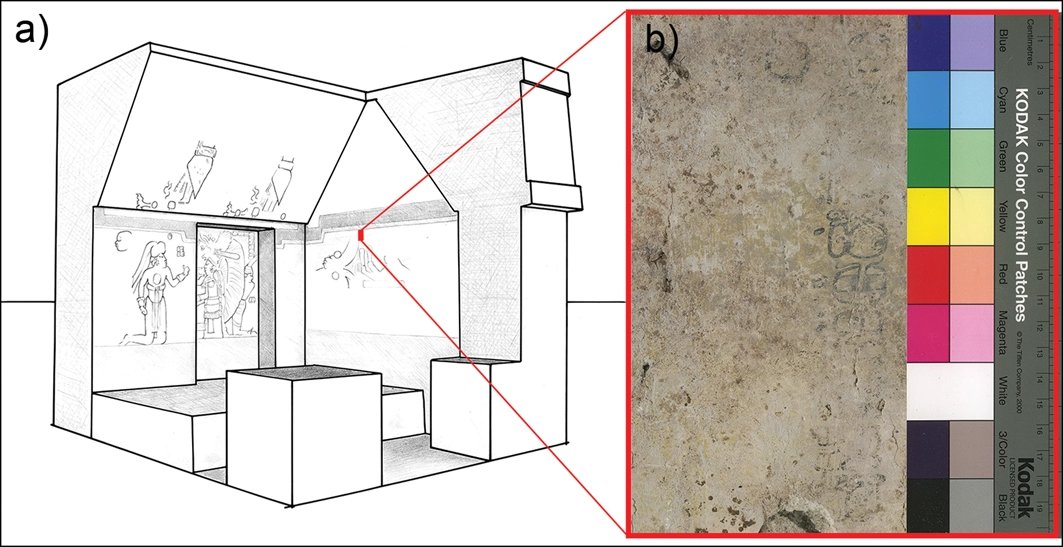
Xultun was first spotted by outsiders in 1915, a sprawling Maya city covering more than six square miles. But its real secrets stayed hidden until 2010, when a Boston University student chasing looter trails stumbled into a buried structure. The next year, excavators cleared a small room and found murals — painted figures, glyphs, and dense astronomical calculations running across the walls.
The room, researchers later determined, was a dedicated scribal workshop from the mid-8th century. Its east and northeast walls carry roughly 50 text segments — essentially scratchwork, the kind of rough math a scholar leaves behind while figuring out celestial mechanics.
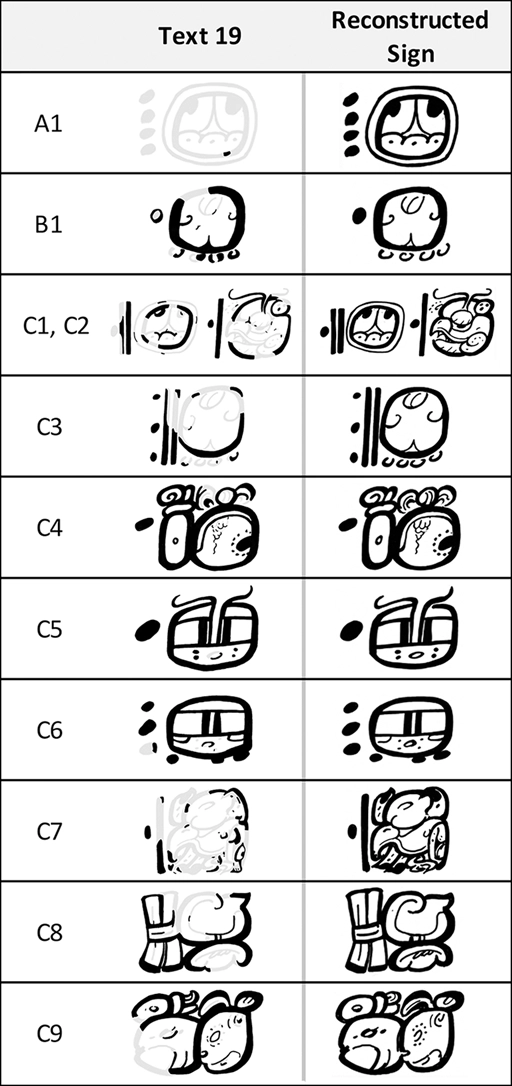
The centerpiece of the new study is a set of 11 glyphs arranged in an L-shape, about 10 centimeters tall, cataloged as “Text 19.” The first nine glyphs encode a conversion formula for the 2,920-day cycle — a number that happens to equal exactly five Venus cycles of 584 days and eight solar years of 365 days. The formula also linked that cycle to the 260-day sacred tzolk’in calendar, the 360-day tun year, the 20-day uinal month, and the 780-day Mars cycle.
Hurst called it “mathematical flexing by an ancient scholar.” The formulation was elegant and compressed — some dates were written in shorthand, with the first part spelled out and the rest implied. That compression made the decoding hellish.
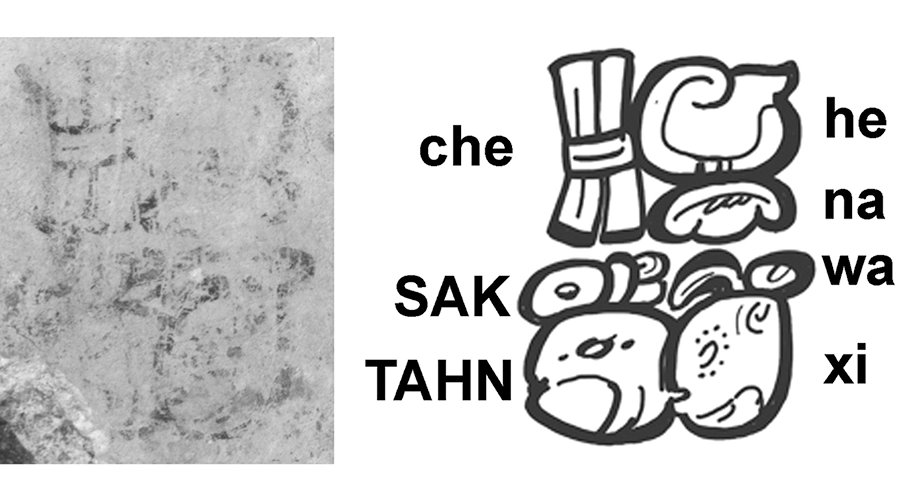
The breakthrough came at the second-to-last glyph in Text 19. It uses the phrase “so says,” followed by the final glyph: Sak Tahn Waax. No feminine prefix, so the scribe was male. The signature, Hurst said, is the mathematician’s self-identification as the author of the formula.
What does it mean for a Maya scholar to sign his work? A lot. Gerardo Aldana, an anthropologist at UC Santa Barbara, said the act of signing demonstrates that mathematicians in Maya society commanded the same kind of recognition and prestige as artists. “Whether this scribe was signing his own calculation or attributing the intellectual work to someone else,” Rossi added, “we have a formula and the name of its creator — and that alone proves how much these intellectual contributions mattered in Classic Maya society.”
The research team argues that this mathematician’s achievement puts him in company with Archimedes, Ptolemy, and al-Khwarizmi. Eric Heller, an archaeologist at USC Dornsife, described the Maya as “intelligent, thoughtful, creative, and curious people — transmitting knowledge, studying, and even doing mathematics for the sheer pursuit of understanding.”
So what was this formula actually used for? Rossi said it doesn’t seem to have fed into any larger system — at least not one that survives. “We think it was meant to demonstrate economically and meaningfully the relationship between these two planets and human timekeeping — relationships that could then be applied to political rituals, predictive astronomy, and understanding the seasons.”
The date encoded in Text 19, converted to the Julian calendar, most likely falls on November 7, 781 CE.
This find also connects to older knowledge. Comparing this wall inscription with the 11th-12th century Dresden Codex — one of the few surviving Maya books — shows that Maya mathematics was among the most advanced in the ancient world. They used place-value notation, complex arithmetic, algebraic relationships, negative numbers, and multiplication factors. One thing they apparently never developed: formal geometry. Aldana suspects that’s because of Mesoamerica’s geographic isolation — no Greek-style geometric tradition ever arrived to cross-pollinate.
There’s a strange footnote to the Xultun site. Back in 2012, the same excavation hit global headlines when murals were found recording time spans stretching 7,000 years into the future. That got misread by media as evidence for a “2012 apocalypse” prophecy. The actual science was far more mundane and far more impressive: a culture that cared enough about tracking time to plan seven millennia ahead.
The full paper is published in Antiquity under DOI 10.15184/aqy.2026.10378.