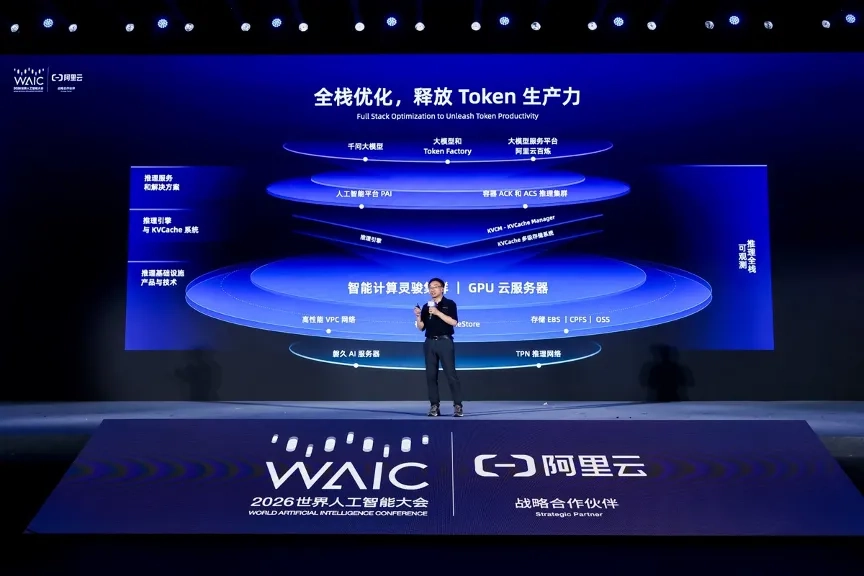
Alibaba Cloud's M890 Supernode Handles Trillion-Parameter AI Models on Public Cloud
Alibaba Cloud quietly raised the ceiling on public cloud AI computing Thursday at the World AI Conference in Shanghai. The company’s new Lingjun Zhenwu M890 supernode instance is the first time it’s offering this class of compute — a single interconnected cluster of GPUs acting as one machine — through its public cloud rather than behind private data center walls. The service is already in beta in Ulanqab, Inner Mongolia.
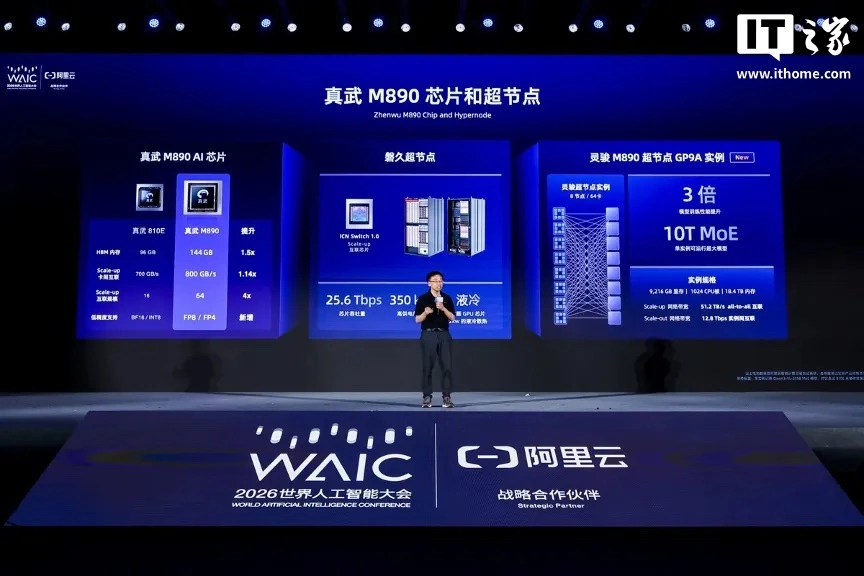
The M890 leans heavily on Alibaba’s ICN Switch 1.0 chip, which scales GPU interconnect from 16 cards to 64 while pushing card-to-card bandwidth to 800 GB/s. That memory bandwidth matters because the instance supports FP8 and FP4 low-precision computation — the format most large language models use during inference. Alibaba claims a single M890 supernode can handle a ten-trillion-parameter Mixture-of-Experts model without splitting the workload across multiple clusters. For training workloads like autonomous driving or embodied AI, the company says performance is three times higher than the previous-generation Zhenwu 810E.
The networking backbone is HPN 8.0, a unified architecture for training and inference that supports up to 130,000 heterogeneous GPU cards in a single cluster, with support for prefill-decode separation. Alibaba says the architecture can scale to a million cards. The system also includes automated fault monitoring with minute-level self-recovery and a claimed 99.7% average availability — metrics that matter when a training job can run for weeks.
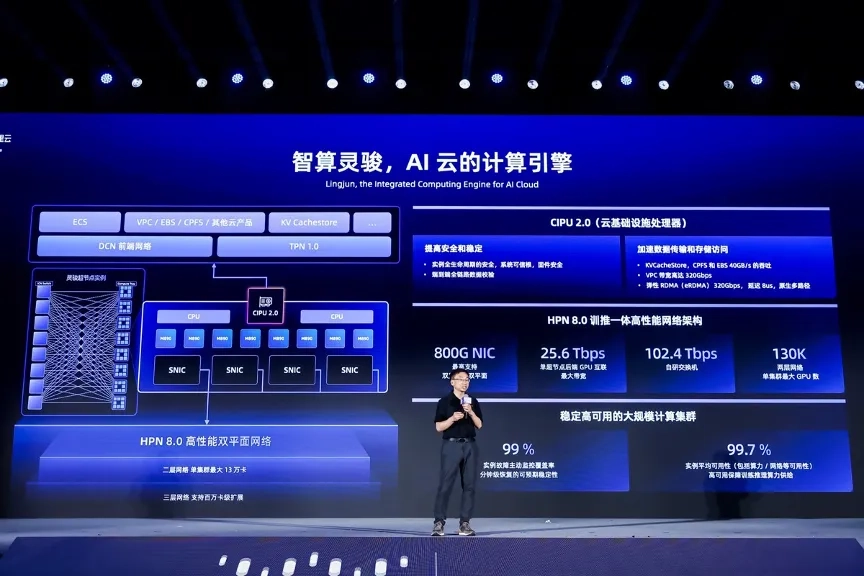
On the front end, the M890 uses Alibaba’s CIPU 2.0 networking processor for data acceleration and security. On the storage side, the company rebuilt its CPFS parallel file system on top of Apsara Pangu with a control-plane/data-plane separation design that scales horizontally. The company says the file system delivers hundreds of petabytes of capacity with hundreds of terabytes per second of throughput and billions of IOPS.
What makes the M890 worth watching is not just the raw numbers — plenty of cloud providers have big clusters. It’s that Alibaba is selling this as a public cloud instance, not a bespoke private deployment. That means a startup training a large model can rent supernode-class compute by the hour instead of committing to a multi-million-dollar buildout. The beta in Ulanqab will tell us whether the 99.7% uptime promise holds up under real customer workloads, but for now, Alibaba has made the loudest statement yet that hyperscale AI compute is becoming a commodity you buy off the shelf.