A Professor Suspected AI Was Doing His Students' Exams. He Switched to In-Person Testing and Watched Grades Collapse.
There’s a quiet tension building in college classrooms across America. Professors assign take-home work and students turn in near-perfect results. Nobody can prove what happened in between. At Brown University, one professor decided to test the gap.
Roberto Serrano teaches welfare economics and social choice theory at Brown. Last December, a shooting on campus left two students dead, so Serrano made his midterm a take-home exam. The results were suspiciously good — students scored higher than he had ever seen. Many hit the 90s. Some were close to perfect. He suspected AI was doing the work.
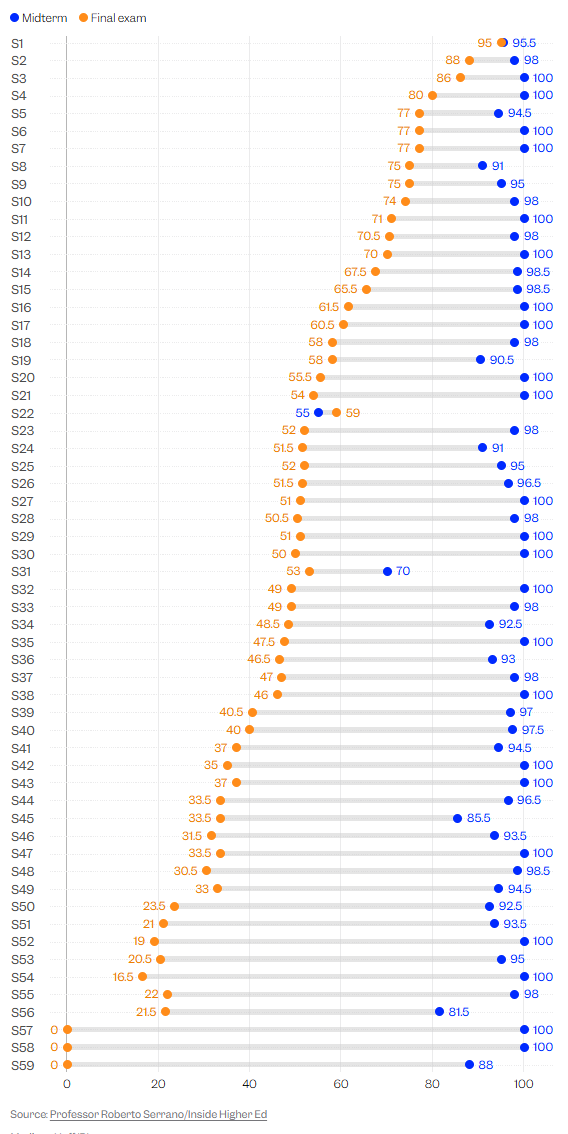
So Serrano made a change. He announced the final exam would be held in person, closed book, with no laptops. What happened next was stark: some of the best-performing students simply didn’t show up. Those who did saw their scores crater. Students who scored 90-plus on the midterm were suddenly pulling 50s on the final.
Inside Higher Ed published a comparison chart that laid the data bare — each student’s midterm and final scores side by side. The pattern was unmistakable: a dramatic drop for most, with only a handful holding steady.
“The problem with this technology is that the cost of cheating has dropped to nearly zero,” Serrano told Business Insider. “Students find it very hard to resist that temptation.”
The story spread fast. Paul Graham posted about it on X. Employees from Google DeepMind weighed in. Serrano said he received hundreds of emails from alumni and colleagues who reached out even during summer break. “I’m a bit overwhelmed right now,” he said.
Brown’s vice president for communications, Brian E. Clark, confirmed that Serrano submitted the case to the standing committee on academic integrity on July 8. “Brown takes any suspected violation of academic integrity extremely seriously,” Clark said.
A few students stood out from the data. One scored 95.5 on the midterm and 95 on the final — consistent through both formats. Serrano called them a very good student he knows well. Another student scored 55 on the midterm and 59 on the final — equally consistent at the low end. “I appreciate this person,” Serrano said.
The online conversation quickly turned to the workplace. If students lean on AI to pass exams, can they be trusted on the job? Some argued that the students with consistent scores are the ones companies should actually hire. Serrano agrees. “I’ve always valued integrity very highly, so if I were hiring, I’d choose those people,” he said.
A few caveats: exam difficulty varies, and the final could have been harder than the midterm. There’s no definitive proof yet that widespread AI cheating occurred — the university investigation is ongoing. But the pattern is hard to ignore.
Serrano has already decided he won’t offer take-home exams again. He also plans to remove homework weighting from the final grade. His advice to other faculty: take a hard look at your AI policies.
“This is undoubtedly a wake-up call for all educators,” he said. “We have to take this seriously.”