China puts another batch of Qianfan internet satellites into orbit with Long March 6A
China launched another batch of satellites for its ambitious Qianfan broadband internet constellation on Saturday, sending the 13th group of polar orbit satellites into space from the Taiyuan Satellite Launch Center. The Long March 6A rocket lifted off at 5:30 p.m. Beijing time and delivered the payloads to their intended orbit without issue.
The flight was the 655th mission for China’s Long March rocket family, a program that has steadily accumulated launches since the 1970s and now averages well over 50 per year across multiple vehicle types.
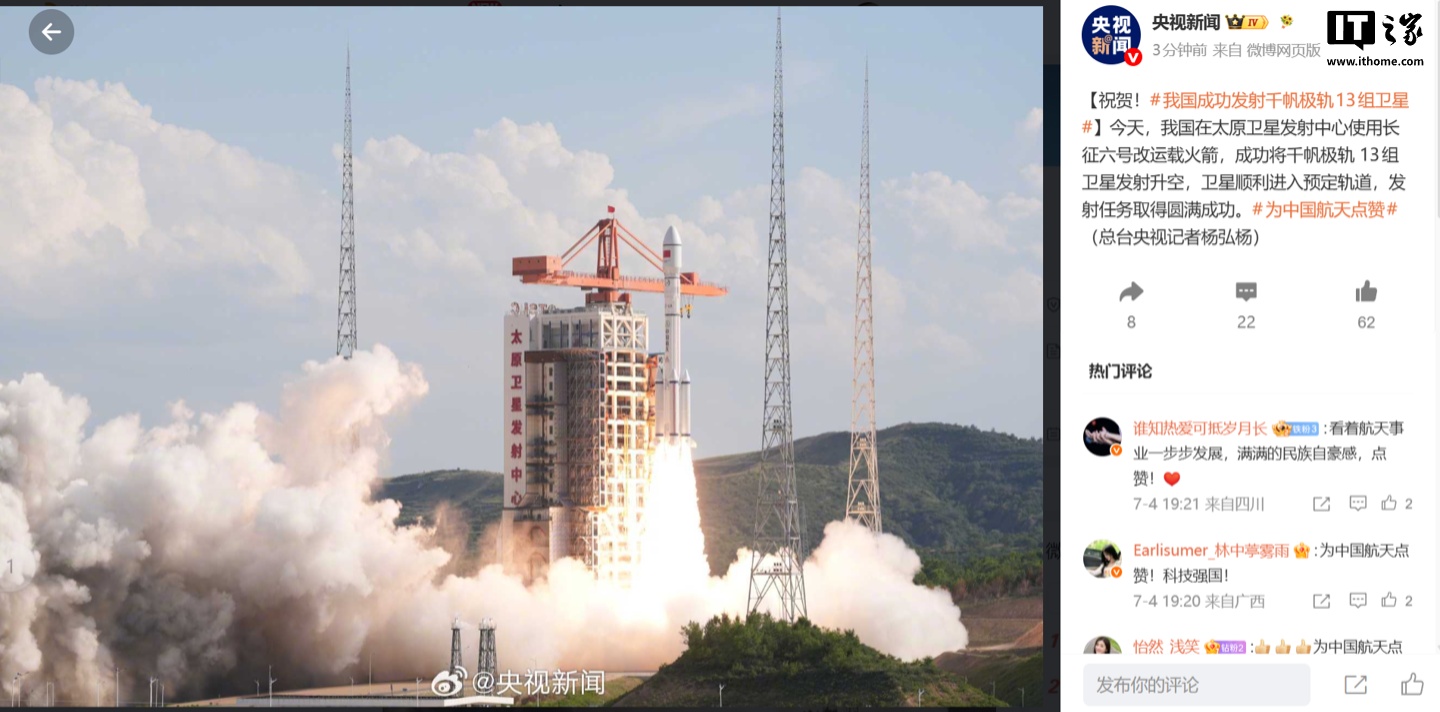
The satellites belong to the Qianfan constellation — Qianfan means “Thousand Sails” in Chinese — which is being built and operated by Shanghai Yuanxin Satellite Technology Co. The system is designed to deliver low-latency, high-speed broadband internet from orbit, with an architecture that can evolve to support future 6G network standards.
China has laid out an aggressive three-phase deployment plan. Phase one calls for 648 satellites to provide regional coverage. Phase two doubles that to 1,296 for global coverage. Phase three pushes the constellation well past 15,000 satellites to handle diverse commercial and institutional traffic.
The Long March 6A, also designated the Long March 6 Modified, is a medium-lift launch vehicle developed by the Shanghai Academy of Spaceflight Technology under the China Aerospace Science and Technology Corporation. It uses a hybrid solid-liquid propulsion design and can lift at least 6.5 tons to a 500-kilometer sun-synchronous orbit. The rocket is built for密集 multi-satellite deployment — a capability China has been refining across its recent launch campaigns.

Before Saturday’s mission, the most recent Qianfan launch took place on June 5, when a Long March 8 rocket lifted off from the Hainan Commercial Space Launch Site with the 12th group of polar orbit satellites. That brought the constellation’s on-orbit tally to 182 satellites, a number that will climb quickly as China accelerates toward its phase-one target.
The Qianfan project joins a growing list of large low-earth orbit satellite constellations, competing indirectly with systems like Starlink while serving a primarily domestic and allied-nation customer base. With each launch — and the Long March 6A is proving itself a reliable workhorse for the task — the network moves closer to operational reality.