A Rare Bacteria in Meta's Data Center Wastewater Shut Down a City's Water System
The city of Cheyenne, Wyoming, spent months tracking down the source of a mystery contaminant in its reclaimed water system. The culprit turned out to be a rare bacteria — and it came from Meta’s data center construction site.
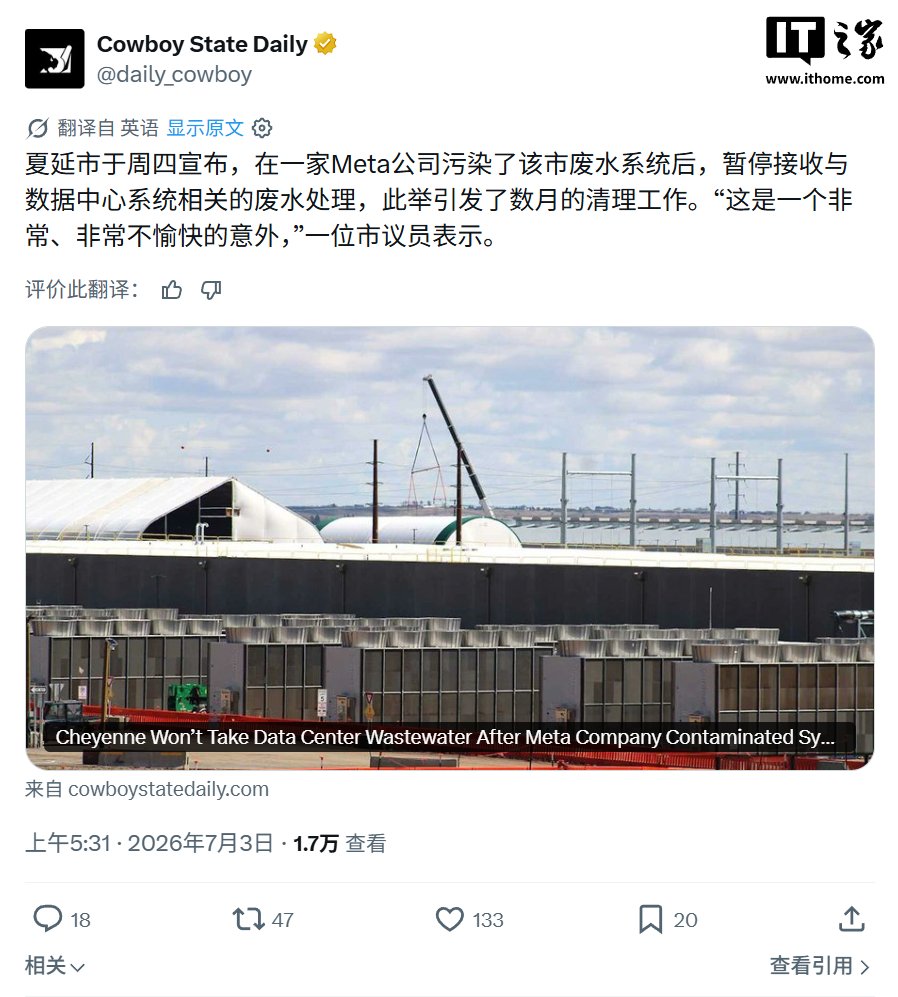
On July 2, Cheyenne’s Board of Public Utilities (BOPU) confirmed that Goat Systems LLC, a contractor working on Meta’s data center, was the source of industrial wastewater that had contaminated the city’s reclaimed water system. The discovery has prompted the city to suspend all wastewater intake from data center-related construction operations indefinitely.
The trouble began in February 2026, when routine fecal bacteria testing at one of the city’s water treatment facilities turned up something unusual. Lab staff detected signs of Cupriavidus gilardii, a metal-resistant bacterium so uncommon it isn’t covered by standard water quality monitoring protocols. The organism isn’t classified as a regulated contaminant under federal law, but its presence was enough to interfere with the biological processes at two of Cheyenne’s water reclamation facilities, forcing them offline for months.
BOPU traced the bacteria back to a “fill-and-flush” operation at the Meta construction site. During this phase of data center construction, workers pump water through the cooling system piping to clear out construction debris before the facility goes live. That water is then discharged into the municipal sewer system. In this case, it carried the rare bacterium with it.
The contamination forced the shutdown of both the Dry Creek and Crow Creek treatment plants, which handle Cheyenne’s reclaimed water. The city uses treated wastewater for irrigating parks, golf courses, and other public green spaces, so the stoppage had real consequences. By March 24, BOPU had revoked Goat Systems’ industrial wastewater discharge permit and expanded the suspension to cover all data center cooling-system wastewater, pending a review of how such discharges should be regulated.
Beyond the bacteria itself, BOPU raised concerns about the chemical makeup of closed-loop liquid cooling systems, which can contain ethylene glycol, propylene glycol, and other additives that municipal treatment plants aren’t designed to handle. The worry is that residual chemicals could create aerosolization risks during irrigation — essentially, contaminants getting airborne when sprayed onto fields.
Meta responded by pointing to its general contractor, Fortis, which stopped discharging to the municipal system immediately after BOPU flagged the issue. The wastewater was redirected to offsite treatment facilities, and an independent environmental lab was brought in to run its own tests. Meta said those independent tests did not find the same contaminant, and the company pledged to keep cooperating with local authorities.
By the end of June, both treatment plants were back to normal operating parameters and the reclaimed water system was running again. Cheyenne Mayor Patrick Collins said he was disappointed by the incident but credited BOPU with catching the problem and restoring the system.
The data center campus where this happened is one of the largest private investments in Cheyenne’s history — roughly $800 million, spread across hundreds of acres with about 800,000 square feet of building space. What happens next is still an open question. The city hasn’t said how it will regulate data center wastewater going forward, whether the suspension affects other projects in the pipeline, or if there are any long-term environmental or health risks to worry about. BOPU has not yet laid out its next steps.