DDR5 Memory Prices Hit Record Highs in Germany — Up 4.5x in a Year
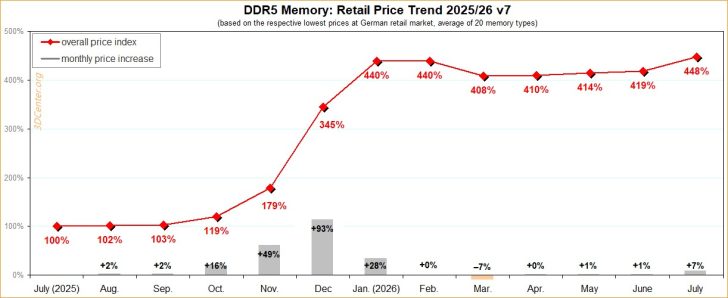
Building a PC has never been cheap, but right now it’s getting ridiculous. DDR5 memory prices in Germany have climbed to levels nobody saw coming — the price index hit 448% in July, according to data from 3D Center. That’s nearly 4.5 times what you’d have paid in July 2025.
The numbers are staggering even by recent standards. January and February of this year were bad — the index sat at 440%, which at the time felt like rock bottom. But July rewrote that record. In June the index was 419%, meaning prices jumped nearly 7% in a single month.
The data comes from multiple German retailers tracking various DDR5 configurations — 8GB, 16GB, 24GB, 32GB, and 48GB kits. It’s not a perfect global snapshot, but it’s a reliable indicator of where the market is headed.
The pain isn’t spread evenly. Two configurations got hit hardest: 2×16GB DDR5-6000 CL28 and 2×16GB DDR5-7200+ kits, which saw month-over-month price jumps of 16% to 17%. Most other kits climbed between 2% and 14%. Only two specs bucked the trend — 2×48GB DDR5-6400 and 2×24GB DDR5-7200 — which held relatively steady.
For anyone planning a new build or a memory upgrade, the timing couldn’t be worse. What started as a “memory crisis” affecting only select SKUs has now spread across nearly the entire DDR5 lineup. The upward trajectory shows no signs of reversing, and with each passing month, the cost of putting together a modern system inches higher.
The question is whether this is a temporary supply squeeze or a structural shift in memory pricing. Given that major manufacturers like Samsung, SK Hynix, and Micron have been prioritizing HBM production for AI accelerators over consumer DDR5, the latter seems increasingly likely.
DDR5 has been the standard for new PC builds since Intel’s 12th-gen and AMD’s Ryzen 7000 series, but at these prices, the value proposition starts to fray. A decent 32GB kit that cost around $80-100 a year ago can now fetch double that in some cases. For budget-conscious builders, the math is getting harder to justify.
For now, the advice is simple: if you don’t absolutely need DDR5 right now, wait. And if you do — brace your wallet.