First Rocky Exoplanet With an Atmosphere Confirmed in the Habitable Zone, Just 48 Light-Years Away
The habitable zone is one of those concepts astronomy fans throw around a lot. It’s the region around a star where temperatures are just right — not too hot, not too cold — for liquid water to exist on a planet’s surface. But here’s the thing: being in the habitable zone doesn’t mean a planet is actually habitable. It’s more like a starting point. You still need an atmosphere, the right radiation environment, and a dozen other things to line up.
That’s what makes the new discovery so significant. For the first time, researchers have confirmed an atmosphere on a rocky planet orbiting within the habitable zone of another star. The planet is LHS 1140 b, a super-Earth about 48 light-years away, and the findings were published in Science on July 16.
LHS 1140 b was first spotted back in 2017. It orbits a red dwarf star — much smaller, dimmer, and quieter than our Sun. Fewer flares, less violent activity. That relative calm matters when you’re looking for signs of an atmosphere; a more active star would strip it away.
The planet itself is a substantial piece of rock. It has about 5.6 times the mass of Earth and a radius 70 percent larger. Not exactly Earth’s twin, but close enough in composition and temperature to draw comparisons.
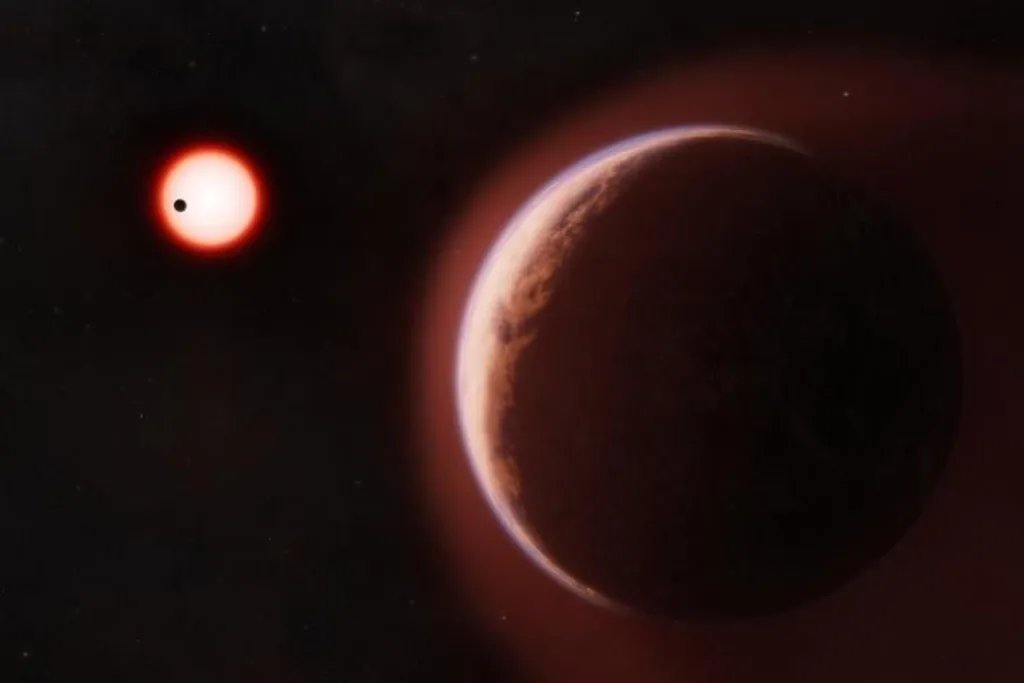
“This is the first time humanity has observationally confirmed the presence of an atmosphere on a rocky planet in the habitable zone beyond the solar system,” said Dr. Collin Cherubim from Harvard University, a co-author of the study.
The research team detected helium escaping from the planet’s upper atmosphere — a signature that gives away the presence of an atmospheric envelope. Interestingly, the same team checked LHS 1140 c, another rocky planet in the same system, and found no atmosphere at all. That detail matters: it suggests atmospheric retention depends on more than just a planet’s position in the habitable zone. Size, magnetic field, stellar activity — they all play a role.
Forty-eight light-years is still a very long way. But in cosmic terms, that’s practically next door. And this planet, with its confirmed atmosphere sitting in the habitable zone, is now the best candidate we have for studying what a potentially life-supporting world actually looks like beyond our own solar system. The Science paper is titled “Helium escaping from the atmosphere of a nearby rocky exoplanet orbiting in a habitable zone.”