China's first L4 autonomous truck is already hauling real packages — 43 tons at a time
On July 3, JD Logistics sent a heavy-duty truck from its sorting center in southeastern Beijing down Daxing Airport Expressway and the Southern Sixth Ring Road to a distribution hub 31 kilometers away. Nothing unusual — except the truck was driving itself the whole way, and it was carrying a full 43 tons of packages.
The run marks the first L4 autonomous heavy truck demo in China’s express delivery industry, a collaboration between JD Logistics, Sinotruk, and autonomous driving startup Inceptio Technology. The trial takes place inside Beijing’s High-Level Autonomous Driving Demonstration Zone, a designated area where companies can test self-driving vehicles on public roads.
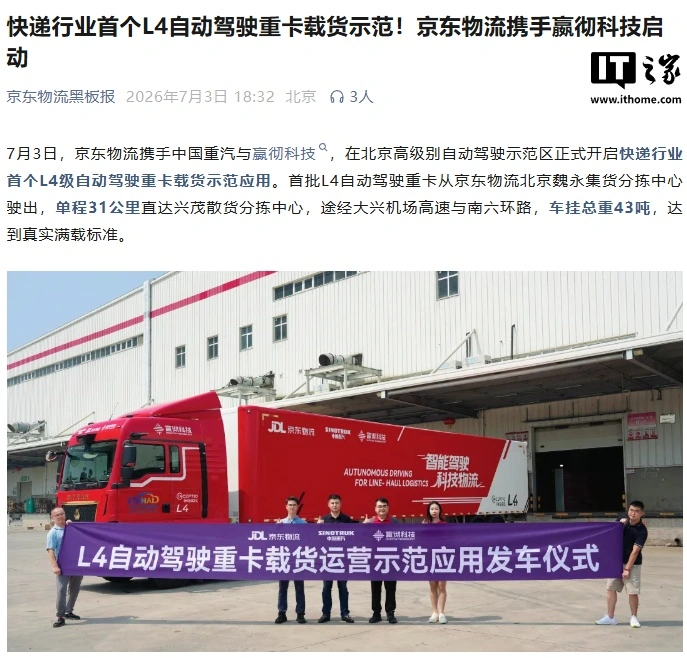
The trucks are equipped with Inceptio’s L4 system, a full-stack autonomous driving platform that fuses LiDAR, millimeter-wave radar, and multi-camera vision. It handles highway mainline driving, ramp merging, and exiting — the kinds of scenarios that make or break a commercial autonomous trucking operation. The safety architecture runs on three layers: on-board decision-making, cloud-based real-time monitoring, and remote emergency intervention. A safety driver still sits in the cab.
This isn’t JD’s first rodeo in automation. The company’s sixth-generation “Lone Wolf” delivery robots operate in cities across China. It has self-developed light-duty autonomous vans in the pipeline. Its “Flying Wolf” drones now cover over 100 domestic routes. Last year, JD Logistics announced a five-year procurement plan for 3 million robots, 100,000 unmanned vehicles, and 10,000 drones — numbers that sound ridiculous until you consider the scale of China’s parcel volume.
With the L4 heavy truck online, JD has filled what it calls the last gap in its end-to-end automation chain — moving from last-mile delivery robots and mid-mile vans all the way to long-haul highway transport. For a company shipping billions of packages a year, even a small percentage shift to autonomous trucks translates to massive cost savings.