China's Domestic FPGA: Unisoc's Titan-3 Uses FinFET, Targets Data Centers
There’s a quiet war happening inside the chips that power cloud data centers, telecom networks, and defense systems — and China just moved a piece into place. Unisoc, a subsidiary of the New Unisplendour Group, announced the Titan-3 series at the 2026 Munich Shanghai Electronics Show: the country’s first domestically developed billion-gate high-end FPGA.
FPGAs — field-programmable gate arrays — are flexible logic chips that can be reconfigured after manufacturing. That makes them essential for telecom base stations, video processing, aerospace systems, and any application where hardware needs to adapt without a full redesign. Until now, the billion-gate tier of the FPGA market has been dominated by a small number of Western suppliers.
The Titan-3 series is built on a FinFET process and includes multiple core models — the PG3T1300 and PG3T1500. Unisoc says the chips pack on-chip large-capacity HRM+DRM architecture, high-speed DDR4 memory interfaces, multi-rate EMAC hard cores, hard PCIe Gen4 IP cores, and high-speed SerDes interfaces. In plain English: they’re designed to handle the kind of throughput that modern data centers, network security appliances, and AI workloads demand.
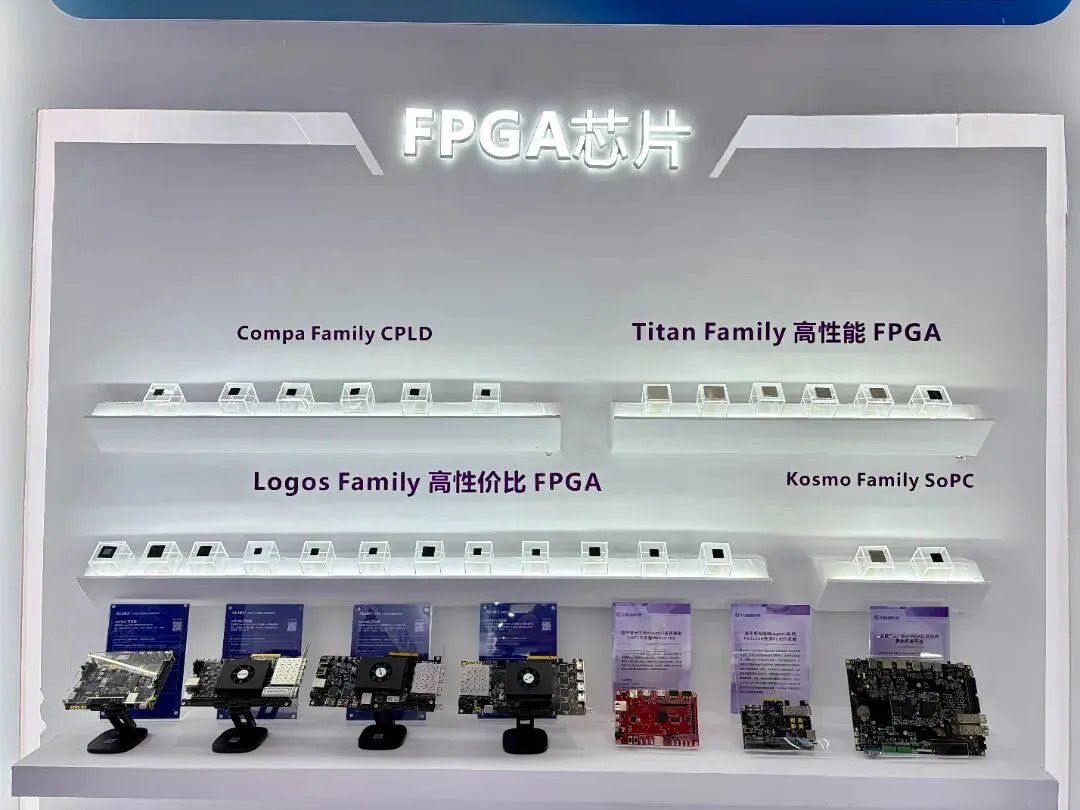
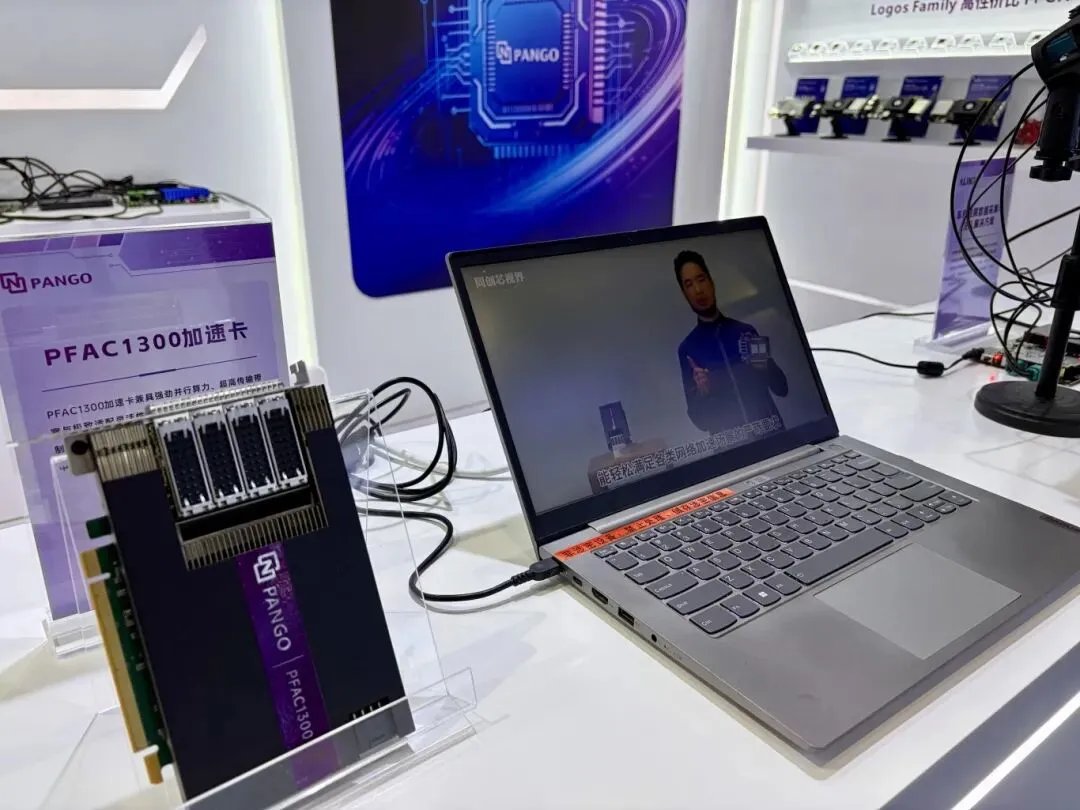
Alongside the Titan-3 FPGA, Unisoc also showed the PG3T1300 accelerator card — the first domestically developed accelerator card built on a homegrown high-end FPGA. The card uses a single-slot, full-height, half-length standard form factor. It carries four 25G optical ports, configurable up to 100G of aggregate bandwidth, and connects over PCIe 4.0 x8. Under low power loads the slot itself provides enough juice; for high-performance mode, the card can pull supplementary power as well.
The accelerator card’s use cases are telling. Unisoc is positioning it for cloud computing virtualization acceleration, image and video transcoding, high-frequency financial trading, storage acceleration, data acquisition and processing, and large model inference — the same workloads that have driven demand for programmable logic in Western hyperscale data centers. That’s not an accident. With export controls tightening on advanced semiconductors, having a domestic alternative at this performance level matters for Chinese infrastructure operators.
The Titan-3 family fills a specific gap: high-bandwidth, high-reliability programmable logic chips that don’t depend on foreign supply chains. Whether it competes on performance-per-watt against equivalent Xilinx or Altera parts remains to be seen — Unisoc hasn’t published benchmark numbers yet. But the fact that a billion-gate FinFET FPGA exists as a Chinese domestic product at all changes the calculus for anyone building out network or data center infrastructure in that market.