LONGi just pushed solar cell efficiency to 35.5% — and it's closing in on production
Solar energy has a math problem. The best commercial silicon panels top out around 22-24% efficiency, and single-junction cells have a theoretical ceiling of 33.7%. To go higher, you need a different approach — stacking two materials that each capture a different slice of the solar spectrum. LONGi Green Energy, the world’s largest solar manufacturer, just showed how far that approach can go.
On July 14, at the company’s Photovoltaic & Storage Innovation Technology Conference in China, LONGi announced that its crystalline silicon-perovskite tandem solar cell reached 35.5% conversion efficiency, certified by the European Solar Test Installation (ESTI). That’s a new world record for the technology class.
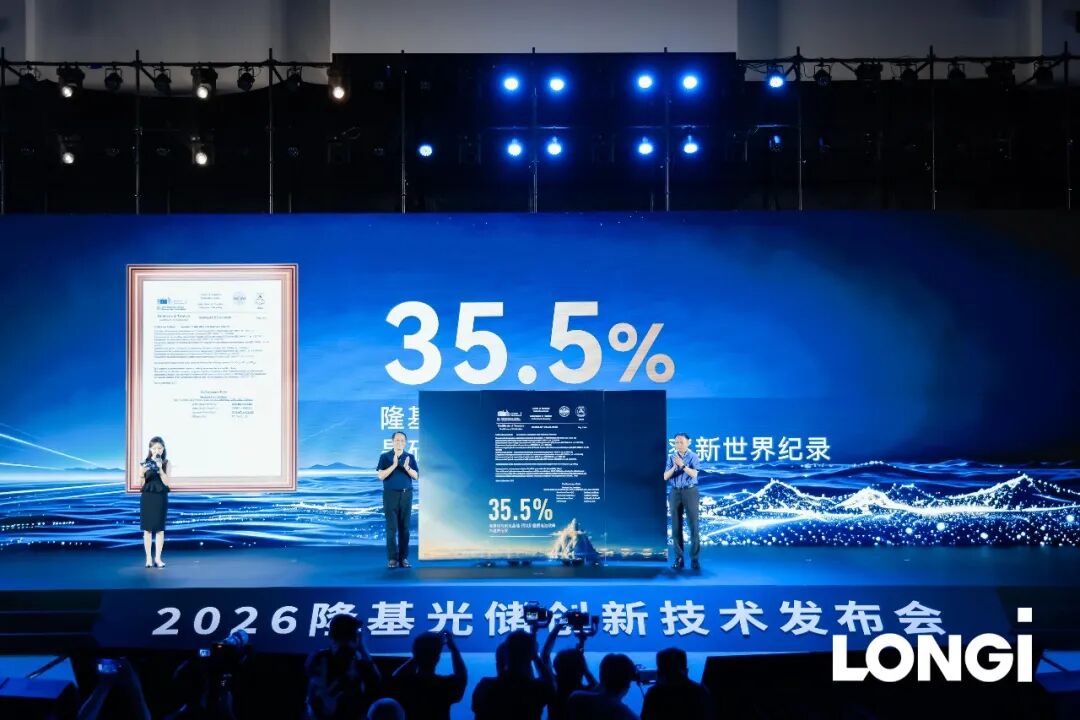
The theoretical ceiling for this tandem architecture is around 43% — well beyond what any single-junction design can achieve. LONGi’s team has been climbing that ladder methodically: 33.9% in November 2023, 34.6% in June 2024, then 34.85%, 35.2%, and now 35.5%. Five verified improvements in less than three years.
What makes this more than a lab number is the pace and the scale. In May, the 35.2% result was included in Version 68 of the Solar Cell Efficiency Tables published by Professor Martin Green’s team at the University of New South Wales — the industry’s standard reference for validated records. More importantly, LONGi also demonstrated 34.3% efficiency on a 261 cm² device and 32.2% on a 274 cm² device, both much closer to production-relevant sizes than the tiny cells used in most record announcements. Tandem modules — the actual product you’d install — reached 31.4% and 29.4%, figures that have also been independently certified and published in the efficiency tables.
The gap between a lab champion cell and a manufacturable product is usually measured in years, not months. LONGi’s results on near-industrial areas suggest the gap is narrowing faster than most analysts expected. For an industry where every percentage point of efficiency translates into lower balance-of-system costs — fewer panels, less land, less mounting hardware for the same power output — the trajectory matters as much as the current record.
Perovskite-silicon tandem cells have been called the next frontier in photovoltaics for years. LONGi is making it look like less of a frontier and more of a destination with a timeline.