Moonshot AI pauses new Kimi subscriptions after K3 demand overwhelms capacity
Moonshot AI has paused new consumer subscriptions to Kimi, its AI assistant — not because of low demand, but because too many people signed up.
The company announced Saturday that traffic from the newly released K3 model has pushed its computing clusters to their limits. Existing subscribers will continue to receive full service without disruption.
“Since the release of Kimi K3, we have received far more support than expected — but also faced an unforeseen computing challenge,” the Kimi team said in a public statement. “In the past 48 hours, user requests have significantly exceeded our projections and are approaching the carrying capacity of our existing clusters.”
K3 launched on July 16 as Moonshot AI’s most capable model yet, with 2.8 trillion parameters and a 1 million token context window. It is designed for long-session coding, spatial reasoning, and end-to-end knowledge work — some of the most compute-intensive tasks in the industry.
Zhang Yutong, president of Moonshot AI, said on social media Friday that the company plans to open-source K3’s weights soon. That commitment may have accelerated adoption among developers, who rushed to benchmark the model after launch.
The financial impact was immediate. On July 17, the day after K3’s release, Moonshot AI’s annualized recurring revenue posted its largest single-day increase in company history, spiking sharply from a previously flat trajectory.
K3 pricing follows a token-based model: 2 yuan ($0.28) per million input tokens with cache hits, 20 yuan ($2.75) per million without, and 100 yuan ($13.80) per million output tokens.
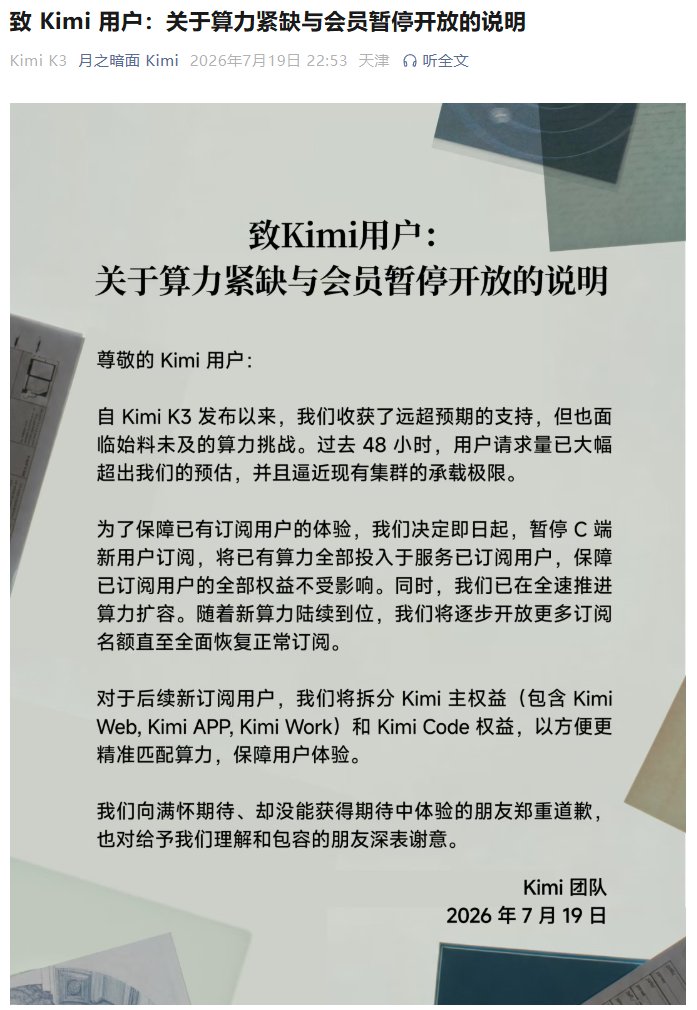
Moonshot AI plans to split Kimi’s core features — web, app, and Kimi Work — from Kimi Code, the developer platform, once subscriptions reopen. The separation is meant to allocate compute resources more efficiently and prevent the same bottleneck from recurring.
The company is racing to add new compute capacity and says it will resume normal subscriptions gradually. No timeline has been set.
The episode is a rare public glimpse of the infrastructure strain behind China’s AI boom. When a well-funded lab with thousands of GPUs still has to turn away users, it says something about how fast demand is growing — and how far supply still has to catch up.