Moonshot AI to Musk: 'Welcome to the 2 Trillion+ Club'
The public back-and-forth between AI labs has become a sport in itself, and the latest round involves Moonshot AI and Elon Musk trading barbs about model size.
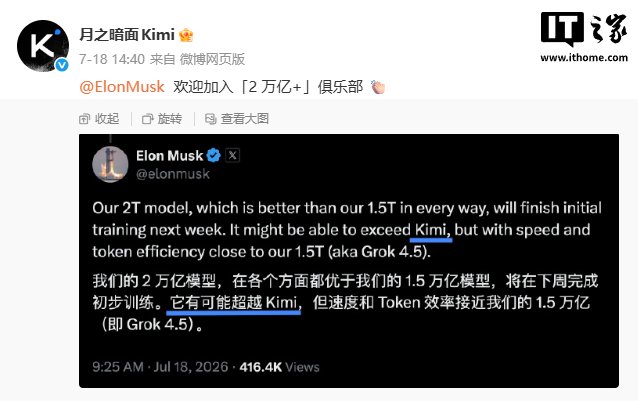
Moonshot AI’s open-source Kimi K3 model recently topped global benchmark rankings, drawing attention from the broader AI community — including Elon Musk. On July 18, Musk posted on his social platform claiming that his company’s 2 trillion parameter model outperforms the current 1.5 trillion parameter version across every metric. He said it would complete preliminary training next week and could surpass Kimi, while maintaining inference speed and token efficiency close to the existing 1.5T model — Grok 4.5.
Moonshot AI responded publicly on Weibo, tagging Musk directly. “Welcome to the 2 trillion+ club.” The reply is short and pointed, and for anyone watching the AI arms race it reads as a clear signal that the Chinese lab sees itself setting the pace.
The subtext here matters. Moonshot’s Kimi K3, released as an open-source model, has been climbing global leaderboards. It’s not just hype — independent benchmarks show the model competing with frontier systems like OpenAI’s GPT and Anthropic’s Claude. By publicly acknowledging Musk’s claim while pivoting it into membership in a club Moonshot already belongs to, the company is asserting its position in the hierarchy.
What’s less clear is exactly what Musk is building. xAI (now operating under the SpaceXAI banner after merging with SpaceX) has not revealed a formal release date for Grok 4.6, nor its training details or complete technical specifications. The company released Grok 4.5 on July 9, its first model specifically trained for coding and agent tasks. SpaceXAI developed it jointly with Cursor, the AI-assisted coding platform, and Musk described it as an “Opus-level model” — a direct reference to Anthropic’s Claude Opus tier.
The parameter count jump from 1.5 trillion to 2 trillion is significant but not surprising. Every major lab is scaling up. What matters more is whether the larger model actually delivers on efficiency — Musk claims token efficiency close to the 1.5T version, which would be an achievement given that larger models typically require more compute per token.
For now, Moonshot has the rankings and the public retort. Whether the next week’s training run gives Musk bragging rights of his own is the open question.