Musk confirms 2-trillion-parameter Grok 4.6, says training wraps next week
Elon Musk says xAI’s next large language model will run on 2 trillion parameters — and it’s closer to shipping than most people realize.
In a reply on X Saturday, Musk revealed that Grok 4.6 is in its final training phase, with initial training expected to complete next week. He said the 2-trillion-parameter model outperforms the current 1.5-trillion-parameter version in every dimension, while maintaining roughly the same inference speed and token efficiency as Grok 4.5. He floated the possibility that it could surpass Moonshot AI’s Kimi 3, though he didn’t provide benchmarks.
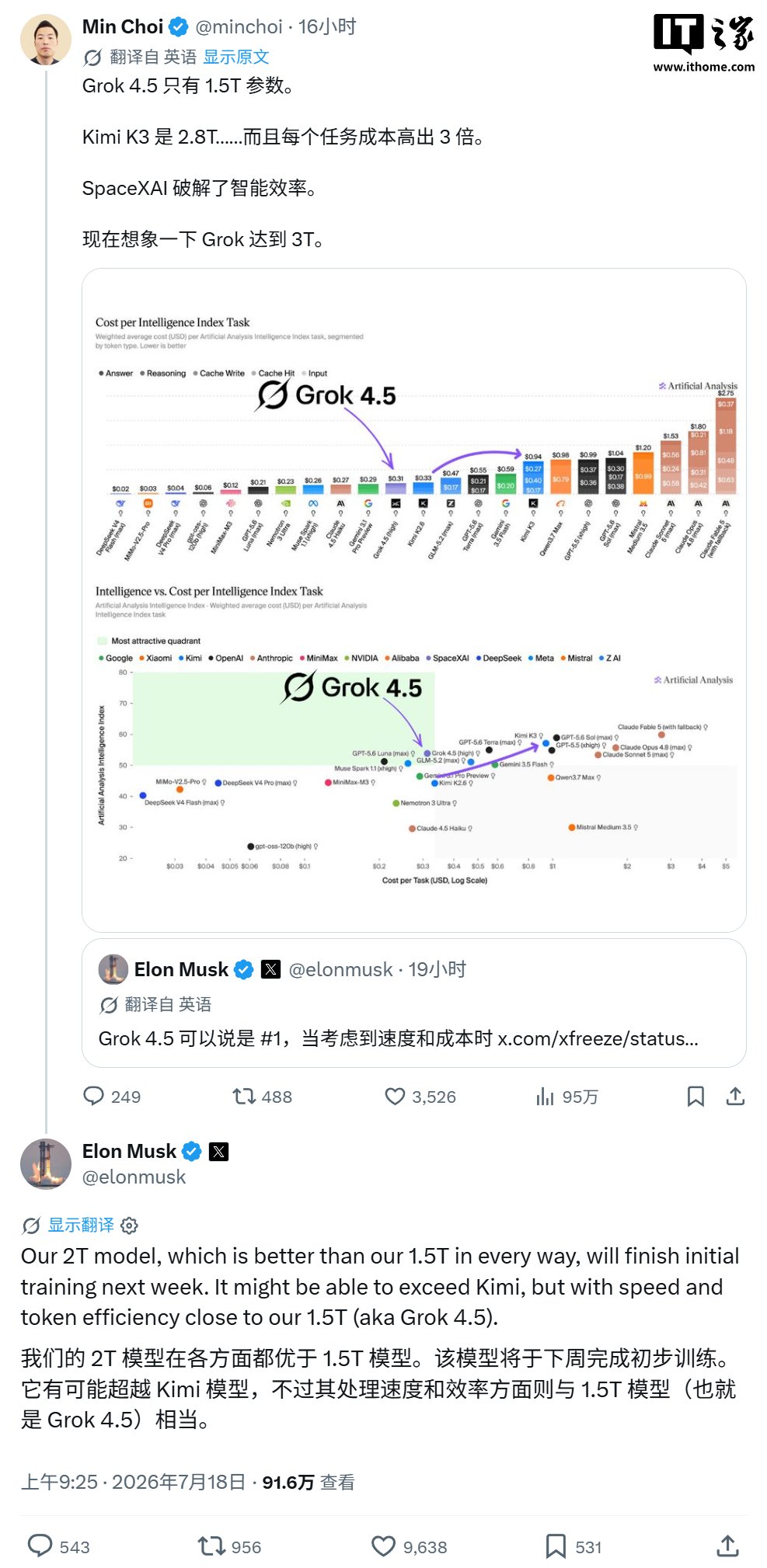
The timing lines up with what xAI has been signaling all year. Back in May, Musk said Grok’s V9-Medium base model — a 1.5-trillion-parameter architecture that underpins Grok 4.5 — had finished training and was moving through fine-tuning and reinforcement learning stages. A jump from 1.5T to 2T parameters in a single generation would be significant, though parameter count alone doesn’t tell the full story.
Model quality depends on training data, architecture, compute budget, and post-training optimization as much as raw size. Musk’s claim that Grok 4.6 can match the inference speed of a smaller model while running more parameters suggests xAI has made architectural improvements alongside the scale-up. That would explain why training ran long enough for him to share interim progress publicly.
xAI has been aggressive about compute infrastructure. Grok 4 was trained on Colossus, the company’s in-house AI cluster that reportedly runs around 200,000 GPUs. That scale of hardware is what makes a 2-trillion-parameter training run feasible in months rather than years.
The company hasn’t announced a formal release date for Grok 4.6, and Musk’s timeline — “next week for initial training” — leaves room for the weeks or months of fine-tuning and safety testing that typically follow. But the update signals that xAI is positioning itself in the upper tier of the generative AI arms race, alongside OpenAI, Google, and Anthropic, all of whom are pushing their own next-generation models.