Pan Jianwei becomes first Chinese scientist to win UNESCO Mendeleev Prize for quantum breakthroughs
There’s a quiet kind of revolution happening in quantum physics, and one of its architects just picked up a major global prize.
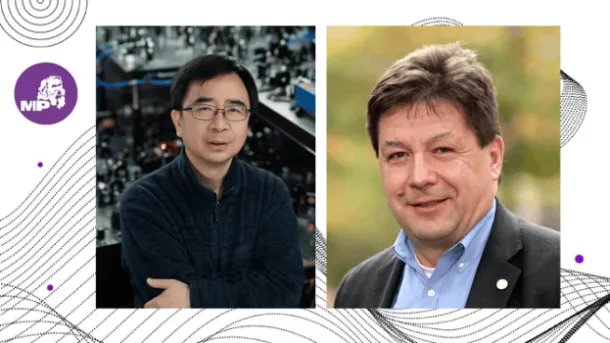
Pan Jianwei — a Chinese Academy of Sciences academician and professor at the University of Science and Technology of China — has become the first Chinese scholar to receive the UNESCO-Russia Mendeleev International Basic Science Award. The ceremony took place Wednesday at UNESCO headquarters in Paris. Pan shared this year’s honor with Sergei Sheiko, a chemistry professor at the University of North Carolina at Chapel Hill recognized for his contributions to polymer physics and materials science.
UNESCO’s citation described Pan as a “world leader in quantum optics, quantum communication, and quantum computing,” specifically calling out his pioneering work in large-scale secure quantum communication and scalable quantum computing.
What does that actually mean in practice? Pan’s team built the “Micius” quantum science satellite — named after the ancient Chinese philosopher — which demonstrated quantum key distribution and quantum teleportation across thousands of kilometers. The satellite has achieved quantum teleportation over 1,200 kilometers and enabled satellite-to-ground quantum key distribution across 12,900 kilometers using a micro-nano satellite. These aren’t theoretical projections: Micius has been in orbit doing real work since 2016.
On the computing side, Pan’s team has been iterating the “Jiuzhang” series of photonic quantum computers at a pace that’s hard to keep up with. The original machine manipulated 76 photons. The latest version — Jiuzhang 4 — handles over 3,000 photons. At Gaussian boson sampling, a task that’s essentially impossible for classical machines, Jiuzhang 4 is about 10^54 times faster than the fastest conventional supercomputer. That is not a typo.
UNESCO described these achievements as moving global quantum networks “from theory to reality,” laying the groundwork for secure, efficient quantum information infrastructure.
Just days before the Mendeleev award, on July 11, Pan and his colleague Lu Chaoyang also received the 2026 IEEE Photonics Society Quantum Electronics Award for “pioneering work in single-photon sources and optical quantum computing.”
The Mendeleev Prize was established by UNESCO in 2019, proposed and funded by the Russian government, to mark 150 years since Dmitri Mendeleev created the periodic table. It’s awarded annually to two scientists working in chemistry, physics, mathematics, or biology. Each winner receives US$250,000, a gold medal, and a certificate.
UNESCO Director-General Khaled El-Enany spoke at the ceremony, calling basic science “the foundation of all knowledge” and emphasizing its role in fostering collaboration across disciplines and borders. China’s permanent representative to UNESCO, Yang Xinyu, also attended.
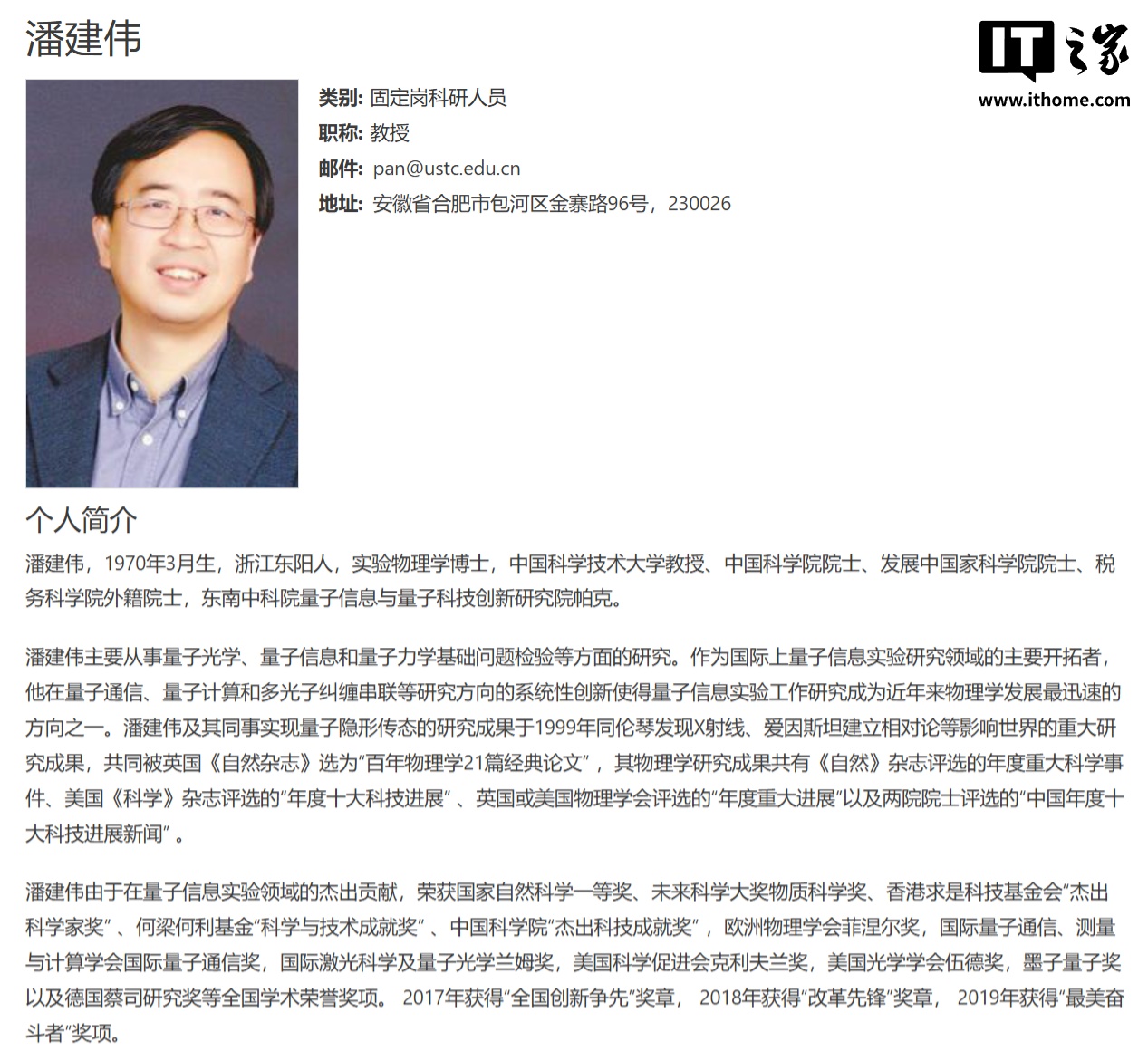
In his acceptance speech, Pan credited the broader research team and China’s long-term investment in science and technology. He committed to continuing open collaboration with the global scientific community to push quantum information technology forward.